Hawkins-Menu: A·
B·
C·
D·
E·
F·
G·
H·
I·
J·
K·
L·
M·
N·
O·
P·
Q·
R·
S·
T·
U·
V·
W·
Z
Wiki-Menu: 1·
2·
A·
B·
C·
D·
E·
F·
G·
H·
I·
K·
L·
M·
N·
O·
P·
Q·
R·
S·
T·
U·
V·
W·
Y·
Z
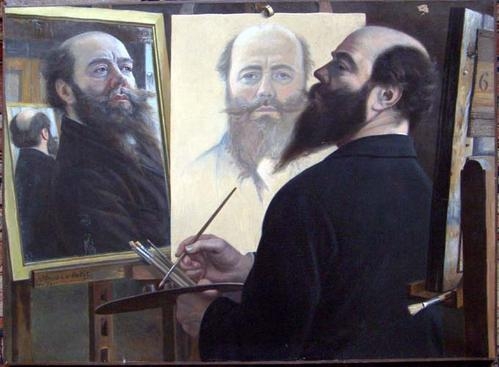
Beobachten – Beobachter
Sich von der Identifikation mit Inhalten lösen – Bewusstsein erlauben
Der Betrachter eines Gemäldes an der Wand nimmt nicht für sich in Anspruch, das Gemälde zu sein oder es geschaffen
zu haben. Diese Metapher lässt sich auf die Inhalte des Bewusstseins übertragen.
Sich mit Inhalten zu identifizieren, heißt auszuschließen, dass man als Mensch Bewusstsein [Kontext] ist.
Die Einsicht, dass man Bewusstsein, nicht Inhalt des Bewusstseins, ist, ist die Gelegenheit für das Auftreten des inneren Beobachters.
↑
Stufen des fortschreitenden Erkennens
| Form-Gebundenheit | Nichtlineare Feld-Orientierung |
Ein linearer (formgebundener) Gedanke wird
→ Registriert (wahrgenommen)
→ Erkannt
→ Betrachtet
→ Erlebt
→ Gewahrt | Im nichtlinearen virtuellen Feld
→ wird (durch den Beobachter) beobachtet,
Laut Heisenbergs Unschärferelation beeinflusst der Beobachter das Feldgeschehen.
→ wird (durch den Zeugen) bezeugt,
→ ist das Licht des Bewusstseins gegenwärtig,
→ ist das Manifeste als All-Sein (SELBST) gegenwärtig,
→ ist das Unmanifeste (Gottheit) gegenwärtig. |
|
↑
Zeugenschaft – Von der konkreten Form zum abstrakten Kontext
Die von Aspiranten angestrebte Realität ist VOR dem Denken, nicht zwischen den Gedanken präsent.
Vor dem Auftauchen des Gedankens ist Stille, ist das Nichtdingliche, das unendliche unbewegliche Feld, das dem Egomind, das von Detail zu Detail hüpfen muss, unzugänglich ist.
Was du bist, ist VOR dem Gedanken anwesend.
Gedanken sind Formen. Wer Form mit Form einfangen möchte, ist unzureichend ausgerüstet.
Aus der Perspektive des Zeugen-Beobachters, der innerhalb des Feldes (Kontext) ist, sieht man einen Gedanken aus der Stille aufsteigen.
It is the nature of awareness being itself to know what is going on in consciosness.
It is the nature of consciousness to know what is going on in mind.
It is the nature of mind to know what is going on with sensations,
and it is the nature of sensations to know what is going on with the body.
It is important to know that all ordinary experience is going on in consciousness alone.
It is important to know that consciousness has no particular space, no physical area, and no limitation.
David Hawkins, Healing and Recovery, chapter 10 "Pain and Suffering", S. 302, 2009 |
|
↑
Zitate zum Thema Beobachten und Bezeugen / Observing and witnessing
Zitate von D. Hawkins
- Weise (z.B. bei Natur-Katastrophen) niemandem Schuld zu. Beobachte einfach, wie sich die Evolution entfaltet.
Quelle unbekannt
- Entwachse sowohl dem Widerstand (Yin – Tamas – Lethargie) als auch dem Bemühen/Energieaufwand (Yang – Rajas – Aktivität) und verweile als Beobachter in Frieden (Frieden – Sattva – das Tor des Göttlichen, das mit Liebe beginnt). Quelle unbekannt
- Durch innere Beobachtung kann man unterscheiden, dass die Persönlichkeit ein System von angelernten Antworten darstellt und die Persona nicht das wirkliche "ICH" ist. Das wirkliche "ICH" liegt dahinter und geht darüber hinaus. Man ist Zeuge dieser Persönlichkeit, und es gibt überhaupt keinen Grund, warum man sich mit ihr identifizieren sollte. So-
bald das wirkliche SELBST als das wahre "ICH" auftaucht, geht die Persönlichkeit nach einer gewissen Anpassungs-
zeit sofort in die Interaktion mit der Welt, welche keinen Unterschied zu bemerken scheint. Die Persönlichkeit ist wei-
terhin eine Art Unterhaltung und oft komisch und wird, wie auch der Körper, irgendwie etwas Neues. Statt "Ich" sein
zu wollen, wird die Persona zu einem "Es", das sozusagen von seinem eigenen Generator betrieben wird. Dieses Es
hat seine Angewohnheiten, seinen Lebensstil, seine Vorlieben und Abneigungen, aber diese haben nicht länger ir-
gendeine reale Bedeutung oder Wichtigkeit, und sie haben insbesondere keine Folgen in Bezug auf Glücklich- oder
Unglücklich-Sein. Gleichermaßen bleibt ein Anflug von gewöhnlichen menschlichen Emotionen, die kommen und gehen, aber keinerlei Kraft oder Einfluss mehr haben, da sie nicht länger als "meine" der Identifikation oder Besit-
zeranspruch unterliegen. FU Das All-sehende Auge, S. 144, 2005
- Die Erkenntnis, dass Geist/Gemüt nicht dasselbe ist wie "Ich", zerbricht die Identifikation des Selbstes mit dem Geist.
Diese Erkenntnis dehnt sich auch auf den Körper aus, sobald man erkennt, dass man nur Zeuge, Erfahrender und Beobachter von Empfindungen ist. Man erfährt dabei nicht wirklich den Körper, sondern lediglich die Sinne.
Das All-sehende Auge, S. 157, 2005
- Der spirituelle Schüler muss vor allem begreifen, dass das jeweilige innere Wesen dessen, was wir "Realität"
nennen, in tiefgreifender Weise durch den bloßen Akt menschlicher Beobachtung beeinflusst und verändert wird.
Abgesehen von der Mathematik kann ein Studierender der Quantentheorie schlussfolgern, dass das, was man entdeckt, ein Ergebnis der eigenen Intention ist, insofern dass das, was man findet, davon abhängt, wonach
man sucht. FU Licht des Alls. Die Wirklichkeit des Göttlichen, "Anhang D", S. 564, 2006
Korrigierender Hinweis: Der Veranstaltungsort der Solvaykonferenz von 1927 war nicht wie unten angegeben in
Kopenhagen (DK), sondern in Leiden (NL).
- Die Entdeckungen der Quantenmechanik machten ein Umdenken beim erkenntnistheoretischen und philosophi-
schen Verständnis erforderlich, um die Einwirkung der menschlichen Beobachtung und Beteiligung an wissen-
schaftlich geprüften Ereignissen zu erklären. 1927 [Anm. Korrektur: 1967] befasste sich die Solvaykonferenz in
Kopenhagen mit dem Problem und im Anschluss daran gab es unterschiedliche Interpretationen von Bohr, Ein-
stein, Dirac, von Neumann, Wigner und anderen bei der Lösung des Problems, dass die berühmten Schrödinger
Gleichungen unzulänglich waren, indem sie die Einwirkung des Betrachters nicht berücksichtigten. Das wurde
später das "Heisenbergsche Auswahlprinzip" genannt.
OU Licht des Alls. Die Wirklichkeit des Göttlichen, "Anhang D", S. 565, 2006
- Du bist sowohl der Zeuge, der Beobachtende als auch der Erlebende.
Audioserie The Discovery (engl.) CD 5 Advanced Practices for the Committed Mystic, 'The nine central elements of seriously committed inner spiritual work' von 6, Nightingale-Conant, United Kingdom, Mai 2007
- Du nimmst an, dass ein persönliches "Ich" der Initiator, der Entscheider und der Agierende ist. Um dieser Täuschung zuvorzukommen, musst du in weniger als einer 10,000stel Sekunde gewahren. Die Schnittkante des Egos, des persönlichen "Ichs", benötigt eine 10,000stel Sekunde, um sich einzuklinken und für sich in Anspruch zu nehmen, der Initiator und der Erlebende zu sein. Mithilfe von spirituellen Vorgehensweisen […] ist es möglich,
das zu überschreiten. Und der Verstand wird still.
[…]. Es gibt kein persönliches "Ich", das beschließt, was man sagt. Alles geschieht unwillkürlich, auch die Einbildung eines persönlichen Ichs und der Aufstieg in den Beobachtungszustand, wobei man aufhört, sich als persönliches "Ich" zu identifizieren und in den Zeugen-Beobachter übergeht. Der Zeuge-Beobachter bemerkt, dass sich, sobald eine Entscheidung gefällt wurde oder etwas geschieht, eine "Ich"-Persönlichkeit einschaltet und sich als Urheber ausgibt. Dem Verstandeswesen fällt es am schwersten, den Anspruch der Urheberschaft eines persönlichen "Ichs" aufzugeben. Sedona Seminar Experiential Reality: The Mystic, 3 DVD-Set, 8. Dezember 2007
↑
Quotes by D. Hawkins
- [Paraphrased] I am a "what-ness" that is noticing or witnessing or observing the story [of one's life unfolding].
Source unknown
Check for the triple Gunas.
- Transcend resistance (Yin – Tamas – lethargy) and energies/efforts (Yang – Rajas – activity) and rest observing in peace (Peace – Sattva – gateway to the divine beginning with love). Source unknown
- The realization that everything is knowable about anything or anyone, anywhere, at any point in time, creates
at first a paradigm shock. This reaction arises, generally, from realization of the non-locality, impersonality and universality of consciousness itself; and, specifically, from the realization of the observability of one's own thoughts and motivations, their transparency across time. That one's every thought and action leave an indelible trace forever
in the universe can be an unsettling thought.
Power vs. Force. The Hidden Determinants of Human Behavior, "Preface", S. 10, Veritas Publishing, 1st edition 1995
- One's own consciousness as Self is the only Eye by which anything can be experienced or known. The inner sense
of reality is bestowed by the Self on the 'outer' surroundings, which is what makes them seem real. The sense of realness is therefore a projection of consciousness by the self, originating from the Self. One is therefore not the witness of a 'real' world; one is actually the source of its seeming reality.
The Eye of the I From Which Nothing is Hidden, chapter 4 "The Basics", S. 48-49, Veritas Publishing, revised edition 2002
- Is experiencing done by a 'who' or by a 'what'?
One will, by observation, discover that 'something' rather than 'someone' is functioning as the impersonal experiencer and observer, which is unchanged and unaffected by the content of that which is being experienced, observed, or witnessed. The Eye of the I From Which Nothing is Hidden, S. 101, 2001
- The objectives of the ego/mind can never be achieved. Its efforts are noisy and upsetting. In actuality, one is much better off without it. Once one observes that it is hopeless, one can begin to abandon it by withdrawing interest from it. Once one can begin to disown its hypnotic fascination and step back progressively from watcher to observer, to consciousness itself and finally to the awareness that illuminates consciousness and enables awareness to be aware.
The Eye of the I, chapter 8, S. 170, 2001
- Like the notes of music which fade away as soon as they are sounded, the experiences of life are fleeting and ephemeral. Each moment is already in the process of ceasing at the very instant it arises. The focus of awareness is like a moving flashlight in the night which briefly illuminates each object and then quickly moves on. They appear and disappear. To the observer, life is therefore merely a procession of appearances and disappearances. There-
fore, nothing can be said to be happening because of this constant sequencing of attention. Focus is therefore an arbitrary positionality and accounts for the so-called Dance of Shiva.
Eye of the I From Which Nothing is Hidden, S. 287, 2001
Participant or subject vs. audience
- [F]rom the impersonal viewpoint of the witness/observer, we watch how it [the ego] operates. The realization eventually occurs that the ‘I’ is not the content or the data but an impersonal field several steps removed from the content of the programs. One then realizes that one is the audience rather than the participant or subject. Many spiritual practices and techniques have evolved over the centuries to facili-
tate this disidentification with the ego and its world of limited perceptual dualities of content. This is also assisted by spiritual knowledge of the nature of consciousness. One piece of correct information has within it the power to cancel out vast amounts of erroneous concepts and positionalities. The spiritual information is accompanied
by a high-frequency carrier wave of great power that originates from the Self of the sage, teacher, or avatar and is therefore far more powerful than the weak energy field of the ego.
I, Reality and Subjectivity, heading "Progressive Fields of Realization", S. 119-120, 2003
- As observation moves through the levels, the sense of 'I' and self-definition move with it. The easiest transition is
the realization that one is not the focus or content of the mind but the unchanging experiencer/witness/observer.
Although the story of life changes, there is always an aspect of consciousness continuously watching,
and on a slightly different level, experiencing. The sense of 'I' moves progressively from content to
context. I, Reality and Subjectivity, heading "Progressive Fields of Realization", S. 292, 2003
Level 600 – Enlightenment
- Question: How can one simultaneously participate and yet not get attached or involved? Does that not lead to avoidance?
Answer: It is the motive that determines the effects of participation. Activities are merely what one 'does', but not
what one 'is'. All seeming events present learning opportunities. One can participate and at the same time experi-
ence phenomena from the level of the witness/observer and watch what arises from the psyche. It is important to
differentiate detachment from nonattachment. Detachment can result in avoidance or withdrawal, whereas non-
attachment allows for participation without taking a stake in the outcome.
Discovery of the Presence of God. Devotional Nonduality, chapter 5 "Clarifications", S. 102-103, 2007
- Awareness/consciousness is located just beneath or prior to the function of the watcher/observer. It is silent and unmoving, like the sky or space itself. By relinquishing anticipation, clinging, seeking pleasure, or avoiding un-
pleasantness, the focus remains poised on the razor's edge of the crest of the fleeting moment. By this poised
position, mentation and imaging gradually recede and reveal that the underlying field is activated by the desire
and intention of thinkingness itself.
Discovery of the Presence of God. Devotional Nonduality, chapter 7 "The Razors Edge", S. 123, 2007
- As focus and interest move from content to the observer/witness, it will be found that the observer/witness is an emanation of consciousness as awareness and a nonlinear, impersonal quality that is primary, innate, and autonomous.
Although this meditation/contemplation may seem unfamiliar or awkward at first, because it is in accord with
the will and Divine energy, it eventually becomes self-positioning without resistance.
Discovery of the Presence of God. Devotional Nonduality, chapter 7 "The Razors Edge", S. 123, 2007
- If the witnessed data are neither desired, resisted, nor given value as "mine" they begin to subside and eventually fall away. In turn, each is surrendered to God as it arises, and the silent source that is desirous of
thinking or experiencing is revealed. To de-energize it, it Is only necessary to surrender the desire to God.
Discovery of the Presence of God. Devotional Nonduality, chapter 7 "The Razors Edge", S. 123-124, 2007
- With incorporation into daily life, a spiritual practice can take the form of the continuous surrendering of
volition, which then emerges into autonomous witnessing and effortless observation. These capacities
will then be discovered to be qualities of consciousness, and not personal.
Concentrated spiritual focus is like a 'mind set' by which spiritual processing becomes prioritized. Eventually,
the illusion of a distinct, separate, personal 'I' that is 'doing' the processing drops away. The phenomenon is
then witnessed to be happening spontaneously of its own.
Reality, Spirituality, and Modern Man, chapter 19 "Practicum", S. 355, 2008
- The realization eventually occurs that the "I" is not the content or the data, but an impersonal field several
steps removed from the content of the programs. One then realizes that one is the audience, rather than the
participant or subject.
Jeffrey, Scott, Dissolving the Ego, Realizing the Self. Contemplations from the Teachings of David R. Hawkins, M.D., Ph.D.,
edited by Scott Jeffrey, chapter 5 "Witnessing and Observing", S. 83-84, last quote, Hay House, August 2011
- As the physical eye sees images, it does not claim authorship of the images, nor does the ear claim author-
ship for the sound. Therefore, with some experience in witnessing and pure observing, it also becomes
apparent that the thoughts are not authored by a unique personage called "I." They are the result of com-
binations and permutations of ideational and emotional programs that are playing on the game board. The
realization that the mind is not the same as "I" or "me" breaks the identification of the self with the mind.
Jeffrey, Scott, Dissolving the Ego, Realizing the Self. Contemplations from the Teachings of David R. Hawkins, M.D.,
Ph.D., edited by Scott Jeffrey, chapter 5 "Witnessing and Observing", S. 93, quote 1, Hay House, August 2011
- To watch the mind from a detached position is educational and nonstressful, and it can be done with equa-
nimity. Jeffrey, Scott, Dissolving the Ego, Realizing the Self. Contemplations from the Teachings of David R. Hawkins,
M.D., Ph.D., edited by Scott Jeffrey, chapter 5 "Witnessing and Observing", S. 98, Hay House, August 2011
- That which you are is the witness, the observer and also the experiencer.
This is happening automatically as a consequence of the field of consciousness. The realization that the ego will
always take credit for spontaneous ocurances is essential.
Audio series The Discovery, CD 5 of 6 "Advanced Practices for the Committed Mystic", subheading "The nine central elements
of seriously committed inner spiritual work", Nightingale-Conant, United Kingdom, May 2007
- So, with sort of a deep humility, you begin to witness that everything is happening spontaneously on its own because there is potentiality. Potentiality then mani-
fests as actuality; and it does so by the power of the field, not by the power of you – minor little correction [Laughter.] makes the difference between heaven and hell. [Laughter.] Minor little correction
to withdraw the illusion of grandiosity – it's really a narcissistic grandiosity – because the ego, the core of the ego,
the narcissistic core of the ego believes that it is God. You can see that in politics all of the time. [Laughter.] […]
[W]hat you're asking is not such a minor thing; therefore, the ego puts up quite a resistance. It provides arguments
and all kinds of things. Alright, so [...] don't go with the ego. Don't listen to reason because that's its playground.
It plays with your head. Don't let it play with your head. Say "I don't want to go there." It's a matter of witnessing.
Sedona Seminar Vision, DVD 1 of 3, minute 7:00, 25. February 2005
- Let go of your attachment to the processing about the world. If it weren't for the processing, you wouldn't even think there was a world out there. […] Get closer to the phenomenon of the processing of the input. […] You are identifying with the data of the processing. […] Look at the phenomenon of the witnessing-observing that is going
on. Look at the front of the camera, not what the camera is taking a picture of. The witnessing phenomenon stays
the same. You are saying what's out there is what it's about. You think that the data being accumulated is what's
real. I am saying no, it's the witnessing. And whatever you witness is irrelevant. Witnessing is the closest
to the source. Sedona Satsang Q&A, 2 CD set, 10. January 2007
- You have the presumption there is a personal "you" that is the initiator, the decider and the doer. To jump ahead
of this illusion, has to be done faster that 1/10,000th of a second. The leading edge of the ego, the personal
"I" jumps in in 1/10,000th of a second and claims to be the author the initiator and the experiencer.
Through the spiritual styles […] it is possible to transcend that. And the mind becomes silent.
People identify automatically and most importantly as the doer, […] the chooser, the one who feels, the one who
wants, […] who makes decisions […]. There is no 'you', making any decision about anything at all. All that
is 100% illusion. There is no personal 'you' deciding what to say. It is all happening autonomously and your
rise to that observation as you move to identifying as a personal self and move to the witness-observer. The wit-
ness-observer notices that as soon as a decision is made or something happens a sense of personal
'I' jumps in and claims authorship. The hardest thing to get over, as a mind, is the claiming of authorship of
a personal "I". There is no personal "I" making any decisions. All this is happening autonomously including
the illusion that there is a personal "I". Therefore you don't have to feel guilty about considering yourself to be
an independent decider or initiator of action and thoughts and feelings because even that is happening auto-
nomously without asking your permission.
Sedona Seminar Experiential Reality: The Mystic, 3 DVD-Set, 8. Dezember 2007
- Question: The past couple of months I have had a really difficult time focusing. I call it 'spiritual practice ADD'. [...] Ill set the intention to do a certain practice and then I don't know what happens and then on top of that, there is a lot of level confusion and mind is using your teachings as like opposites and I've never been so confused until the passed couple of months.
Answer: What's causing the confusion, you're doing some type of practice?
Questioner: I just can't keep focused. That's the problem.
Answer: Focused on what?
Questioner: On the practice that I choose.
Answer: Like for instance?
Questioner: Like to watch everything that arises, you know, to watch all the energies that come up, all the sensations, all the thoughts.
Answer: It means to non-verbally be aware of them. Maybe what you're trying to do is identify them. Instead of just being with it. Like if you stand up in the breeze, you don't have to say the word 'breeze' to yourself or that I'm stan-
ding in the breeze. You understand? It's more to be with the phenomena as they unfold. To be with the waves as
they unfold. Without using the term 'wave' , 'unfolding', you see? You may be trying to identify it and verbalize it [...]
instead of just being with it. The bird just IS with the wind. It doesn't say 'wind', doesn't say 'I'm flying". Doesn't say
anything.
Questioner: That's what's happening. There is like this narrator.
Answer: You can eliminate the narrator. One time I was standing in the pacific ocean on the beach [...] and there was
this really strong wind coming off the ocean – and up above, this huge bird was just like this in the wind [puts his arms straight out like a bird, moving slightly back and forth]. Just moving like this and stayed up there minute after minute, half an hour up there, just not moving at all. Not exerting anything. And the wind is doing all the work, it just goes with the wind like this [moves back and forth with his arms straight out, showing what a bird does in the wind, being moved gently by the wind] [...] Anyway, that's the way one is. One just IS with it, without necessarily processing anything on
a linear, verbalization basis. [...] Don't identify them. [...] Just be that way. [...] So that is the contemplative lifestyle.
You are just aware of all that is arising – without stopping to work on it, to study it, to label it.
Questioner: Yes, that is what I've been doing.
Answer: Don't do that, you'll end up with "Spiritual ADD" if you do that! (Laughter)
Sedona Satsang Q&A, CD 2 of 2, second question, 14. March 2007
To be in the world not of the world
- [Consciousness is] the capacity to stand apart, and yet be That which is perceived. So you are both What Is, and that which realizes what Is. Cottonwood Seminar Most Valuable Qualities for a Spiritual Seeker, DVD 2 of 3, 21. May 2011
↑
Zitate von anderen Quellen
- Ich beobachtete alle Taten, die unter der Sonne getan wurden.
Das Ergebnis: Das ist alles Windhauch und Luftgespinst. –
Alles ist Eitelkeit und ein Haschen nach Wind. Kohelet (Prediger Salomo) 1, 14 (AT)
Empfehlungen
- Um dich selbst zu beobachten, schau nach innen.
Um dich selbst zu erneuern, reinige dich beständig.
Um dich selbst zu üben, suche nicht außerhalb deiner.
Um dich selbst von dir zu lösen, mache keine Unterschiede.
Zugeschrieben Gautama Buddha [BW 1000] (563-483 v. Chr.) indischer Avatar, Lehrer der Erleuchtung, Zentralfigur des Buddhismus
- Beobachte, wie er handelt, betrachte seine Motive und untersuche, worin er seine Ruhe findet. Wie könnte ein
Mensch dir dann noch etwas verbergen? Konfuzius [BW 590] (551-479 v. Chr.) chinesischer Weiser, Sozialphilosoph, Stif-
ter der chinesischen Staatsreligion, zitiert in: Gute Zitate
- Als Ramana Maharshi im Jahr 1903 an seinem Standort in Tiruvannamalaivon dem angesehenen Sanskritgelehrten Ganapati Sastri gebeten wurde, ihm das Wesen von Tapas zu erläutern, unterbrach der Weise sein übliches Schweigen und antwortete:
Wenn man beobachtet, von wo die Vorstellung 'Ich' aufsteigt, dann löst sich der Verstand/Gemüt dort auf. Das ist Tapas. Wenn man ein Mantra wiederholt und beobachtet, von wo der Mantra-Klang aufsteigt, dann löst sich der Verstand/Gemüt dort auf. Das ist Tapas.
Dr. phil. T. M. P. Mahadevan, M. A., indischer Professor für Philosophie, Universität von Madras, Übersetzer, BHAGAVAN RAMANA, Nachdruck aus Ramana Maharshi and His Philosophy of Existence, Sri Ramanasramam 1971, Taschenbuch 1974, Nesma Books
Indien, 3. Auflage 1. Januar 1999, 1. Januar 2002
- Die Forderung, dass er [der Beobachter] nur objektiv sehe, ist gar nicht zu erheben; denn das ist unmöglich. Wenn
man nicht zu subjektiv sieht, so dürfte man schon zufrieden sein. […] Insofern befähigt der Balken im eigenen Auge
geradezu zur Auffindung des Splitters in des Bruders Auge.
Carl Gustav Jung [BW 520/540] (1875-1961) Schweizer Psychiater, Psychoanalytiker, Gründer einer neuen Schule der Tiefenpsy-
chologie, Autor, Gesammelte Werke, Band 6. Psychologische Typen, Rascher, 10. revidierte Auflage 1967
- Der Standpunkt des Beobachters bestimmt die Beobachtung (das Beobachtete).
Aristoteles [BW 498] (384-322 v. Chr.) altgriechischer Philosoph, Arzt, Wissenschaftler, Frauenhasser, Referenz in: Jean
Piaget (1896-1980) Schweizer Entwicklungspsychologe, Epistemologe, Entwickler der genetischen Epistemologie, Autor,
Die Entwicklung des Erkennens. Band 2. Das physikalische Denken, S. 84, Klett-Cotta, 1973
- Es wäre nach Ansicht einiger Physiker wünschenswert, [...] zur Vorstellung einer objektiven, realen Welt zurückzu-
kehren, deren kleinste Teilchen in der gleichen Weise objektiv existieren, wie Steine und Bäume, gleichgültig, ob
wir sie beobachten oder nicht. Dies ist aber unmöglich oder jedenfalls wegen der Natur der atomaren Erschei-
nungen nicht vollständig möglich.
Wenn wirkliches Neuland betreten wird, kann es aber vorkommen, dass nicht nur neue Inhalte aufzunehmen sind,
sondern dass sich die Struktur des Denkens ändern muss, wenn man das Neue verstehen will. Dazu sind offenbar
viele nicht bereit oder in der Lage.
Werner Heisenberg [BW 485] (1901-1976) deutscher theoretischer Physiker, Entwickler der Heisenbergschen Unschärferelation, 1927, Physiknobelpreisträger, 1932, Autor, Der Teil und das Ganze. Gespräche im Umkreis der Atomphysik, Piper Verlag,
München, 1969, S. 88, Taschenbuchausgbe 8. Auflage, August 1996, 1. November 2001
- Es gibt keine tiefere Realität. Realität wird durch Beobachtung geschaffen.
Niels Bohr [BW 450] (1885-1962) dänischer Quantenphysiker, Nobelpreisträger für Physik, 1922, Resultat der Kopenhagener Deutung, einer Interpretation der Quantenmechanik weitgehend entwickelt von Bohr und Heisenberg (1925-1927), zitiert in: Nick Herbert, Quantenrealität. Jenseits der Neuen Physik, Kapitel "Die Physiker verlieren ihren Halt", S. 31-49, Springer Basel AG, 1985
- Alles was gesagt wird, wird von einem Beobachter gesagt. Humberto Maturana (1928-2021) chilenischer Biologe, Mitentwickler des Konzepts der Autopoiesis, Philosoph, radikaler Konstruktivist, Autor
- Alles was gesagt wird, wird zu einem Beobachter gesagt. Heinz von Foerster (1911-2002) österreichischer Professor für Biophysik, Physiker, Direktor des Biological Computer Laboratory, Universität von Illinois, Philosoph des Radikalen Konstruktivismus, Mitbegründer der kybernetischen Wissenschaft, Autor
Zitiert in: Nachruf Der Frosch, die Fliege und der Mensch, präsentiert von der überregionalen deutschen Tageszeitung Frankfurter Allgemeine Zeitung (FAZ), Dirk Baecker, 7. Mai 2021
↑
Quotes by various other sources
- You are the one observer and, as such, you have, indeed, always been free.
Your only bondage has been that you see someone else as the observer.
You have been bitten by the deadly black serpent of the ego,
and you therefore consider yourself as the doer.
Drink the nectar of the faith that you are not the doer, and be happy.
Ashtavakra Gita, Advaita Vedanta scripture, 500-400 BC
- For the perfect idler, for the passionate observer it becomes an immense source of enjoyment to establish his dwelling in the throng, in the ebb and flow, the bustle, the fleeting and the infinite. To be away from home and yet to feel at home anywhere; to see the world, to be at the very center of the world, and yet to be unseen of the world, such are some of the minor pleasures of those independent, intense and impartial spirits, who do not lend themselves easily to linguistic definitions. The observer is a prince enjoying his incognito wherever he goes.
Charles Baudelaire (1821-1867) French poet, essayist, art critic, pioneering translator of Edgar Allan Poe [Work LoC 450], essay "The Painter of Modern Life", written 1859, published in "Le Figaro", 26./29. November and 3. December 1863; cited in: Baudelaire Selected Writings on Art and Artists, S. 399-400, 1972
↑
BW-Werte: Emotionen / Emotions
Index: Beobachter / Observer – Bücher von D. Hawkins
Index: Audio- und Videomedien (engl.) von und mit D. Hawkins
↑
Links zum Thema Beobachten und Bezeugen / Observing
Literatur
Literature (engl.)
↑
Externe Weblinks
External web links (engl.)
↑
Audio- und Videolinks
Audio and video links (engl.)
After several bouts of depression Carrey had an encounter with awakening induced by a DMT drug experience.
↑
|
Interne Links
Wiki-Ebene