Hawkins-Menu: A·
B·
C·
D·
E·
F·
G·
H·
I·
J·
K·
L·
M·
N·
O·
P·
Q·
R·
S·
T·
U·
V·
W·
Z
Wiki-Menu: 2·
A·
B·
C·
D·
E·
F·
G·
H·
I·
J·
K·
L·
M·
N·
O·
P·
Q·
R·
S·
T·
U·
V·
W·
Y·
Z
Beobachten → Orientieren → Beschließen → Handeln
|
Die Militärausbildung lehrt vier Schritte des Entscheidungsprozesses :
1. Beobachten 2. Orientieren 3. Beschließen 4. Handeln.
|
↑
Zitate zum Thema Entscheidung / Choice / Decision
Zitate von D. Hawkins
- Die Hölle ist […] die unvermeidliche Konsequenz der eigenen Entscheidungen. Die Hölle ist das Endergebnis, wenn man sich unablässig für das Negative entscheidet und sich so von der Liebe absondert. Quelle unbekannt
- Schicksal wird in erster Linie durch die spirituellen Entscheidungen und Handlungen während unseres Lebens bestimmt, und großer Wert wird gelegt auf die Absicht, die Verantwortlichkeit und die Zustimmung zum (göttlichen) Willen. Quelle unbekannt
- Spirituell ausgedrückt ist es eine ziemlich akademische Frage, ob eine physische Reinkarnation erfolgt oder nicht. Die Prinzipien und das Schicksal des Energiekörpers sind dieselben, egal ob er erneut eine körperliche Existenz aufnimmt oder auf einer energetischen Ebene bleibt. Das All-sehende Auge, S. 233-234
- Jede Aktion, jede Entscheidung, jeder Gedanke oder jede Wahl verändert das miteinander in Wechselwirkung stehende Gleichgewicht und ruft Auswirkungen hervor. Das All-sehende Auge, S. 249
- Die Menge der zur Verfügung stehenden Wahlmöglichkeiten wird begrenzt durch vorherrschende Bedingungen, die von unserem eigenen, karmisch strukturierten Energiefeld angezogen oder ausgebracht werden. Wahl übersteigt Karma und kann es beherrschen und durch einen Willensakt verändern. Das All-sehende Auge, S. 252
- Sokrates sagte, alle Menschen könnten nur das wählen, wovon sie glaubten, dass es gut sei. Erleuchtung ist möglich, 'Einfache Werkzeuge von großem Wert', S. 362
- Durch deine Zustimmung und deine Entscheidungen bist du mit dem riesigen elektromagnetischen Feld unendlicher Wirkmacht verbunden. Dein Karma, deine Bestimmung, liegen einzig und allein in deinen Händen (eine Botschaft, vor der die Menschen sich fürchten). Was du zu sein wählst, verändert deine Ladung. Nichts geschieht zufällig, noch könnte es das. Audiointerview The Meaning and Purpose of Life, präsentiert von US Webradiosender Beyond the Ordinary, 11. Januar 2005
↑
Zitate (engl.) von D. Hawkins
- The ultimate choice, really, is whether to align with a high energy attractor field or a low energy attractor field. Source unknown
- To choose to experience the presence of God occurs outside of time. It is therefore nowhere in the future; it is available only in the present. No other condition is necessary or even possible because the present moment is permanent; it never changes; it never disappears into yesterday or tomorrow. In fact, it is inescapable. Everyone is actually safe in the exact moment of now. Source unknown
- "Many are called but few choose to follow," Thus, the choice is by decision and assent of the inner will, and by this assent, the enormous power of Divine Will aligns with intention and empowers devotion to overcome all obstacles. Seminar, source unknown
- Man has freedom of choice, without which there would be no accountability or responsibility. The ultimate choice, really, is whether to align with a high-energy attractor field or a low-energy field […] One makes one’s choice and then takes the consequences. Power vs. Force. The Hidden Determinants of Human Behavior, S. 14
- The experience of the presence of God is available and within at all times but awaits choice. That choice is made by surrendering everything other than peace and love to God. The Eye of the I, S. ?
- Peace is literally a choice and a decision, although not a popular one in our society despite all the rhetoric about the term. The decision to overlook the seeming inequities of life instead of reacting to them is a choice [for peace]. The Eye of the I, S. 198
- The soul is the author of its own fate by the exercise of its own choice and selection. Each gravitates to its own concordant dimension. Spiritual paradoxes may appear in response to spiritual choice; for example, the spiritual seeker wants love and joy but that intention triggers the surfacing of all that obstructs it and prevents its appearance. Those who dedicate themselves to peace and love automatically pull up from the unconscious all that is cruel, unloving, and hateful to be healed. This may bring about consternation until judgmentalism is replaced with compassion, and forgiveness take its place. These were, after all, what had obstructed the love and joy, so one can be thankful that these deterrents have been brought up to be resolved by the spiritual tools available. I. Reality and Subjectivity, S. 24-25
- The destiny of the spirit will be for better or worse, depending on the choices and decisions one makes. |. Reality and Subjectivity, S. 154
- Be passionate for God, not for belief systems. That is the only real decision that has to be made and can be applied to any and all situations. The question is always whether to be at the effect of the world or aligned with the Truth of God instead. The search for enlightenment is different from that of seeking worldly success. |. Reality and Subjectivity, S. 355
- At every instant, one is really making a choice between heaven or hell. The cumulative effect of all these choices determines the calibrated level of consciousness and one’s karmic and spiritual fate. |. Reality and Subjectivity, S. 397
- Unlike an iron filing that has no say as to where it will be pulled within a magnetic field, the human spirit is gifted with the option of choice, and by its own hand (spiritual will) determines its fate. By comprehending the nature of the evolution of consciousness itself, forgiveness and compassion arise at the witnessing of human suffering and anguish that are the consequences of ignorance and naivete. Truth vs. Falsehood, S. 229
- Freedom and choice can be looked at from so many ways. You can look at it as Pavlovian Conditioning, you can look at it as operant conditioning. Ultimately it's an epistomologic dilemma [erkenntnistheoretisches Dilemma]. What does it mean by "free" and what does it mean by "choice"? And who is implied in making this choice? And what do you mean by choice? Options, hypothetical options or real options? Neither one of us can't decide to fly right now. So, obviously our options are limited by karma. And it also implies what karma means. It means that one is the consequence of the history of the entire universe up to this moment. It took the entire history of the universe, to be what it was, through all of time for this very instant as we two sit here and speak together. Sedona Seminar Dialogue, Questions, and Answers, DVD 2 of 3, minute 1:50:35, December 2003
- Question: You said that the time of death is pre-destined in this lifetime. Is the ability to attain enlightenment also?
Answer: No, no, no! The law of the Universe is freedom. Every instant you're free to choose a this or a that, a this or a that, until you see there is no more this or that, and then it stops. Sedona Seminar Perception and Positionality, CD 4 of 6, 19. June 2004
- To know the one thing: All is happening in and of its own by Divine Ordination [...] in and of itself because of the Infinite Power of the Field of Divinity and for no other reason. That's all you need to know. [Doc's arm flings out.]
Was there a decider there who decided to do that? That's a very hard illusion to break. The difference between being enlightened and not enlightened is merely to see that. To be radically honest means to completely surrender that all things happen by Divine Providence by the Will of God and for no other reason. Sedona Seminar Witnessing and Observing, DVD 1 of 3, 16. October 2004
- You are a little karmic spiritual iron filing. Every choice pulls you one way or another. You make thousands of decisions every day. This is the world of the greatest karmic opportunity. Every time you choose integrity and truth, you charge yourself one way, and every time you choose the opposite, you move the other way. This is happening in an infinite field of Divinity itself. Where you are in the overall field is just a consequence of what you have become. When you leave the physicality, you go to that which you are. You are moving closer to Divinity and then when you refuse that opportunity, you move the other way by your own choice. Sedona Seminar God vs. Science. Limits of the Mind, 3 DVD set, 17. February 2007
- The spiritual knight came up again; the spleen of the spiritual knight came up, indignation. […] You’ve got to have choice, otherwise how can you get rid of negative karma and choose positive karma. Sedona Seminar Creation vs. Evolution, DVD 2 of 3, track 8, minutes 34:30-35:10, 20. October 2007
- Choice is the only thing we can ever do. However, programming is even overriding choice sometimes. Sedona Seminar Freedom: Morality and Ethics, 3 DVD set, 8. November 2008
- Question: What about the choices between self-evolution and social responsibility?
Answer: How are they different? Each one is an expression of the other. Prescott Seminar What is the World?, 3 DVD set, 28. February 2009
↑
Der weniger begangene Weg
* * *
In einem gelben Wald, da lief die Straße auseinander,
und ich, betrübt, dass ich, ein Wandrer bleibend, nicht
die beiden Wege gehen konnte, stand
und sah dem einen nach so weit es ging:
bis dorthin, wo er sich im Unterholz verlor.
Und schlug den andern ein, nicht minder schön als jener,
und schritt damit auf dem vielleicht, der höher galt,
denn er war grasig und er wollt begangen sein,
obgleich, was dies betraf, die dort zu gehen pflegten,
sie beide, den und jenen, gleich begangen hatten.
Und beide lagen sie an jenem Morgen gleicherweise
voll Laubes, das kein Schritt noch schwarzgetreten hatte.
Oh, für ein andermal hob ich mir jenen ersten auf!
Doch wissend, wie’s mit Wegen ist, wie Weg zu Weg führt,
erschien mir zweifelhaft, dass ich je wiederkommen würde.
Dies alles sage ich, mit einem Ach darin, dereinst
und irgendwo nach Jahr und Jahr und Jahr:
Im Wald, da war ein Weg, der Weg lief auseinander,
und ich –
ich schlug den einen ein, den weniger begangnen,
und dies war der ganze Unterschied.
Robert Frost (1874-1963) US-amerikanischer Dichter
Übersetzung: Paul Celan (1920-1970)
rumänischstämmiger deutschsprachiger Dichter, Lyriker
Zwei Waldwege trennten sich und ich –
ich entschied mich für den weniger begangenen Weg.
Und das hat mein ganzes Leben verändert.
Robert Frost (1874-1963) US-amerikanischer Dichter, vierfacher Pulitzer-Preisträger
↑
Zitate von anderen Quellen
Als sie weiterzogen, kam Er in ein Dorf, wo Ihn eine Frau mit Namen Martha in ihrem Haus beherbergte. Auch ihre Schwester, die Maria hieß, war dort; die setzte sich dem Herrn zu Füßen und hörte Seinen Worten zu. Martha aber wurde durch vieles Bedienen abgelenkt; und herzutretend sagte sie: "Herr, kümmert es Dich nicht, dass meine Schwester mich allein bedienen lässt? Sage ihr nun, dass sie mit mir zugreifen möge!" Der Herr aber antwortete ihr: "Martha, Martha, du sorgst dich und bist um vieles in Unruhe; doch weniges braucht man – oder nur eins. Maria hat nämlich das gute Teil erwählt, das ihr nicht genommen werden soll. Lukas 10, 38-42 (NT)
- Die wichtigste Entscheidung, die wir treffen, ist, ob wir glauben, in einem freundlichen oder einem feindlichen Universum zu leben. Albert Einstein [BW 499] (1879-1955) deutschstämmiger US-amerikanischer theoretischer Physiker, Entwickler der Allgemeinen Relativitätstheorie, Physik-Nobelpreisträger
- Ich kann, weil ich will, was ich muss. Immanuel Kant [BW 460] (1724-1804) deutscher Philosoph der Aufklärung
- Das griechische Wort crisis bedeutet neben Krise auch Entscheidung, Scheidung, Zwiespalt, Trennung, Urteil, Wahl und Erprobung. Rüdiger Dahlke (*1951) deutscher Arzt, Psychotherapeut
- Der wahrhaft freie Mensch hat keine Wahl. Er tut einfach, was getan werden muss. Dane Rudhyar (1895-1985) Autor, Komponist, humanistischer Astrologe, Pionier der transpersonalen Astrologie
- In vielerlei Hinsicht haben wir die Wahl und können entscheiden. Getriebene sind wir hingegen dann, wenn wir andere für uns entscheiden lassen und uns nicht aktiv an der Gestaltung der Zukunft beteiligen. Es liegt an uns, ob wir mitsteuern oder nur passiv im Schlepptau hängen! Dr. Walter Spielmann, österreichischer Germanist, Geschichtswissenschaftler, Leiter der Robert-Jungk-Bibliothek für Zukunftsfragen, Salzburg, Moderator von Zukunftswerkstätten, Mitherausgeber der Zeitschrift „pro ZUKUNFT“, Interview, Magazin KursKontakte Nr. 130, S. 17. Januar 2004
- Ich propagiere, nicht alle Angelegenheiten in einem exklusiven Rat zu entscheiden, vielmehr das Gremium zu öffnen und zu einem wie auch immer zu strukturierenden großen Forum zu machen. Jeder Weisenrat, so attraktiv er auch sein möge, hat zugleich etwas Undemokratisches. Dr. Walter Spielmann, österreichischer Germanist, Geschichtswissenschaftler, Leiter der Robert-Jungk-Bibliothek für Zukunftsfragen, Salzburg, Moderator von Zukunftswerkstätten, Mitherausgeber der Zeitschrift „pro ZUKUNFT“, Interview in Magazin KursKontakte Nr. 130, S. 17. Januar 2004
- Neurobiologisch gesehen gibt es keinen Raum für Freiheit. Das, was wir als freie Entscheidung erfahren, ist nichts als eine nachträgliche Begründung von Zustandsveränderungen, die ohnehin erfolgt wären. Wolf Singer, deutscher Professor für Hirnforschung, Direktor des Max-Planck-Instituts für Hirnforschung, Frankfurt am Main
- Durch unsere Entscheidungen definieren wir uns selbst. Allein durch sie können wir unseren Worten und Träumen Leben und Bedeutung verleihen. Allein durch sie können wir aus dem, was wir sind, das mache, was wir sein wollen. Sergio Bambarene (*1960) peruanischer Schriftsteller, Der träumende Delphin
- Momente der Entscheidung formen unser Schicksal. Anthony Robbins (*1960) US-amerikanischer Erfolgstrainer, NLP-Trainer, Bestsellerautor
- Kein Mensch kann die Konflikte seines Lebens lösen, solange die Angst vor Strafe sein Ich, seinen Entscheidungsspielraum, seine Freiheit besetzt hält. Eugen Drewermann (*1940) ehemals katholischer deutscher Theologe, suspendierter Priester, Psychoanalytiker, tiefenpsychologischer Exeget, Schriftsteller, Kirchenkritiker, Jesus von Nazareth. Befreiung zum Frieden, Band 2, S. 296, Walter Verlag, Zürich, Düsseldorf, 1997
- An irgendeinem Punkt muss man den Sprung ins Ungewisse wagen. Erstens, weil selbst die richtige Entscheidung falsch ist, wenn sie zu spät erfolgt. Zweitens, weil es in den meisten Fällen so etwas wie Gewissheit gar nicht gibt. Lee Iacocca (*1924) italienisch-US-amerikanischer Manager in der Automobilindustrie
- Man kann sich schon darauf verlassen, dass die Politiker intelligente, weise, staatsmännische Entscheidungen treffen. Allerdings in der Regel erst, nachdem sie alle anderen Alternativen ausprobiert haben. Benjamin Disraeli (1804-1881) britischer konservativer Staatsmann, Premierminister, Parlamentarier, Literat
- Nicht die Schönheit entscheidet, wen wir lieben, sondern die Liebe entscheidet, wen wir schön finden. Sophia Loren (*1934) italienische Filmschauspielerin
- [...] indem man Versuchspersonen untersucht, deren ventromedialer präfrontaler Cortex (VMPC) zerstört ist, eine Hirnregion hinter Nase und Stirn, die als Mittler zwischen Gefühl und Verstand gilt. Solche Menschen sind wenig einfühlsam und empfinden kaum Schuld oder Scham. [...] Ging es darum, direkte Gewalt anzuwenden, zögerten Probanden mit einem geschädigten VMPC nicht und segneten diese Handlungen als rational gerechtfertigt ab. Der einzige Maßstab, der sie offenbar zu interessieren schien, waren die Folgen einer Aktion, nicht die Handlung selbst. Hirnforschung und Ethik – Moral braucht Gefühl, Süddeutsche Zeitung, Hubertus Breuer, 22. September 2007
↑
Die Entscheidung, der eigenen Bestimmung zu folgen
|
Ich erinnere mich sehr deutlich daran, wie ich mit fünfzig Jahren in die Menopause kam. Eines Tages war ich gerade in meinem Keller am Aufräumen, als mir plötzlich eine verführerische Stimme ins Ohr flüsterte:
Das Angebot war verlockend, doch ich spürte in mich hinein und stellte fest:
Nein, ich habe noch kaum angefangen.
„Möchtest du Krebs bekommen oder möchtest du dich verjüngen?“,
fuhr die Stimme fort. Ich war schockiert.
„Ich wusste gar nicht, dass ich diese Wahl habe“,
antwortete ich innerlich.
„Du hast sie“,
wurde mir geantwortet.
„Krebs ist der panische Versuch des Körpers, ziel- und planlos zu wachsen. Verjüngung entsteht, wenn du dich dafür entscheidest, den tieferen Plan deiner Evolution zu aktivieren. Die Tendenz zum Krebs wird zur Regeneration deiner Zellen umgewandelt, solange du bereit bist, deiner höheren Bestimmung zu folgen. Der Tod kommt, wenn du dich entscheidest, es nicht mehr zu tun. Du wirst so lange leben, wie du schöpferisch tätig bist. Die Menopause führt so zur Metamorphose.“Barbara Marx Hubbard (*1929) US-amerikanische spirituelle Lehrerin, Futuristin, visionäre Autorin, ehemals Kandidatin der Demokraten für das Amt der Vizepräsidentin, Vom Ego zur Essenz, Koha Verlag, 1. Juli 2003
|
↑
Zitate (engl.) von anderen Quellen
- The truth is that you are responsible for what you think, because it is only at this level that you can exercise choice. What you do comes from what you think. A Course in Miracles textbook [LoC 550]
- Before you make ANY decisions for yourself, remember that you have decided AGAINST your function in Heaven, and consider carefully whether you WANT to make decisions here. Your function here is only to decide AGAINST deciding what you want, in recognition that you do not KNOW. How, then, can you decide what you should do? Leave all decisions to the One Who speaks for God, and for your function as He KNOWS it. So will He teach you to remove the awful burden you have laid upon yourself by loving not the Son of God, and trying to teach him guilt instead of love. Give up this frantic and insane attempt, which cheats you of the joy of living with your God and Father, and awaking gladly to His Love and Holiness which join together as the truth in you, making you One with Him.
When you have learned how to decide WITH God, all decisions become as easy and as right as breathing. There is no effort, and you will be led as gently as if you were being carried along a quiet path in summer. Only your own volition seems to make deciding hard. The Holy Spirit will not delay at all in answering your EVERY question what to do. He KNOWS. And He will TELL you and then do it FOR you. You who are tired might consider whether this is not more restful than sleep. For you can bring your guilt into sleeping, but not into this. A Course in Miracles textbook [LoC 550], , pg. 280, third edition, The Foundation for Inner Peace
- I must have decided wrongly, because I am not at peace. I made the decision myself, but I can also decide otherwise. I want to decide otherwise, because I want to be at peace. I do not feel guilty, because the Holy Spirit can undo all the consequences of my wrong decision if I will let Him. I choose to let Him, by allowing Him to decide for God for me. A Course of Miracles text book [LoC 550]
- It is very important to know that we ourselves don't make decisions. […] when something inside us moves us we want to be clear that it is an inspiration from the Divine, not from data plane from the past. Audio interview with Dr. Ihaleakala Hew Len, Hawaiian master teacher of Self Identity through Ho'oponopono (SITH), presented by web radio station News for the Soul, Vancouver, August 2007
- The intellect or the conscious mind believes it is the problem solver, that it controls what happens and what is experienced.
In his book The User Illusion. Cutting Consciousness Down to Size, the Danish science journalist Tor Norretranders (*1955) paints a different picture of Consciousness. He cites research studies, particularly those of Professor Benjamin Libet of the University of California at San Francisco, that show that decisions are made before Consciousness makes them, and that the intellect is only conscious of between 15 or 20 bits of information per second out of millions in reaction below its awareness! Dr. Ihaleakala Hew Len, Hawaiian master teacher of Self Identity through Ho'oponopono (SITH), Who's In Charge? (see Forgiving)
- Her difficulties, her poverty, made me question again whether I had taken the right path. That was always the conundrum: Had I made the right choice in putting the people's welfare before that of my own family? Nelson Mandela [LoC 505] (*1918) president of South Africa (1994-1999), 27 years imprisoned during apartheid, president of South Africa, reflecting upon his mother's death 1968, Long Walk to Freedom. The Autobiography of Nelson Mandela [LoC 505] (*1918) president of South Africa (1994-1999), Back Bay Books, 2. June 2008
- Everything can be taken from a man or a woman but one thing: the last of human freedoms to choose one's attitude in any given set of circumstances, to choose one's own way. Viktor E. Frankl (1905-1997) Austrian psychiatrist, psychotherapist, neurologist, Nazi death camp survivor, meaning researcher, founder of logotherapy
- The last of human freedoms is the ability to chose one's attitude in a given set of circumstances. Viktor E. Frankl (1905-1997) Austrian psychiatrist, psychotherapist, neurologist, Nazi death camp survivor, meaning researcher, founder of logotherapy
- A human being is a deciding being. Viktor E. Frankl (1905-1997) Austrian psychiatrist, psychotherapist, neurologist, Nazi death camp survivor, meaning researcher, founder of logotherapy
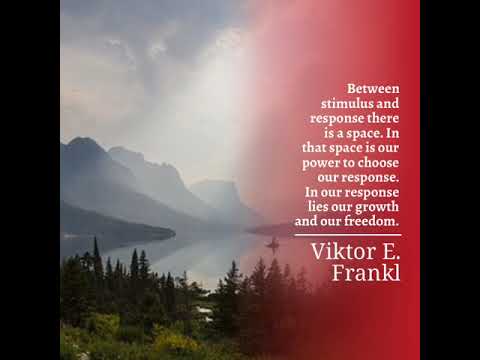
- Between stimulus and response there is a space. In that space is our power to choose our response. In our response lies our growth and our freedom. Viktor E. Frankl (1905-1997) Austrian psychiatrist, psychotherapist, neurologist, Nazi death camp survivor, meaning researcher, founder of logotherapy
- Life has meaning under all circumstances.
- Everyone has a will toward meaning.
- Human beings have freedom of choice, over attitudes, even if over nothing else.
Viktor E. Frankl (1905-1997) Austrian psychiatrist, psychotherapist, neurologist, Nazi death camp survivor, meaning researcher, founder of logotherapy, edited by Joseph Fabry, et. al., Logotherapy in Action, pg. 33
- Don’t tell yourself you‘re sick, you’re wounded. Get over it. You have two choices: Get bitter or get better. Caroline Myss Myss.com (*1952) US American spiritual teacher, mystic, medical intuitive, five-time New York Times bestseller author, lecturer, keynote address, Living a Fearless Life: Why Not Risk It All?, part 2 of 2, presented by Omega conference WMA, New York, 31. March-2. April 2006
- The most important decision we make is whether we believe we live in a friendly or a hostile universe. Albert Einstein [LoC 499] (1879-1955) German-born US American theoretical physicist, developer of the theory of general relativity
- Sheldrake's human morphic field and C. G. Jung's collective unconscious are the same. This means that when a critical number of people change their perceptions and behavior, it becomes a new choice or pattern in the collective psyche, which each of us can contribute to or draw from. The Hundredth Monkey in the allegorical story was the monkey who, upon learning a new behavior, tipped the scales, so that monkeys who were not even in direct communication now changed what they did. When a critical mass is reached, in this theory, new attitudes and behavior will spread through the species unconsciously. This can either be deducted through researched examples or grasped intuitively. Jean Shinoda Bolen, US American, Jungian analyst, author, spritual teacher, proactive women researcher and supporter, crone, Prophets Great List, Newsletter, 31. May 2003
|
|
600.000 moments for making a choice per month
|
- The Psychological Present is said to be about 3 seconds long, that means that in a life there are about 600 million of them, in a month 600,000. We have 600,000 chances each month to improve the decisions we are making in the present – those are a whole lot of opportunities to make amazing improvements to our lives. Video presentation by Daniel Kahneman, Israeli-American psychologist, Nobel laureate in economics, The riddle of experience vs. memory on the "experiencing self" (present) vs. the "remembering self" (past, score keeper, story teller), presented by TED2010 Talks, minute 7:22, 20:07 minutes duration, filmed February 2010, posted March 2010
- The remarkable thing is we have a choice every day regarding the attitude we will embrace for that day. We cannot change our past [...] we cannot change the fact that people will act in a certain way. We cannot change the inevitable. The only thing we can do is play on the one string we have, and that is our attitude [...]. I am convinced that life is 10% what happens to me and 90% how I react to it. And so it is with you [...] we are in charge of our attitudes. Charles Swindoll (*1934) US American evangelical Christian pastor, author, educator, radio preacher, founder of Insight for Living
- We do not know how we decide things, and in a sense we don't really care. Decisions are made for us by our unconscious, the conscious is in charge of making up reasons for those decisions which sound rational. We can, on the other hand, think rationally about the choices that other people make. We can do this because we do not know and are not trying to satisfy unconscious needs and childhood fantasies. As for making good decisions in our lives, when we do it is mostly random. We are always operating with too little information consciously and way too much unconsciously. Roger Schank, US American psychologist, computer scientist, author, designing E-Learning classes, What Do You Believe Is True, Edge.org
- We are co-creators, not mere slaves, and we are left free to choose either the world of cruelty or the world of love. Andrew Harvey (*1952) US American author, religious scholar, teacher of mystic traditions, Soho's New York Open Center
- If you choose not to decide, you still have made a choice. Neil Peart (*1952) Canadian musician, author, drummer of the rock band Rush
- Chance makes our parents, but choice makes our friends. Jacques Delille (1738-1813) French poet, translator
- If we want the beauty of the world that we have co-created to be experienced by our children and our children's children, we will have to become spiritual activists right here, right now, and cause that to happen. We must choose to be a cause in the matter. Ross Heaven, US American first white Voodoo Shaman of Haiti, psychologist
- Choices are the hinges of destiny. Edwin Markham (1852-1940) US American poet
- Informed decision-making comes from a long tradition of guessing and then blaming others for inadequate results. Scott Adams (*1957) US American creator of the Dilbert comic strip, author of several nonfiction works of satire, commentary, business, and general speculation
- I would rather have had one breath of her hair, one kiss of her mouth, one touch of her hand, than eternity without it. Movie line excerpted from City of Angels, character angel Seth, in love with mortal Dr. Maggie, had to become a human being; City Of Angels, YouTube film, 0:53 minutes duration, posted 4. December 2009
↑
Englische Texte – English section on Decision
The OODA principle: Observe → Orient → Decide → Act
|
The military teaches four steps of decision-making reminding leaders to the OODA principle:
1. Observe 2. Orient 3. Decide 4. Act.
|
↑
The Choice Between Two Paths
The left path of Ego – the Prostitute Path
- Let's say you're the guy, and you want to 'get lucky'. With the prostitute you go, pay the fee, and get exactly what you want from her. […] but since it is illegal, you may end up getting hit with a few arrows as well.
David Wilcock divinecosmos.com (*1973) US American consciousness researcher, author, lecturer, filmmaker, The Deeper "Secret", part II, Thursday 29. March 2007
The right path of SELF – the Maiden Path
- The […] positive path — is to approach your Higher Self as if it were a maiden. […] If you want to connect with the maiden, it's not so simple. You have to LISTEN to her. You have to dance with her […] explore her needs […] find out what she wants […] and be willing to move with her own free will, so that the two of you can COMBINE your visions into a MUTUAL view of what you want. Only then do you consummate the relationship.
David Wilcock divinecosmos.com (*1973) US American consciousness researcher, author, lecturer, filmmaker, The Deeper "Secret", part II, Thursday 29. March 2007
↑
The Road Not Taken – Robert Frost
I shall be telling this with a sigh
somewhere ages and ages hence:
Two roads diverged in a wood,
and I took the one less traveled by,
and that has made all the difference.
Robert Frost (1874-1963) US American poet, The Road Not Taken, 1916
Video presentation The Road Not Taken, read by the author Robert Frost and Alan Bates,
YouTube film, 2:00 minutes duration, posted 23. February 2010
Video presentation by Kevin Murphy, US American professor of English, Ithaca College,
Robert Frost's "The Road Not Taken", YouTube film, 23:47 minutes duration, 29. June 2008
Examination of the discrepancy between Robert Frost's popularity during his lifetime and the darker implications
of his poetry, as exemplified by one of his most cherished poems.
↑
Links zum Thema Entscheidung / Choice / Decision
Literatur
Literatur (engl.)
↑
Externe Weblinks
Externe Weblinks (engl.)
Audio- und Videolinks
Audio- und Videolinks (engl.)
- Video presentation by Barry Schwartz, US American psychologist, Dorwin Cartwright professor of social theory and social action, Swarthmore College, The Paradox of Choice – Why More Is Less, presented by Google Tech Talks, Google video, 1:04:07 duration, 27. April 2006
- Video presentation by Daniel Kahneman, professor of psychology, Princeton university, Nobel laureate in economics, founder of behavioral economics, on Explorations of the Mind: Intuition, presented by UCtelevision UCTV, University of California Television, Series: "UC Berkeley Graduate Council Lectures", April 2007, Show ID 12301, YouTube film, 56:00 minutes duration, 31. January 2008
- Video interview with Daniel Kahneman, professor of psychology, Princeton university, Nobel laureate in economics, founder of behavioral economics, on Conversations with History (Series ID 12295) on research on intuition and decision making, presented by UCtelevision UCTV, University of California Television, host Harry Kreisler, Institute of International Studies, YouTube film, 53:20 minutes duration, 16. May 2008
↑
|
Interne Links
Wiki-Ebene