SpiritualWiki

Hawkins / Frieden

Hawkins-Menu:


Wiki-Menu:  

2·2012


Frieden Erleuchtung BW 600+


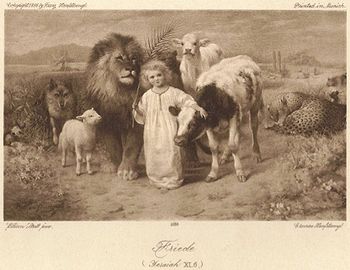
Illustration des Friedensreichs nach Jesaja 11, 6 (AT), 19. Jht.


Wortherkunft

Göttlicher Frieden und zugleich der Zustand der Erleuchtung ist bei einem Bewusstseinswert von BW 600+ erreicht.


Pax ist das lateinische Wort für Frieden. Pax in Verbindung Reichs-, Völker- oder Ortsnamen steht für
Konzepte weltanschaulicher Macht und politischer Einflussnahme im Sinne des Namensgebers
oder von konkreten Friedensverträgen.
So entstanden die Pax Romana, Pax Augusta, Pax Britannica,
Pax Americana, Pax Arabica
und Pax Augustana.

Zitate von zum Thema Frieden / Peace

Zitate von D. Hawkins

  • Das letztendliche Gewahrsein und tiefste Verständnis der Gegenwart Gottes ist Friede. Dieser Friede verströmt unendliche Sicherheit und Geborgenheit in nie endendem Schutz. Keinerlei Leiden ist überhaupt noch möglich. Es gibt keine Vergangenheit zu bedauern und keine Zukunft zu fürchten. Da alles bekannt und allgegenwärtig ist, sind alle möglichen Unsicherheiten oder Ängste vor dem Unbekannten für immer aufgelöst. Die Garantie des Überlebens ist absolut. Es gibt keine Wolken am Horizont und ebenso wenig so etwas wie eine Zukunft oder einen nächsten Augenblick, der irgendetwas Unangenehmes oder Unglückliches im Verborgenen bereithalten könnte. Das Leben ist ein immerwährendes „Heute“. OU Das All-sehende Auge, S. 141

Zitate (engl.) von D. Hawkins

Personal avowals
Transcending into the state of peace / enlightenment

  • It [LoC 600] is more that one is indifferent to [the body]. The state is so complete and perfect that there is no wantingness. To move something you have to have a wantingness. All wantingness disappers. [The physical functions] seem to operate in a delayed way. Many of the basic physiological functions do stop. Breathing will even stop. Video presentation on Hawkins experience of enlightenment, title and date unknown
  • The person who has found inner peace can no longer be intimidated, controlled, manipulated, or programmed. In this state, one is i'nvulnerable to the threats of the world and therefore has mastered life'. Source unknown


  • As we sacrifice our personal lives for the sake of the world, we sanctify the life of the world. You can leave your peace signs at home; they’re political slogans that become divisive. By lifting the field, you lift the world. Spiritual work becomes attacked by many people in a very yang way. Source unknown


  • When this state [LoC 600] is reached, the distinction between subject and object disappears, and there's no specific focal point of perception. Not uncommonly, individuals at this level remove themselves from the world, as the state of bliss that ensues precludes ordinary activity. Some become spiritual teachers; others work anonymously for the betterment of mankind. A few become great geniuses in their respective fields and make major contributions to society. Power vs. Force, S. ?


  • At the energy field of 600, ordinary thought ceases. Power vs. Force, S. ?


  • Peace can't be created this way: peace is the natural state of affairs when what's preventing it is removed. Relatively few people are genuinely committed to peace as a realistic goal, for in their private lives, most people prefer being "right" at whatever cost to their relationships or themselves. A self-justified positionality is the real enemy of peace. When solutions are sought on the level of coercion, no peaceful resolutions are possible. Power vs. Force, S. 221


  • Every advance that we make in our awareness benefits unseen multitudes and strengthens the next step for others to follow. Every act of kindness is noticed by the universe and is preserved forever. The Eye of the I, S. 118


  • Peace is literally a choice and a decision, although not a popular one in our society despite all the rhetoric about the term. The decision to overlook the seeming inequities of life instead of reacting to them is a choice [for peace]. The Eye of the I, S. 198


  • It is a relief to let the mind become silent and just 'be' with surroundings. Peace results, and appreciation and calm prevail. In order to realize that a running commentary is not necessary or even authorized, the will gives the mind permission to be silent. When devalued and humbled, the vanity basis of thinkingness collapses, and in its place one discovers the joy of inner silence, which actually constitutes ninety-nice percent of the mind. Only one percent is actually chattering. Transcending Levels of Consciousness, S. 234


  • A subtle inner pleasure accompanies true spiritual endeavor. An inner quality of peace and fulfillment accompanies the subtle inner knowingness that one is finally 'homeward bound' in the transition from the world of the self to the expanded awareness of the Self. There is also relief from inner spiritual guilt that accompanies spiritual negligence and willful indulgence of the ego’s demands and desires for gain. Reality, Spirituality and Modern Man, chapter 10 Experiential versus Conceptual, S. 194


  • When you totally accept that you are dumb and ugly you have peace. So I'm dumb and ugly! Sedona Satsang Q&A, CD 1 of 2, transcribed by Jon Kalman, Estland, 10. January 2007

Zitate (engl.) von D. Hawkins – Krieg / War

(↓)

Percentage of war times'

Gloria Steinem, Gregg Braden, Richard Wilkinson, Ph.D., Marija Gimbutas, estimate:
'''There were 90% non-war periods, 10% war periods in human history.

  • There has been war 97% of the time [of recorded human history]. Let‘s just accept that war is a natural condition. If people wanted peace, they would have peace. Sedona Satsang Q&A, 2 CD set, 10. January 2007

Gedichte – Frieden

* * *

Der erste Frieden ist der Wichtigste.
Er ist es, der in die Seelen der Menschen einzieht, wenn sie ihre Verwandtschaft, ihr Einssein,
mit dem Universum begreifen und verinnerlichen, dass das große Geheimnis im Mittelpunkt der Welt wohnt
und diese Mitte tatsächlich überall ist. Sie ist in jedem von uns.
Dies ist der wirkliche Friede, alle anderen sind lediglich Widerspiegelungen davon.

Der zweite Friede wird zwischen Einzelnen geschlossen.

Und der dritte Friede ist der zwischen den Völkern.


Doch vor allem möget ihr verstehen, dass es niemals Frieden geben kann, solange nicht
der erste Friede vorhanden ist, welcher, wie ich schon so oft sagte, im Innern der Menschenseele wohnt.


Black Elk ['Hehaka Sapa', deutsch 'Schwarzer Elch'] [BW 499] (1863-1950), Drei Arten von Frieden,  
Black Elk war ein Wichasha Wakan, ein Medizinmann und Ältester der Oglala-Lakota-Indianer.
Im Jahre 1876 nahm er mit erst zwölf Jahren an der Schlacht am Little Bighorn River teil.
Das Massaker am Wounded Knee 1890 überlebte er schwer verletzt. Er war ein Cousin
von Crazy Horse und kannte Sitting Bull und Red Cloud.
Obwohl er kein Englisch sprach, hat er viel von der Welt des Weißen Mannes gesehen.
Mit der "Buffalo Bill Wild West Show" ist er nach Italien, Frankreich und England gereist,
wo er unter Anderem für Königin Victoria tanzte. Black Elk verfügte über
große spirituelle Kraft und inspirierte sein Volk und viele andere weltweit.

Quelle des Friedens

Zitate von anderen Quellen

  • Ihr sollt nicht wähnen, dass ich gekommen sei, Frieden zu bringen auf die Erde. Ich bin nicht gekommen, Frieden zu bringen, sondern das Schwert [der Unterscheidung der Geister]. Matthäus 10, 34 (NT)


Talmidei hukhamim marbin shalom baolam. Übersetzung.: Es sind die weisen Männer, die den Frieden bringen werden. Talmud, Hauptschrift des gewöhnlichen Judentums [BW 595]


  • Wenn wir keinen Frieden finden, so liegt das einzig daran, weil wir vergessen haben, dass wir alle zusammengehören. Mutter Teresa (Agnes Gonxha Bojaxhiu; 'Engel von Kalkutta') [BW 710] (1910-1997) albanisch-indische katholische Missionarin, Nonne, Ordensgründerin, Friedensnobelpreisträgerin, 1979, Heilige


  • Sobald die Menschen ihr Einssein mit dem Universum erkennen, wird Frieden in ihre Herzen einkehren Black Elk [BW 499] (1863-1950) nordamerikanischer Medizinmann [Wichasha Wakan], Ältester der Oglala-Lakota-Sioux-Indianer,  katholischer Katechist, Pine-Ridge-Reservation, Süd-Dakota


  • Wer den Frieden will, muss mit dem Gegner gemeinsam leben wollen. Wir müssen vertrauen wagen. Darum Schluss mit dem Rüsten. Martin Niemöller (1892-1984) deutscher protestantischer Pastor, Nazi-Widerständler


  • Der Frieden kommt durch Verständigung, nicht durch Vereinbarung. Arabisches Sprichwort


  • Jeder Krieg ist eine Niederlage des menschlichen Geistes. Henry Miller (1891-1980) US-amerikanischer Schriftsteller, Maler, Der Koloss von Maroussi


  • Krieg ist zuerst die Hoffnung, dass es einem besser gehen wird, hierauf die Erwartung, dass es dem anderen schlechter gehen wird, dann die Genugtuung, dass es dem anderen auch nicht besser geht, und hernach die Überraschung, dass es beiden schlechter geht. Karl Kraus (1874-1936) österreichischer Schriftsteller, Journalist, Satiriker, Aphorist, Bühnenschriftsteller, Dichter


  • Wir tragen den Frieden wie ein Gewand, an dem wir vorn flicken, während es hinten reißt. Wilhelm Raabe (1831-1910) deutscher Erzähler, Romanschriftsteller des poetischen Realismus


  • ICH wünsche nicht, dass du in irgendeiner Weise Gewalt oder überwältigende Anstrengung einsetzt. Dies ist nicht die Methode, die der gütige, freundliche, friedliche Geist anwendet. Vielmehr wünsche ICH mir, du entspannst dich regelrecht in das Gewahrsein meiner GEGENWART hinein und betrachtest die Wahrheit für alle auf Erden, während du dir bewusst bist, dass mein Licht in deinem Inneren leuchtet. Ruby Nelson, Das Tor zur Unendlicheit, Aquamarin Verlag, Grafing, 1999

Zitate (engl.) von anderen Quellen

The whole of the Torah is for the purpose of promoting peace. Talmud, central scripture of mainstream Judaism [LoC 595]


Talmidei hukhamim marbin shalom baolam.Transl.: It is the wise men who will bring about peace. Talmud, central scripture of mainstream Judaism [LoC 595]


Blessed are the peacemakers, for they shall be called sons of God. Matthew 5, 9 (NT)


  • Peace comes from within. Do not seek it without. Buddha [LoC 1000] (563-483 BC) Indian Avatar, teacher of enlightenment, central figure of Buddhism


  • We need to find God, and he cannot be found in noise and restlessness. God is the friend of silence. See how nature – trees, flowers, grass – grows in silence; see the stars, the moon and the sun, how they move in silence. […] We need silence to be able to touch souls. Mother Teresa of Calcutta [LoC 710] (1910-1997) Albanian-born Indian Catholic nun, saint, missionary, humanitarian, founder of the Order of the Missionaries of Charity, Nobel Prize for Peace laureate, 1979


  • If we have no peace it is because we have forgotten that we belong to each other. Mother Teresa of Calcutta [LoC 710] (1910-1997) Albanian-born Indian Catholic nun, saint, missionary, humanitarian, founder of the Order of the Missionaries of Charity, Nobel Prize for Peace laureate, 1979


  • If there is to be peace in the home, there must be peace in the heart. Lao-Tzu [LoC 610] (604-531 BC) Chinese sage, philosopher, founder of Daoism, author of Tao Te Ching (also The Book of the Way)


  • Peace is always in God, because God is peace. Peace cannot be destroyed, but strife will be. Nicholas of Flüe (1417-1487) Swiss patron saint, mystic, hermit, ascetic, famous statement in his letter of thanks to the Council of the City of Bern, 1482


  • We are not at peace with others because we are not at peace with ourselves, and we are not at peace with ourselves because we are not at peace with God. Thomas Merton [LoC 515] (1915-1968) Anglo-American Catholic writer, Trappist monk, poet, social activist, student of comparative religion


  • Peace is not just an absence of war; it is a virtue, a state of mind, and a disposition for benevolence, confidence (courage) and justice. Baruch Spinoza [LoC 480] (1632-1677) Dutch philosopher, 1656


  • There is no way to peace along the way to safety. For peace must be dared. It is the great venture. Dietrich Bonhoeffer (1906-1945) German Lutheran pastor, theologian, martyr, Address at Fano


  • Peace is not merely a distant goal that we seek, but a means by which we arrive at that goal. Rev. Martin Luther King, Jr. (1929-1968) US American clergyman, activist, leader of the African American civil rights movement


  • It is not all of life to live, nor yet all of death to die. For life and death are one, and only those who will consider the experience as one may come to understand or comprehend what peace indeed means. Edgar Cayce ['Sleeping Prophet'] Association for Research and Enlightenment (1877-1945) US American trance medium, visionary, healer


  • Mankind must remember that peace is not God's gift to his creatures, it is our gift to each other. Elie Wiesel (*1928) German-French Jewish writer, professor, political activist, Holocaust survivor, Peace Nobel Price laureate, Nobel Peace Prize Lecture, 11. December 1986


  • Sometime they'll give a war and nobody will come. Carl Sandberg (1878-1967) US American writer, poet, editor


  • If women around the world in the twenty-first century would get their act together they could, partnered with men of like mind, shift the direction of world history to create a future without war. Judith L. Hand, US American evolutionary biologist, animal behaviorist (ethologist), novelist, pioneer in the emerging field of peace ethology, Women, Power, and the Biology of Peace, Questpath Publishing, 1. September 2003


  • When the power of love overcomes the love of power, the world will know peace. Jimi Hendrix (1942-1970) US American guitarist, singer-songwriter


  • A people free to choose will always choose peace. Ronald Reagan (1911-2004) 40th US president (1981–1989)


  • We are here today to raise the flag of victory over the capital of our greatest adversary. […] we must remember that […] we are raising it in the name of the people of the United States, who are looking forward to a better world, a peaceful world, a world in which all the people will have an opportunity to enjoy the good things of life, and not just a few at the top. Let us not forget that we are fighting for peace, and for the welfare of mankind. We are not fighting for conquest. We want peace and prosperity for the world as a whole. We want to see the time come when we can do the things in peace that we have been able to do in war. If we can put this tremendous machine of ours, which has made this victory possible, to work for peace we can look forward to the greatest age in the history of mankind. That is what we propose to do. Harry S. Truman [LoC 495] (1884-1972) 33rd US president during World War II, at the end of World War II, Berlin, 20. July 1945


  • Well, let's put it this way, money trumps peace sometimes. (Calibrated at LoC 365.) George W. Bush (*1943) 43rd US American president, press conference, 14. February 2007 and presidential address, 22. August 2007, cited in: Reality, Spirituality and Modern Man, chapter 1, pg. 40

Zitate (engl.) von anderen Quellen – Krieg / War

  • If women ran the world, there would be no wars. Winston Churchill [LoC 500] (1874–1965) British prime minister


(↓)

Final insight of a lifelong pacifist

Muted as a result of a stroke and bound to his death bed Hurr wrote this message:

  • War [Below LoC 200] is not the answer.
    Pacifism [LoC 185] is not the answer.
    Spirit [LoC 500+] is the answer.
    Gerald Hurr, US American pacifist

Englische Text – English section on Peace

Poems – Peace

* * *

The True Peace


The first peace,  which is the most important,
is that which comes within the souls of people when they realize their relationship,
their oneness with the universe and all its powers, and when they realize
at the center of the universe dwells the Great Spirit,
and that its center is really everywhere, it is within each of us.
This is the real peace, and the others are but reflections of this.

The second peace is that which is made between two individuals,

and the third peace is that which is made between two nations.

But above all you should understand that there can never be peace between nations
until there is first known that true peace which is within the souls of men.


Black Elk ['Wičháša Wakȟáŋ; Hehaka Sapa'] [LoC 499] (1863-1950) North American medicine elder
and heyoka of the Oglala Lakota tribe (Sioux) of the Oglala Lakota (Sioux),
Catholic katechist, Pine Ridge reservation, South Dakota,
The Sacred Pipe: Black Elk's Account of the Seven Rites of the Oglala Sioux, 1953


Peace Poem – Tao Te Ching

If there is to be peace in the world,
there must be peace in the nations.

If there is to be peace in the nations,
there must be peace in the cities.

If there is to be peace in the cities,
there must be peace between neighbors.

If there is to be peace between neighbors,
there must be peace in the home.

If there is to be peace in the home,
there must be peace in the heart.

Tao Te Ching

Imagine

Imagine all the people living life in peace.
You may say I'm a dreamer, but I'm not the only one.
I hope someday you'll join us, and the world will be as one.

John Lennon (1940-1980) English musician, singer-songwriter, founding members of The Beatles

BW-Werte: Frieden / Peace

  • BW 90 – Kriegsgötter
  • BW 145 – Pazifisten im Zweiten Weltkrieg
  • BW 185 – Pazifismus im Allgemeinen
  • Unter BW 200''' – Töten auf militärischen Befehl oder als Folge von zivilen Sachzwängen und Vollstreckung der Todesstrafe
  • 500+ – Spirit

Index: Frieden / Peace – Bücher von D. Hawkins


Index: Audio- und Videomedien (engl.) von und mit D. Hawkins


Links zum Thema Frieden / Peace

Friedensgedenk- und Aktionstage – Veranstaltungen

Literatur

Literatur (engl.)

Externe Weblinks


  • Vortrag von Prof. Dr. Hans-Peter Dürr, Vorsitzender der Vereinigung Deutscher Wissenschaftler (VDW) Friede als Ernstfall, Veranstaltung von Institut für Friedens- und Sicherheitspolitik, Hamburg (IFSH), Hamburg, PDF, 12. Oktober 2001

Externe Weblinks (engl.)


Audio- und Videolinks

Audio- und Videolinks (engl.)

  • Dr. Judith Hand, Women and Peace, Lecture Clip, 4:00 minutes duration
  • Audio interview with Dr. Judith Hand, evolutionary biologist, animal behaviorist (ethologist), novelist, pioneer in the emerging field of peace ethology, Women, Power, and the Biology of Peace, presented by web radio station WS Radio, The Doug Noll Show, host Doug Noll, 4 parts, each around 10-15 minutes duration including ads, aired 30. April 2009
    Peace education in the Middle East conflict
  • Video interview with Dan Bar-On Ph.D. (1938-2008) professor for psychology, Beersheva University, Israel, peace researcher and Sami Adwan, Bethlehem University, Bethlehem-Palestinian National Authority, founders of the Peace Research Institute in the Middle East (PRIME) on Crossing the Borders, presented by Peace Builders, host Dr. Saliba Sarsar, Monmouth University, NJ, USA, spring 2007, Vimeo film, 30 minutes duration, posted 5. June 2010
    Two peace educators from Israel and Palestine created a dual-narrative history-teaching textbook.


Interne Links

Wiki-Ebene