Hawkins / Quantenphysik
Inhaltsverzeichnis: (verbergen)
 Zeichnung Zeichnende Hände, 1948
|
|
In der Quantenmechanik wird […] wichtiger- |
|
Gewöhnliche reduktionistisch-materialistische Naturwissenschaft endet an der Demarkationslinie des Newtonschen Welt-
Die Quantenphysik ist eine der Wissenschaften, welche die 500er-Schwelle passiert hat und im dritten Jahrtausend wohl die Disziplin darstellt, die neben der modernen Hirn- und Bewusstseinsforschung am stärksten an der Wiederverbindung der gespaltenen Bereiche Körper versus Geist, Naturwissenschaft versus Mystik engagiert ist.
Alles ist mit allem verbunden.
Vier Grundgesetze der Quantenphysik
Alles ist mit Allem verbunden
|
Ändert ein Teilchen seinen Zustand, so erfolgt diese Änderung wie durch "Spukhafte Fernwirkung" zum exakt gleichen Zeitpunkt auch bei dem anderen. Diese Verschränkung bleibt auch dann erhalten, wenn die Wechselwirkung in der Vergangenheit statt-
gefunden hat und die beiden Teilchen weit voneinander entfernt sind. Moderne Wissenschaftler gehen seit kurzem davon aus, dass große Teile des Universums seit dem angenommenen kosmischen Big Bang [BW 135] vor 13,7 Milliarden miteinander verschränkt sind.
Ein Physikerteam aus Genf unter der Leitung von Professor Nicolas Gisin hat im August 2008 erstmals die Geschwindigkeit des Informationsaustausches zweier miteinander verschränkter Teilchen messen können. In einer komplizierten Berechnung kamen sie zu dem Ergebnis, dass die Ausbreitungsgeschwindigkeit der spukhaften Fernwirkung mindestens 100.000 mal größer sein muss als die Lichtgeschwindigkeit. Demnach scheint sich die Theorie zu bestätigen, dass die "wahre" Ausbreitung der Informa-
tion unendlich schnell, das heißt simultan, erfolgt.
Der englische Quantenphysiker Terence Graham Rudolph vom Londoner Imperial College kommentierte Gisins Erkenntnis:
Die Konsequenzen des Versuchs kann die Fugen des bestehenden Weltbildes so erschüttern wie zur Zeit der kopernikanischen Wende.
| Quelle: ► Prof. Jack Sarfatti (*1939) US-amerikanischer theoretischer Physiker, Autor von populären Werken über Quantenphysik und Bewusstsein, Verbindung von Wissenschaft und Religion , präsentiert von der Publikation ExtremeNews, 8. Dezember 2008 |
Statt 1927 fand das Ereignis Solvaykonferenz 1967 statt. Der Veranstaltungsort 1927 war Leiden.
Divinity Infinite: potential – omnipotence
Creation Finite: manifestation – omnipresence
Consciousness Infinite: omniscience
Persönliche Bekenntnisse
Zukunftsaussichten
|
|
|
Hayward schlussfolgert, dass das menschliche Bewusstsein möglicherweise grundlegender als Raum und Zeit sei.
|
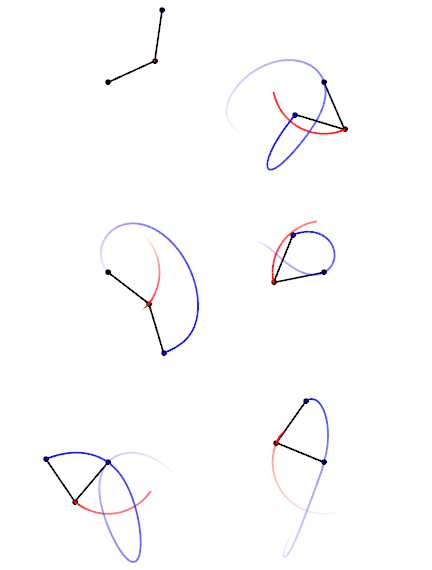
Erklärung des Wirkungsprinzips des Chaospendels

| Quelle: ► Video Konferenzvortrag von Prof. Dr. Hans-Peter Dürr (1929-2014) deutscher Quantenphysiker für Elementarteilchenphysik und Gravitation, Universität München, "passionierter Grenzgänger", ehemaliger Direktor des Max-Planck-Instituts für Physik (Werner-Heisen- berg-Institut), München, alternativer Nobelpreisträger, Ganzheitliche Physik (2002), internationale Wissenschaftskonferenz zum Thema Unity in Duality – Tendrel, Hotel Bayerischer Hof, München, 10.-13. Oktober 2002, YouTube Film, Ausschnitt Minute 1:26:36-1:40:28, 1:47:38 Dauer, eingestellt 20. März 2014 |
| Referenzen: de.Wikipedia-Einträge ► Doppelpendel und ► Multipendel |
| Medienangebote Videoanimationen zum Tripelpendel: ► Fun with Phun – Chaotic Triple Pendelum, YouTube Film, 5:30 Minuten Dauer, eingestellt 20. Juni 2010 ► Chaos Modell von Technik und Design München Tripendulum 100 Blau Alu Gelb, YouTube Film, 0:46 Minuten Dauer, eingestellt 3. Juni 2011 |
| Siehe auch: ► Physik und ► Kinesiologie |
Personal avowals

Fun with Phun – Chaotic Triple Pendulum, YouTube film, 5:30 minutes duration, posted 20. June 2010
Chaos Modell von Technik und Design München Tripendulum 100 Blau Alu Gelb, YouTube film, 0:46 minutes duration, posted 3. June 2011

|
|
|
| Source: ► Paul Hartal, Ph.D. (*1936) Hungarian-born Canadian Harvard-trained psychiatrist, board govenor of the Columbia Pacific University, painter, poet, World Renowned Psychiatrist and Author: David R. Hawkins, MD PhD, 28. August 2005 Link deleted |
|
Note: The two coexisting orders are expressed in different cosmologies, world views and theories.
| |||||||||||||||||||||||||||||||||||||||||||||||||||||||
|
In Walter's Theory of Everything (TOE) the universe is shaped as a giant double bubble expressing a Lorenz attractor dynamic oscillating between its two basins of attraction.
The 1D time in the linear bubble and the 1D space in the nonlinear bubble bond at the Planck level interface resulting in a polarized 1D axis stretching across both domains.
According to Katya Walter's TOE human life happens within twin bubble domains – in a Lorenz oscillator caught in a giant Klein bottle universe built by a nonlinear fractal chaos. It is being influenced by the universal unified mind combined with the tiny human minds. This is assembling the continual chaotic flow of events that humans experience. |
|
Note: The organic growth number pattern expressed in the Fibonacci numbers 0–1–1–2–3–5 and the Golden ratio. | ||||||||||||||||||||||||
| Sources: ► Lao Tzu (604-531 BC) Chinese sage, philosopher, founder of Daoism, author of Tao Te Ching, verse 42, 6th century BC ► Michael S. Schneider, US American mathematician, educator writer, Magical Egypt – Living Geometry, YouTube film, minute 3:30 (Fibonacci sequence), YouTube film, 9:16 minutes duration, posted 4. February 2010 ► Michael S. Schneider, US American mathematician, educator writer, Michael Schneider – Constructing The Universe, presented by the West Swedish web radio station Red Ice Radio, host Henrik Palmgren, YouTube film, 1:07:11 duration, first aired July 2010, posted 10. February 2018 | ||||
| References: en.Wikipedia entries ► Entanglement and ► Lemniscate and ► Fibonacci numbers 0–1–1–2–3–5 and ► Golden ratio | ||||
|
The 11 dimensions of the double bubble universe comprise three cooperating subsets
 Knot of eternity Events subject to abrupt, seemingly random changes, emerging in an nonlinear progression are created by mind and matter.
Beyond the ego's limits men can tap into the antimatter realm below the Planck level. In dreams, sleep, meditation, remote viewing, channeling, and other altered states of conscious- |
| See also: ► Cosmology and ► Linearity ⇔ Nonlinearity |
|
|
Quantum Mechanics
The differences between Newtonian and quantum paradigms of reality can be stated in general terms.
The evolution of mathematical understanding of advanced theoretical physics requires a progression through its development.
Understanding quantum mechanics requires to set aside customary beliefs based on conventional macroscopic physics. The underlying state depends on position, momentum, time, potential, kinetic energies, angle, and nonsubstance qualities such as the act of human observation itself, namely consciousness (the famous Heisenberg Uncertainty Principle).
The various substrata of what is assumed to be reality are profoundly affected and can be altered by the mere act of human observation.
Comprehension of advanced theoretical physics is subject to interpretation of the basic epistemology involved in the philosophy of scientific thought. One of the most important philosophical implications of quantum discovery involves the breakdown of the causality principle in subatomic phenomena.
A student of quantum theory may conclude that what one perceives is a product of intention in that what one discovers depends on what one is looking for.
| When an atom of matter encounters an atom of antimatter, there is an emission of two photons that fly off in different directions. At the time of their emission, there is no rotation to the photon. If one of the photons is looked at by a human observer, however, it instantly begins a rotation. At the same instant of time, the other photon simultaneously begins to rotate in the opposite direction. The phenomenon does not begin of its own but only as a consequence of human observation. So there is an underlying matrix/lattice field underlying both the subjective consciousness of the human and the phenomenological world of matter. |
Explanation
The discoveries of Quantum Mechanics required innovations of epistemologic and philosophic comprehension to explain the impact of human observation and participation in scientifically studied events.
The Heisenberg choice / principle is the threshold between the linear to the nonlinear domain. Albert Einstein [LoC 499], still locked into the Newtonian paradigm [LoC 499], refused to make the transition to nonlinearity and rejected the inclusion of consciousness as an integral element essential to explaining events.
The kinesiologic muscle test (indicating "yes" or "not yes") correlates with the "Von Neumann formulation" [LoC 460]. A com-
plete comprehension of events in nature requires recognition of two simultaneous processes, called Process I and Pro-
cess II.
Therefore a human only discovers what nature has already influenced and preselected. What counts is the statement itself and its underlying intention.
Scientists and consciousness researchers grapple with the comprehension of the relationship of context and content and
how it relates to brain function in which content and function are dominated by the field effect of context. Choices are thereby
open to possible "yes" answers or precluded by "not yes" exclusion.
The quantum theory of consciousness hits the "glass ceiling" of the limits of the humanly familiar dimension. Experience in the paradigm of the reality of the mystic is a consequence of the collapse of the wave function [LoC 500+].
The interface is the locus of the jump from the linear to the nonlinear, from ego to spirit, and from "knowing about" to "knowing
by virtue of identity with" reality.

Spiritual work of transcending identification with the ego facilitates the transformation necessary to dissolve the limitations of paradigm. The knowingness of self shifts from limited content to unlimited context. It eventually leads to the recognition of the source of existence itself as
"the Infinite "I" of radical subjectivity".
Discussion
Quantum Mechanics provides a rationale to explain such phenomena as the occurrence of the miraculous, the efficacy of prayer, and the exercise
of free will in which choice alters potentiality by altering context that, in turn, influences outcome, but not by resort to force, which would be necessary
if the sequence were due to an implied causality.
If the universe were limited to deterministic causality (i.e. the Newtonian frame of mind), all events would occur as a consequence of force resulting in an endless chain of dependent causes for which there could be no spi-
ritual accountability or freedom. In Reality, all acts are simply limited to a change of conditions, and subsequent phenomena are merely reactions or responses that are expressions of their own essence and not derived from any external source.
Thus, we can see that the presumed observed perception of a seeming chain of events is, in reality, stimulus and response, within which human consciousness is free to choose among a multitude of possible responses.
| Example: Nobody can 'make' another person angry or 'cause' them to do anything. |
The discoveries of Quantum Theory lead to a breakdown of the causality principle as a non-provable reality, a mentation, an operative explanatory theory.
| 'An idea whose time has come'. The idea stands for the content, the 'time has come' for the context. Context as such is comprised of millions of components. When a critical degree of balance, intensity, and density on a socio-political, economic, geographic level is reached, the idea may be activated into a reality. The activation is not due to 'causation' but resulting from the volition of the populace and the shifting of human proclivities. A hit movie can suddenly popularize a bygone era (including its music, decor, clothing styles). Attitudes may reemerge. |
Symbols represent content, context, or both. As such they have a subtle powerful and widespread influence on values, beha-
viors, and priorities. Empires can crash from a public scandal. General, nonspecific conditions (context) can increase or decrease the likelihood of the appearance of innumerable potentialities. The integrity of prevailing political, economic, sociolo-
gical, and spiritual attitudes is of profound importance as they constitute the social context in which innumerable choices are influencing decisions and actions which have far-reaching consequences.
'Content' and 'context' are both arbitrary selections of focus of attention. As words both denote a mentalization and a
point of view rather than different categories or conditions.
In a field of objects, any one or several can be selected for attention or examination and the remainder become termed 'con-
text'. When other objects are selected 'content' and 'context' are shifted.
| Example: When focusing on the planet Earth (content), the rest of the universe becomes context. Selecting the planet Mars instead, the planet Earth becomes part of the context of the rest of the universe. |
There is no actual discrete divisibility of the Allness of the Totality of Creation except in mentalizing about it via arbitrary percep-
tions and points of observation. There are only observables and no actual provables, and the observed is a consequence of arbitrary selection within the mind itself.
By a mere shift of focus of attention, content becomes context linguistically and vice versa. Thus, the seeming scintillation of the universe and its descriptions in 'time' and 'events' are 'sequence', and 'cause', 'antecedent', 'consequent', 'here', and 'there' are inherently really depictions of mentalizations rather than representative of some hypothetical 'objective reality'.
All knowledge rests upon and arises out of an epistemological matrix that of itself forms the very context of comprehension. The context of epistemology is in turn the nonlinear qualities of consciousness. All information systems require a comprehension of the nature of consciousness to reach their full understanding. Deeper research will lead to the realization that knowingness is purely subjective and only possible at all because the Self of the investigator already includes all that exists or it would not be capable of the quality and faculty of knowingness in the first place.
The witness of any mentally selected event is simultaneously both content (1:1) and context (3:1) and trapped in the epistemo-
logical dilemma of duality (2) itself.
The mind can therefore only 'know about' rather than truly comprehend essence, which is a nonverbal realization in which cons-
ciousness and essence are united as Oneness.
Grasping the nonlinear domain:
An infinite number of complex, interacting components constitute a field which, in an infinite number of unidentifiable ways, po-
tentates an infinite number of possible responses, all of which are themselves subject to an infinite number of possibilities. The hypothetical 'cause' of anything that can be perceived or is invisible is the entirety of the whole universe in its collec-
tive totality throughout all time. It proceeds out of the totality of all Creation which continues to expand in infinite dimensions more rapidly than the speed of light.
To assume that the human mind can discern a 'cause' of anything is delusional and an ego trip. The infinite context of all that exists and of all that may possibly by is God.
| Inspired by: ► D. Hawkins, I. Reality and Subjectivity, S. 431-436, 2003 Corresponding with Licht des Alls. Die Wirklichkeit des Göttlichen (German), "Anhang D", S. 563-570, 2006 |
Englische Werke
Links zum Thema Quantenphysik / Quantum physicsLiteratur
Thematisierung der Stringtheorie, verborgene Dimensionen, Suche nach der Weltformel
Literature (engl.)
MAPS OF CHANGE. Discussing the human journey through the mirror-worlds of order and chaos
Externe Weblinks
Diverse Links, ungeordnet:
Diskussion der Frage: Können sich New Age, Parawissenschaften und Esoterik auf die moderne Physik stützen?
Essay zur Quantenfeld- und Stringtheorie
Der US-amerikanische Physiker Prof. Dr. John Jost und seine Mitarbeiter am "National Institute of Standards and Technology", Boulder,
Betrachtungen über die universellen Existenz der (Heisenberg'schen) Unschärferelation bei jeglicher Beobachtung von Teilen eines Ganzen durch Mess- oder Verstandesvorgänge
Linklose Artikel
External web links (engl.)
Entries/links removed after publication of the book Power vs. Truth, 2013
Audio- und Videolinks
Audio- und Videolinks – Hans-Peter Dürr
Veranstaltungen von Gobal Challenges Network
Veranstaltungen von Dropping Knowledge Linkless media offerings
Audio and video links (engl.)
On quantum physics and consciousness
Quantum Mechanic explains how does the wave funtion collapses by the observer
Critique
Linkless media offering
Audio and video links (engl.) – Thomas Campbell
Nature of reality, the normal and the paranormal, mind and matter, physics and metaphysics, philosophy and theology in terms of consciousness
|
Wiki-Ebene
Englisch Wiki
1 Katya Walter, Ph.D., The Universe is Alive and Well: in a new TOE, Kairos Center, 28. December 2010 ⇑
2 20th international conference of the Society for Chaos Theory in Psychology & Life Sciences, Texas State University, San Marcos, Texas, 22-24 July 2010 ⇑
3 Katya Walter, Ph.D., deleted abstracts: Could the Arrow of Time be a Strange Attractor? and A New (and Very Old) Key to Nonlinear Dynamics ⇑
4 That which is Below corresponds to that which is Above, and that which is Above corresponds to that which is Below, to accomplish the miracle of the One Thing. Emerald Tablet of Hermes Trismegistus, translated by Dennis W. Hauck cited by Nicki Scully, Alchemical Healing. A Guide to Spiritual, Physical, and Transformational Medicine, Bear & Company, Rochester, S. 321, 30. September 2003 ⇑
7 On this stream, one may see an ever-changing pattern of vortices, ripples, waves, splashes, etc., which evidently have no independent existence as such. Rather,
they are abstracted from the flowing movement, arising and vanishing in the total process of the flow. Such transitory subsistence as may be possessed by these abstrac-
ted forms implies only a relative independence or autonomy of behaviour, rather than absolutely independent existence as ultimate substances. David Bohm, Wholeness and the Implicate Order, Routledge & Kegan Paul, London, Boston, S. 48, 1980 ⇑
8 Down the Rabbit-Hole, title of chapter 1 of the book Alice's Adventures in Wonderland, used as a metaphor for adventure into the unknown ⇑
9 The questions you are asking are already happening on their own, and you become aware of 'Oh, I just asked that' 1/10,000 of a second after the phenomenon. With full enlightenment, that 1/10,000 of a second [delay] disappears, and suddenly you are transformed into a different dimension of existence. The delay between a that and a me disappears, and that which you are is all there is. Interview with Dr. David R. Hawkins, US American spiritual teacher, Conversations about the Teacher and the Student, part III of III, presented by the dissolved US American Four Corners Magazine, Pamela Becker, August/September 2007 ⇑
10 Rediscovery of Charles Darwin's distorted evolutionary theory ⇑
11 Video presentation by H.H. 14th Dalai Lama Tenzin Gyatso (*1935) Tibetan monk, leader of the Gelug or "Yellow Hat" branch of Tibetan Buddhism, Nobel Peace Prize laureate, 1989, Vancouver Peace Summit 2009, presented by the Canadian broadcast television network CTV Television Network, part 2 of 4, 2/3rd section, minute 50:13-55:00, Vancouver, Canada, Sunday 27. September 2009 ⇑
12 Linearitaet vs Nichtlinearitaet [Linearity ⇔ Nonlinearity Chart] ⇑
13 Henry Stapp, Ph.D. [LoC ~high 400s] (*1928) US American quantum physicist, UC Berkeley, Mind, Matter, and Quantum Mechanics, New York, Springer-Verlag, 1993 ⇑
14 Truth vs. Falsehood. How to Tell the Difference, S. 124, 2005 ⇑
15 Truth vs. Falsehood. How to Tell the Difference, S. 135, 2005 ⇑
16 Truth vs. Falsehood. How to Tell the Difference, S. 135, 2005 ⇑
17 Truth vs. Falsehood. How to Tell the Difference, S. 135, 2005 ⇑
18 Truth vs. Falsehood. How to Tell the Difference, S. 135, 2005 ⇑
19 Truth vs. Falsehood. How to Tell the Difference, S. 135, 2005 ⇑
20 Siehe Truth vs. Falsehood. How to Tell the Difference, Kapitel 6, S. 59-60, 2005
Schöpfung ist Evolution. ⇑
21 Truth vs. Falsehood. How to Tell the Difference, S. 134, 2005 ⇑
22 Prof. Hans Jörg Fahr (*1939) deutscher Astrophysiker, Bundesverdienstkreuzträger für wissenschaftliche Verdienste, Kritiker der Urknall-Theorie, Universum ohne Urknall. Kosmologie in der Kontroverse, Spektrum Akademischer Verlag, Oktober 1995 ⇑
23 Videopräsentation von dem Zeitreisenforscher David Lewis Anderson, Dr. David Anderson Time Technology, YouTube Film, 1:55:20 Dauer, eingestellt 26. Dezember 2013 ⇑
24 Truth vs. Falsehood. How to Tell the Difference, S. 135, 2005 ⇑
25 Truth vs. Falsehood. How to Tell the Difference, S. 135, 2005 ⇑
26 Truth vs. Falsehood. How to Tell the Difference, S. 135, 2005 ⇑
27 Truth vs. Falsehood. How to Tell the Difference, S. 135, 2005 ⇑
28 Truth vs. Falsehood. How to Tell the Difference, S. 135, 2005 ⇑
29 See Truth vs. Falsehood. How to Tell the Difference, chapter 6, S. 59-60, 2005
Creation is ongoing evolution. ⇑
30 Truth vs. Falsehood. How to Tell the Difference, S. 134, 2005 ⇑