Hawkins-Menu: A·
B·
C·
D·
E·
F·
G·
H·
I·
J·
K·
L·
M·
N·
O·
P·
Q·
R·
S·
T·
U·
V·
W·
Z
Wiki-Menu: 1·
2·
A·
B·
C·
D·
E·
F·
G·
H·
I·
K·
L·
M·
N·
O·
P·
Q·
R·
S·
T·
U·
V·
W·
Y·
Z
SELBST BW 600/680
Unendliches ICH BW unendlich
Un-erlöstes Selbst / Persönlichkeitsstruktur BW 1 bis BW 599
Das kleine ich und das große ICH
|
Hawkins beschreibt das SELBST als die endgültige Subjektivität, aus der jedermanns Gefühl von "Ich" hervorgeht.
Das SELBST ist gleichzusetzen mit dem Begriff Atman aus der hinduis-
tischen Philosophie und beschreibt GOTT als manifest gewordene imma-
nente [innewohnende] Göttlichkeit. Das biblische Ich Bin – das Gewahr-
sein von ICH als Seinsheit oder Ist-heit – schwingt auf der BW-Ebene BW 650. Weiter fortgeschrittenes Gewahrsein ist jedoch jenseits von Seinsheit und kennt sich selbst nicht einmal als "Ich", sondern als den eigentlichen Kern der Fähigkeit zu solch einer Aussage.
Nachdem sich das persönliche Ego und das persönliche Karma aufgelöst haben (ab BW 600), strahlt das all-seiende und vollständige, und überall gleichermaßen gegenwärtige SELBST [BW unendlich] als der innewohnen-
de GOTT hervor . Auf der Bewusstseinsebene 700, wo die Erleuchtung er-
füllt ist, tritt das SELBST sichtbar nach außen.
Hawkins empfiehlt, sich fortwährend zu fragen: WAS bin ich?
Das Selbst ist die Identifikation der Seele mit dem Ego – dem Ich-Komplex, der der Wahrnehmung und den Inhalten des Denk- und Fühlapparates ver-
haftet ist. Nur durch die GNADE GOTTES ist es möglich diese Fehl-Iden-
tifikation durch die Offenbarung des SELBSTES aufzulösen.
Das kleine "Ich", das Paracelsus Suppenrührer nannte, schwingt vergleichsweise hohl, während das "ICH" klar und erfüllt ist. Letzteres bezeichnete Emanuel Swedenborg [BW 480] als Homo Maximus.
|
↑
Das SELBST – Erleuchtete und göttliche Stadien
| 1.250
| ICH als Essenz der Schöpfung
|
| 1.100
| ICH als letztendliche Realität jenseits der irdischen Dimension und Dimensionen überschreitend
|
| 1.000+
| Das "ICH" der Ultimativen Realität
|
| 850
| GOTT "SELBST" als Logos
|
| 840
| Das SELBST , als Existenz oder Nicht-Existenz übersteigend
|
| 750
| ICH/GOTT- SELBST [Self-Divinity] als All-Sein (Gottesschau)
|
| 740
| Der Weise – das SELBST als GOTT manifest
|
| 680
| Das SELBST als Existenz
|
| 650
| "ICH Bin" – Gewahrsein von ICH als Seins-heit oder Ist-heit
|
|
Quellen:
► D. Hawkins, Long Beach, California, Seminar The Clear Pathway to Enlightenment, DVD 1 of 3, minute 31:37, 8. March 2008
► D. Hawkins, Licht des Alls. Die Wirklichkeit des Göttlichen, S. 219 und S. 484-485, 2006
► D. Hawkins, "I". Reality and Subjectivity, S. 151-152 und S. 367-368, 2003
|
↑
Tabelle SELBST – ICH
| Bereich | BW | Ausdrucksform |
| Nichtdualität | 650 | "ICH Bin" Bewusstsein |
|---|
| Nichtdualität | 680 | SELBST als Existenz |
|---|
| Nichtdualität – ausgedrückt | 700 | Weiser (SELBST als manifestierter Gott) |
|---|
| Wundersames | 750 | ICH (Göttliches SELBST als Allheit) |
|---|
| Allfeld / Gesamtkontext verinnerlicht | 840 | SELBST jenseits der Existenz
Nichtexistenz [BW -200] Existenz [BW 200+] sind jeweils illusionär.
Die Realität dahinter [ab BW 840+] zählt. |
|---|
| Allfeld / Gesamtkontext verinnerlicht | 850 | Gott (SELBST) als Logos
Freier Willen des SELBST = Spiritueller Wille
= Hingabe an den göttlichen Willen
Dein Wille geschehe! |
|---|
| Jenseits des menschlich fassbaren Bereichs | 1.000+ | "ICH" der Ultimativen Wirklichkeit |
|---|
| Jenseits des menschlich fassbaren Bereichs | 1.250 | "ICH" als Essenz der Schöpfung |
|---|
|
↑
Zitate zum Thema SELBST und Unendliches ICH / SELF and Infinite I
Zitate von D. Hawkins
Gefestigt im Sein, in der absoluten Ebene des Lebens, (Einheit/Yoga) handle.
[Yogastha kuru karmani.] Bhagavad Gita [BW 910], Kapitel 2, Vers 48, 5.-2. Jht. v. Chr.
- Das SELBST geht über Existenz hinaus. Es ist weder Existenz noch Nicht-Existenz zugeordnet, weder Raum noch Zeit und hat weder Anfang noch Ende. Es kann nicht einmal in die Konzepte von Sein und Nichtsein eingeordnet werden. Das SELBST ist weder manifest noch nicht-manifest und außerhalb aller Dimensionen, die von solch einer Einteilung von Konzepten erfasst werden. FU Das All-sehende Auge, 2005
- Das, was das SELBST ausmacht, ist all-seiend und vollständig, es ist überall gleichermaßen gegenwärtig. Es gibt keine Bedürfnisse, Wünsche oder Mängel, weder Unvollkommenheit noch Unstimmigkeit ist möglich und jedes Objekt steht da wie ein Kunstwerk, eine vollkommene Skulptur von Schönheit und Harmonie. Die Heiligkeit der ganzen Schöpfung bewirkt die Huldigung von jedem Ding für jedes andere. Alles ist durchtränkt von großer strahlender Pracht, und alles verharrt in Schweigen, in Ehrfurcht und Anbetung [ BW 570 ]. Die Offenbarung macht alles still in unendlichen Frieden und unendlicher Ruhe. OU Das All-sehende Auge, Kapitel 1 "Prolog", S. 22, 2005
- Das "ICH" des SELBST ist das Auge GOTTES, das die sich als Jetzt entfaltende Schöpfung beobachtet.
Das All-sehende Auge, S. 31, 2005
- Das SELBST ist ALLES, WAS IST, und nichts ist unvollständig. Es gibt nichts, das man wissen müsste, und es bleiben keinerlei Fra-
gen. Alle Ziele sind vollkommen erreicht und alle Wünsche befrie-
digt. Das SELBST ist frei von Wünschen und Wollen oder Stre-
ben. Es hat bereits alles aufgrund der Tatsache, dass es alles
ist. ALLES, WAS IST, zu sein, schließt jeden möglichen Mangel
aus, und da bleibt auch nichts zu tun übrig. Es gibt keine Gedan-
ken, die man denken müsste. Es gibt keinen Geist, um den man
sich sorgen müsste. Das SELBST-GOTT-ATMAN hat keine Be-
dürfnisse, es wird nicht erfreut oder enttäuscht. Es hat keine
Gefühle oder Emotionen, es hat keine Glaubenssätze oder
Haltungen. Die Existenz des SELBST ist mühelos. Die Quelle
der Existenz selbst ist für immer frei und bedingungslos. Die
strahlende Kraft GOTTES leuchtet aus dem inneren Licht von Bewusstsein selbst hervor. Dafür gibt es keine Notwendigkeit für einen Körper oder irgendeine materielle Form. Das Formlose ist der Nährboden der Form. Das SELBST ist nicht urteilend, es ist unparteilich, stets und ganz erreichbar, allgegenwärtig und alles annehmend. Das All-sehende Auge, S. 141, 2005
- Es ist völlig gefahrlos, das kleine Selbst dem SELBST zu überantworten. Die bedingungslose Liebe des SELBST für das Selbst ist die Garantie für Gnade.
Das All-sehende Auge, S. 142, 2005
- Das Selbst, das den spirituellen Willen aktiviert, ist die Heimat unbegrenzter Kraft, gegen die das Kartenhaus des Egos nicht standhalten kann. Das Selbst gleicht einem unendlich starken Magneten, der die Fähigkeit hat, die
Struktur des Egos aufzulösen, wenn und sobald der spirituelle Wille seine Zustimmung dazu gegeben hat.
OU Das All-sehende Auge, Kapitel 9, S. 200, 2005
- Es gibt keine Trennung zwischen dem, was sich zu ereignen scheint, und dem SELBST. "Ursachen" werden
nicht im Außen gesucht, und so genannte "Ereignisse" treten als Ergebnis dessen auf, was sich im Geist befindet.
Es gibt keine Ursachen, die der Welt selbst zugeschrieben werden könnten, sondern nur solche im Bewusstsein.
Das All-sehende Auge, S. 329, 2005
- "Etwas" ist in unsere Existenz verliebt und an diese Existenz gebunden. Und man bemerkt, dass das Ego (Geist/
Gemüt/Körper/Selbst) das Objekt der Liebe ist. [...] Durch Kontemplation, Nachdenken und Meditation kommt das innere Wesen unserer Identifikation nach und nach an die Oberfläche. Dann stellt man fest, dass die wirkliche
Liebe zu sich selbst aus etwas hervorgeht, das größer ist als das kleine menschliche Selbst und in der Lage,
dieses Selbst in seiner Ganzheit zu umfassen. Das vollständige SELBST wird in einem größeren, darunter lie-
genden, nicht-linearen Gewahrseinsfeld gehalten, das ständig anwesend ist. Anstatt des Inhalts ["Etwas", "Dies"
und "Das", kleines Selbst] bildet dieses den Kontext. FU Licht des Alls. Die Wirklichkeit des Göttlichen, S. 88, 2006
- "Bin" bedeutet Seinsheit. Die letzte Wahrheit liegt jenseits von Istheit, Seinsheit oder irgendeinem intransitiven
Verbum. Jeder Versuch einer Definition des SELBST, wie "ICH BIN das ICH BIN" oder "ICH BIN", ist über-
flüssig. Die letzte Realität übersteigt alle Namen. ICH bezeichnet die radikale Subjektivität des Zustandes der
Verwirklichung. Das ist in sich selbst die vollständige Feststellung der Realität.
Licht des Alls. Die Wirklichkeit des Göttlichen, S. 187, 2006
- Sobald die Hindernisse des menschlichen Denkens, der Gefühlsbestimmtheit sowie der Ego-Strukturen, aus
denen diese sich ableiten, überwunden sind, strahlt das SELBST als der innewohnende GOTT aus solch einem
Menschen hervor, gerade so, wie die Sonne hervorleuchtet, wenn die Wolken verschwunden sind.
Licht des Alls. Die Wirklichkeit des Göttlichen, S. 236, 2006
- Das Gefühl von "Ich" wird vom höheren SELBST als eigenes übernommen. Das vollzieht sich jenseits von Willens-
entscheidung und strahlt aus seinem eigenen Wesen aus. Die An-Wesenheit ist die Offenbarung dessen, was
das Gefühl von SELBST als das ursprüngliche ICH ermöglicht. Sie ist die Grundlage für alle Subjektivität. Auf der
reflektierenden Oberfläche gibt es weder Subjekt noch Objekt. Die Wirklichkeit, welche die eigentliche Quelle von
Existenz ist, unterliegt dieser Existenz nicht als Objekt. Ihr eigener Kern ist das Nicht-Manifeste, aus welchem Exi-
stenz und Leben hervorgehen. Licht des Alls. Die Wirklichkeit des Göttlichen, S. 404-405, 2006
↑
Quotes by D. Hawkins
Personal avowals
- The state of the true Self experientially lasted for eons of timelessness. The experience was total, and at every instant, it was all encompassing, timeless, serene, and complete. There was nothing missing, nothing lacking and nothing further to be accomplished. It was a state of profound Love, Peace, and completeness that is beyond description. […]
At first, there was an inner feeling of relief, followed by a quiet joy and ecstacy, and then it went beyond ecstasy. It
went beyond bliss and became an eternal, infinite state, far beyond ordinary consciousness. […]
Sometime later, my father discovered where I was and shook me. He had a very upset, anxious look on his face and
said, "Don't ever do that again! Don't you know you could freeze to death?"
Healing and Recovery, chapter 15 "Death and Dying", S. 457, 2009
- Self is my reality; self is only my temporary expression in this domain.
Prescott Seminar Happiness, 3 DVD set, 25. April 2009
- To ease the transition of identification from self to Self, it is helpful to know that the lesser becomes replaced by the greater, and, thus, no loss is experienced. The comfort and security that was gleaned from clinging to one's identi-
fication with the small self is minuscule compared to the discovery of the true Self. The Self is much closer to the
feeling of 'me'. The Self is like "Me" instead of just 'me'. The Eye of the I From Which Nothing is Hidden, S. 86, 2001
- It is completely safe to surrender the self to the Self. The unconditional love of the Self for the self is its guaran-
tee of mercy. The emanation of Self to self is the province of the Holy Spirit, which is the link between spirit and ego.
By prayer we request, permit, and choose through free will to allow the Holy Spirit to be our guide. By God's grace
the transformation to enlightenment is made possible. The Eye of the I From Which Nothing is Hidden, S. 89, 2001
- What the people in the world actually want is the recognition of who they really are on the highest level, to
see that the same Self radiates forth within everyone, heals their feeling of separation, and brings about a feeling
of peace. To bring peace and joy to others is the gift of the benevolence of the Presence.
Eye of the I From Which Nothing is Hidden, S. 91, 2001
- The Self is the very fulfillment in manifestation of the Creator as existence itself. Nothing exists that is outside the
love of God. The Eye of the I From Which Nothing is Hidden, chapter 6 "The Resolution of The Ego", S. 131, 2001
- Question: What is the 'I'?
Answer: The "Infinite I" is that subjective reality which underlies the individual "I" and allows for the experience
of 'I-ness" as one's existence. It is the 'absolute' that enables the statement "I". It might be said that Descartes
[LoC 490] had it backwards. The truth is not "I think therefore I am" but it's corollary, "I am therefore I think".
Consciousness, or the capacity for awareness, is formless and is the backdrop from which form can the apparent emptiness of space that form can be perceived. 'Somethingness' can be identified only because it stands out
against no other things. It is due to the clarity of the sky that we can see the clouds.
Eye of the I From Which Nothing is Hidden, S. 177, 2001; chapter 12, S. 235, 2001
- Question: Who Is Doing The Seeking?
Answer: The illusion of the ego dissolves as the prefix 'I' is removed from all action. What ego claims as its actions are merely self-existent characteristics whose func-
tions are automatic, determined by local conditions, and without an imaginary 'I' to activate them. One does not think, feel, or even exist because of an action or decision by some inner, invisible 'I'. Thinking and feeling occur unasked. What is searching for higher truth is not a personal 'I' but an aspect of cons-
ciousness itself that expresses as inspiration, devotion, dedication, and perseverance, all of which are aspects of the spiritual will. Therefore, the source of the search for the Self is the Self itself actualizing the necessary processes
by virtue of its own qualities, which are facilitated by Grace.
The Eye of the I From Which Nothing is Hidden, S. 180, Veritas Publishing, revised edition 2002

Rosa sp.
Lucy Cramphorn, Kriloff 1960 Image No. 173
- The Self requires neither speech nor company nor activities and yet it experiences joy in all things. It delights in love in all
its various expressions as existence. Because all that exists is aware, love is recognized by all of Nature, which responds in like. The essence of Reality shines forth as a luminescence. The Self unconditionally loves all that exists. All love benefits all life and all mankind. Even to love one's pet dog actually benefits all mankind and is noticed by the universe. The Eye
of The I From Which Nothing is Hidden, chapter 17, S. 327, 2001
- Question: What does the Self feel like?
Answer: It is like the ultimate completion of being home. There is a knowingness of finality, conclusion, completion, fulfillment, satisfaction, perfection, and beauty. The quali-
ty of Love dissolves all possibility of suffering or wanting. No mentation occurs, nor is it necessary. A profound sense
of certainty prevails. Divinity is unmistakable.
There is absolutely nothing in ordinary human experience to compare with the joy of the presence of the Love of God. No sacrifice is too great nor effort too much in order to realize that Presence.
Eye of the I From Which Nothing is Hidden, S. 372, 2001
- Ask "How am I aware or even know that I exist?" That question is the best that can be acted upon for it leads directly and nonverbally to the ever present Reality. Identify with that quality, capacity, or condition of ever present subjectivity which is experienced as an underlying awareness. It is consciousness itself. Identify with that consciousness in-
stead of with the 'what' it is conscious about. That is the direct route to the Self. It is actually the only practice that
leads directly through the doorway. There is nothing to know, to learn, or to remember. It is merely necessary to focus, fixate, meditate, contemplate, look at, and realize that the substrate and source of existence is the radical subjectivity
of the Presence of God as the Light of Consciousness. I. Reality and Subjectivity, 2003
- When the obstacles of human mentation, emotionality and the ego's structures from which they are derived are trans-
cended, the Self as God, immanent shines forth of its own accord, just as the sun shines forth when the clouds are removed. I. Reality and Subjectivity, S. 16, 2003
- In reality, nothing thoughts say about oneself or others have any reality. All statements are fallacious and represent programming and positionalities. There are also positive statements about one's worth, merit, or value that are equally based on fiction. The true Self is invisible and has no characteristics by which it can be judged. It has no describable qualities nor can it be subject of any adjectives at all. The Self merely 'is' and is beyond verbs, adverbs, and adjectives. It does not even 'do' anything. I. Reality and Subjectivity, S. 25, 2003
- Question: Why the word "Self"?
Answer: The experience of the Presence is radically and profoundly subjective. It is commonly presumed by the mind that God is 'elsewhere', namely, above, beyond, transcendent, in heaven, or somewhere back in history or in the fu-
ture. Traditionally, however, God is described as both transcendent and immanent. The term "Self" emphasizes
that God is discovered within as the ultimate reality that underlies one's actual existence in the 'here and now' (e.g.,
"Heaven is within you.").
The Buddha is said to have avoided using the term "God" because of the prevalence of misconceptions surrounding
it. He wanted to avoid all the limitations that that conceptualization confounds. The Self as Awareness is often refer-
red to in literature as Light. As recounted in Genesis, the Unmanifest became Manifest first as Light, which was
the radiance of the energy of God that took form as the universe.
The term "Self" also overcomes the dualistic notion that one is separated from God. Historically, the picture
that there is a sinner down here on Earth and there is a God up there somewhere in heaven is the viewpoint of the
ego. Thus, to most people, the term "God" implies "otherness." However, there is no separation in the All-
ness of Creation, so it is impossible for the created to be separate from the Creator. Enlightenment is there-
fore the revelation of the Self when the illusion of the reality of a separate self is removed.
The constant awareness of one's existence as 'I' is the ever present expression of the innate divinity of the Self.
This is a universal, constant experience that is purely subjective and of which no proof is possible or necessary.
The 'I' of the Self is the expression of Divinity as Awareness which is therefore beyond time and form. The truth
of this identity is obscured by the duality created by perception and disappears when all positionalities are re-
linquished. I. Reality and Subjectivity, chapter 7 "The Radical Reality of the Self", S. 128-129, 2003
- Question: What does the Self feel like?
Answer: It is central, solid, profound, still, immutable, nonlocal, diffuse, all encompassing, peaceful, tranquil, comfortable, secure, emotionless joy, infinite lovingness, protection, closeness, safety, complete fulfillment, and ultra familiar. It is radically innate. It is the ultimate 'at home', the core of Reality and Awareness. It is the total
and complete 'me' of All That is or ever was or could be, beyond all time, place and conditions. It is the comfort,
warmth and security of total, unconditional, and everlasting Love. It is unconditional and without pain or vulnerabi-
lities. It is beyond all mentalization, question, doubt, word or emotion. It is peace, silence, and stillness, profound
and infinite. It is of the quality of Divinity, which is radiantly self-evident and all encompassing. The Love and Po-
wer of God are one and the same.
I. Reality and Subjectivity, chapter 7 "The Radical Reality of the Self", S. 137, bottom of the page, 2003
- Question: Reality is self-revealing when the ego is removed. How can that be accomplished?
Answer: There are several simple things. First, accept the fact that the real you is not the mind or anything it believes
in or feels. Disengage by seeing that it is an impressive mechanism but not your real Self. Refer to the mind as an 'it'
instead of as 'me'. The real 'you' is a priori to the mind. The real Self is context. I. Reality and Subjectivity, S. 309, 2003
- While consciousness level 600 formally denotes the onset of the states classically known as Illumination/Enlighten-
ment, Realization of the Self is characteristic of the consciousness level of the 700s. In the mid 800s, there is the ob-
stacle of the illusion of the Void to be bypassed, and then, with the actual death of the limitations of context the splen-
dor of full enlightenment bursts forth.
Transcending Levels of Consciousness. The Stairway to Enlightenment, Section 3 "Overview", S. 243, 2006
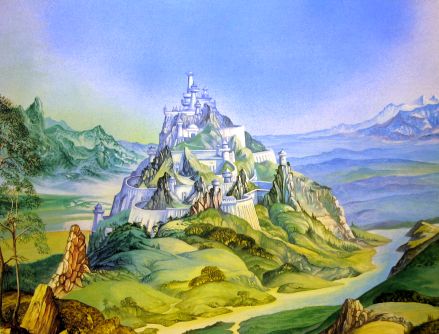
Minas Tirith; Roger Garland, Künstler, 2001
- Humor bridges the gap between res interna (cogitans) and res externa (the world the way it is). Therefore, it forms a striking contrast between what the mind perceives or believes and the essence of the underlying reality. Humor thus exposes the ego's self-serving deceptions. [...] It unmasks the ego, thereby de-
creasing its dominance. It leads away from the self to the Self.
Transcending Levels of Consciousness. The Stairway to Enlightenment, S. 361-364, 2006
- There is no "who" that is searching but some innate quality itself. The real Self brings up the false self for investi-
gation, which eventually leads to the disassembly of the ego structure itself. In the beginning, a seeker assumes
there is a personal self that is seeking the real Self. Actually, it is the real Self that is drawing the seeker to it.
Discovery of the Presence of God. Devotional Nonduality, S. 219, 2007
- Survival is a consequence of the Self, not the self. It is only because of the Self that the ego is of service for a prescribed period of earthly time. When the ego/mind is silenced, life goes on autonomously, paradoxically even seeing effort as effortless. All comes about as a consequence of potentiality's emerging as actuality when conditions
permit. Intention is such a condition. Eventually, even intention subsides as the will is surrendered to God.
Discovery of the Presence of God. Devotional Nonduality, S. 224, 2006
- Curiously, the Self is more truly personal than the ego self.
Healing and Recovery, chapter 15 "Death and Dying", S. 457, 2009
- Our Infinite Self is everything. It is connected with the angelic realms. When we own that angelic condition within
us, and own that we individually have the capacity to join it by our willingness to say yes, to allow ourselves to sur-
render to that energy, to go to the dead and the dying, we now see that there is no such thing as actual death
or dying. Healing and Recovery, chapter 15 "Death and Dying", S. 472, 2009
- If the desire arises to surrender all obstacles to love and to God, then God is already present in the form of willing-
ness. When one reaches devotion, there is already quite an advanced presence that is dissolving the ego and illu-
minating the way. Spiritual progress and discovery are accompanied by joy, which is the radiance of the Self, and
quickly replaces the surrendered ego's positionalities. Spiritual inspiration increases in intensity each step along
the way. When the self stops looking to the world or to the ego, it discovers that its source has been the Self all
along. Along the Path to Enlightenment. 365 Reflections from David R. Hawkins, edited by Scott Jeffrey, Reflection of Octo-
ber 5th, January 2011
- Because the ego deals in form and definition, it cannot comprehend the Self – which is beyond all form, but without form would not appear to exist. In Reality, there is neither subject nor object; therefore, there is no relationship
to be explained. Dissolving the Ego, Realizing the Self. Contemplations from the Teachings of David R. Hawkins, M.D., Ph.D.,
edited by Scott Jeffrey, S. 127, quote 1, Hay House, August 2011
- The constant awareness of one's existence as "I" is the ever-present expression of the innate Divinity of the Self.
This is a universal, constant experience that is purely subjective, and of which no proof is possible or necessary.
The "I" of the Self is the expression of Divinity as Awareness, which is therefore beyond time and form. The truth
of this identity is obscured by the duality created by perception and disappears when all positionalities are relin-
quished. Dissolving the Ego, Realizing the Self. Contemplations from the Teachings of David R. Hawkins, M.D., Ph.D., edited
by Scott Jeffrey, S. 138-139, last quote, Hay House, August 2011
- The Self is not conditional;
- it has no qualities
- and is not dependent or explicable.
- The Self has no duration, beginnings or endings, location, form, or limitations.
- It is the radiance of the Self that illuminates existence, without which there would be no awareness.
- The Self is beyond process.
- All descriptions are inappropriate and inapplicable to the Self.
- Enlightenment is not a condition to be obtained, it is merely a certainty to be surrendered to, for the Self is already
one's reality. Dissolving the Ego, Realizing the Self. Contemplations from the Teachings of David R. Hawkins, M.D., Ph.D.,
edited by Scott Jeffrey, part III, chapter 8 "Nature of Divinity/Self/Truth", S. 147, quote 3, Hay House, August 2011
- The Reality of the Self is characterized as non-dual: beyond form and the duality of "this" and "that," subject and object, "mine" and "yours." The state of nonduality is generally described in highlighting what it is not, pointing to a reality that can't be accurately described, only subjectively experienced.
Dissolving the Ego, Realizing the Self. Contemplations from the Teachings of David R. Hawkins, M.D., Ph.D., edited by Scott Jeffrey, chapter 10 "Nonduality", S. 169, Hay House, August 2011
- Ego/mind thinks,
field (consciousness) knows,
and SELF is.
Dissolving the Ego, Realizing the Self. Contemplations from the Teachings of David R. Hawkins, M.D., Ph.D., edited by Scott Jeffrey, chapter 10 "Nonduality", S. 170, Hay House, August 2011
- So you're aware that everything is happening of its own as an expression of Divinity, which is the Allness, the totality of all that exists. The realization that one's own existence is due to the constant Presence of Divinity. Contrary to the unen-
lightened view, that Divinity created [mmhh], threw the dice somewhere back in history and then disappeared, and is
waiting for you somewhere until that awesome day, called judgement day, is a terrifying misconception of Reality. It's
because of the Presence of God right now; one's existence from instant to instant is dependent completely on the Pre-
sence of God. So, one could say that that which one considers to be oneself, the ego, is the content, and God is the ultimate context. So, self with a small s is the content, Self with a large S is context. Enlightenment is merely identifying progressively with the infinite Self, and realizing that one is all that is, forever.
Sedona Seminar Devotion: The Way to God Through the Heart, 3 DVD set, 27. September 2002
- The greatest way to uplift people is by virtue of that which you yourself have become. By virtue of your presence, they are already uplifted and relieved. And you can see it in their eyes because suddenly the Self in them shines forth to
the Self in you, and you know you're connected. Forever actually, it’s forever.
Sedona Satsang Q&A, Sedona Creative Life Center, 2 CD set, 13. September 2006
↑
Zitate von anderen Quellen
Erhebe durch dein Selbst dein Ich;
Nie sei dein Selbst des Iches Sklav'!
Das Ich ist deines Selbstes Feind;
Dein Selbst, wenn’s herrscht, des Iches Freund.
Denn ich habe nicht von mir selbst aus geredet, sondern der Vater [SELBST],
der mich gesandt hat, der hat mir
Auftrag gegeben, was ich sagen und was ich reden soll, und ich weiß, dass sein Auftrag ewiges Leben bedeutet.
Was ich also rede, das rede ich so, wie der Vater es mir gesagt hat. Jesus BW 1000, Johannes 12, 49 (NT)
Das SELBST ist einzig. Unbeweglich, ist es schneller als Gedanken. Die Sinne holen es nicht ein; denn stets
ist es im Vorsprung.
Stillstehend, überholt es alles sich Bewegende. Ohne das SELBST gibt es kein Leben.
Der Tor vermeint, das Selbst bewege sich, doch es bewegt sich nicht. Dem Toren scheint es weit entfernt,
doch ist es nah. Es ist in Allem und auch außerhalb von Allem.
Wer alle Wesen im SELBST sieht und sein SELBST in allen Wesen, der hasset nicht mehr.
Erleuchtung heißt: das eigene SELBST im ganzen Weltall finden. Überwunden hat Wahn und Sorge, wer
überall die Einheit sieht.
Allgegenwärtig ist das SELBST, strahlend, ohne Leib, ohne Knochen, ohne Fleisch, vollkommen, rein und
unberührt vom Bösen. Der Seher, der Denker, der Eine, der Höchste über alle Welt und aus sich selbst
Seiende, der seit Ewigkeit die Welt schafft.
O Sonne, der Wahrheit Antlitz ist verhüllt von deiner goldenen Scheibe. Entferne sie, auf dass ich Wahrheits-
sucher der Wahrheit Herrlichkeit erblicken kann.
Erhalter du, Seher, Beherrscher des Himmels und der Erde – o leuchtende Sonne, du Lebensquell der Krea-
turen – verhüll' dein Licht und sammle deine Strahlen! Lass deine liebliche Gestalt durch deine Gnade mich
erblicken. Das Wesen, das dir innewohnt, dies Wesen, das bin ich.
Das Geheimnis der Unsterblichkeit ergründet nur der Herzensreine, wenn er, versenkt in tiefster Andacht,
erkennt: Das SELBST in mir und Brahman (das Absolute) außerhalb sind Eins. Einssein mit Gott, das ist
Unsterblichkeit! Upanishaden [BW 970] hinduistische philosophische Lehren
Empfehlungen

Mittelerde, Künstler: Linda und Roger Garland
Schlussfolgerung
- Das Selbst muss gebrochen werden, damit ein SELBST werden kann. Søren Kierkegaard [BW 410] (1813-1855) dänischer existentialistischer Philosoph, Theologe, Schriftsteller, Die Krankheit zum Tode, Rowohlt, München, 1969, Gütersloher Verlagshaus Mohn, Gütersloh, 1982
Einsicht
- Wenn das Selbst erkannt wird, wird Gott erkannt. Tatsächlich ist Gott nichts anderes als das Selbst.
Sri Ramana Maharshi [BW 720] (1879-1950) indisch-hinduistischer Weiser, Heiliger, David Godman, Herausgeber, Kurt Friedrichs, Übersetzer, Sei, was du bist! Die wichtigsten Lehren des großen indischen Weisen von Ramana Maharshi, O.W. Barth Verlag,
1. Juli 2010
- Die Frage "Wer bin ich?" ist die einzige Methode, allem Elend ein Ende zu setzen und höchste Glückseligkeit einzuleiten.
Sri Ramana Maharshi [BW 720] (1879-1950) indisch-hinduistischer Weiser, Heiliger, zitiert in: Ramana Maharshi Zitate
- Nur durch die Frage, "Wer bin ich?" gibt der Verstand das Intellektualisieren auf. Wie der Stock, mit dem man ein Feuer schürt, selbst verbrennt, so löst sich am Ende die Frage Wer bin ich? auf und führt zurück zu der Quelle des SELBST.
Sri Ramana Maharshi [BW 720] (1879-1950) indisch-hinduistischer Weiser, Heiliger, Quelle unbekannt
- Wenn man die Welt sieht, sieht man sich nicht selbst;
wenn man das SELBST sieht, wird die Welt nicht gesehen.
Bleiben Sie also das Selbst und erkennen Sie, dass es nie eine Schöpfung gegeben hat.
Sri Ramana Maharshi [BW 720] (1879-1950) indisch-hinduistischer Weiser, Heiliger, Gespräche des Weisen vom Berge Arunachala, S. 407, Ludwig Verlag, 5. Auflage Mai 2003
- Das kleine Ich sucht sich durch äußere Bestätigung, äußere Besitztümer und äußere Liebe zu erhöhen. Das SELBST, das GOTT erschaffen hat, braucht nichts. Es ist auf ewig vollständig, sicher, geliebt und liebend. Es sucht mit anderen zu teilen, statt zu bekommen; sich auszudehnen, statt zu projizieren. Es hat keine Bedürfnisse und will sich nur aus dem gegenseitigen Bewusstsein der Fülle heraus mit anderen verbinden.
⚡ Ein Kurs in Wundern [BW 550/600], Vorwort zu Ein Kurs in Wundern, 1994
- Wenn du heilst, dann ist es genau dies, was du lernst. Du erfasst den unveränderbaren Geist in deinem Bruder, in-
dem dir klar wird, dass er nicht anderen Geistes geworden sein kann. Auf diese Weise nimmst du den HEILIGEN GEIST in ihm wahr. Es ist allein der HEILIGE GEIST in ihm, DER niemals anderen GEISTES wird. Er selbst mag meinen, er könne es, sonst würde er sich nicht als krank wahrnehmen. Daher erkennt er nicht, was sein SELBST ist.
Wenn du nur das Unveränderbare in ihm siehst, hast du ihn nicht wirklich verändert. Dadurch, dass du dein Denken über seinen Geist für ihn änderst, hilfst du ihm die Änderung aufzuheben, die sein Ego in ihm herbeigeführt zu haben glaubt. ⚡ Ein Kurs in Wundern, Textbuch [BW 550], S. 121, 1994
|
- Das biblische "Ich bin" hat eigentlich ein Fragezeichen hinter sich. "Ich bin – was bin ich?" Also ist die Schöpfung Gottes das Unternehmen, sein Selbst auf alle er-
denkliche Weise zu erforschen, wobei er jeden von uns bei dieser SELBSTerfor-
schung auf ewige Zeit einsetzt.
Retrospektive Betrachtung von Mellen-Thomas Benedict (1949-2017) US-amerikanischer Nahtodüberlebender, Erfinder, Autor,
Edith Zeile, Übersetzerin, Durch das Licht, präsentiert von der Webseite Klarer Blick, 16. April 2011

Graphische Darstellung von Freuds Modell des Es ("Id"), des Ichs und des Überichs
- Alle diese Eigenschaften wie Lächerlichkeit, Gemein-
heit, Dummheit, Lügenhaftigkeit und diese abscheu-
liche Eigenliebe kannte ich nur zu gut aus mir selbst,
das heißt aus jener Persönlichkeit Nr. 1, dem Schul-
jungen von 1890.
Daneben gab es jedoch einen Bereich, wie einen Tempel, in dem jeder Eintretende gewandelt wurde. Von der Anschauung des Weltganzen überwältigt und seiner selbst vergessend konnte er nur noch wundern und bewundern. Hier lebte "der Andere", der Gott als ein heimliches, persönliches und zu-
gleich überpersönliches Geheimnis kannte. Hier trennte nichts den Menschen von Gott. Ja, es war, wie wenn der menschliche Geist zugleich mit Gott auf die Schöpfung blickte.
Carl Gustav Jung [BW 520/540] (1875-1961) Schweizer Psychiater, Psychoanalytiker, Gründer einer neuen Denkschule der Tiefenpsychologie, Autor, Aniela Jaffe, Autobiografie Erinne-
rungen, Träume, Gedanken von C. G. Jung, Zürich und Düsseldorf, 1971, Walter Verlag, 5. November 1993, Juni 2006
- Das [wahre] Ich […] ist das Auge, das sich selber sieht.
Johann Gottlieb Fichte (1762-1814) deutscher politischer Philosoph, Begründer des deutschen Idealismus, Vater des deutschen Nationalismus, Autor, Sämtliche Werke Band I, 1965
- Die Tragik des Menschen besteht darin, dass er fast unaufhörlich Ich und ICH verwechselt. Diese Verwechslung ist
die Wurzel-Verwechslung, die Wurzel aller Verwechselungen. Indem du Ich und ICH verwechselst, verwechselst du
Vorübergehendes und Ewiges, Schein und Wirklichkeit, das Kleine und das Große. Du verwechselst dich mit DIR.
Du verwechselst die Materie mit dem Geist, die Stoffgestalt mit der Geistgestalt.
Ich bin der Andere bzw. Ich bin ICH. Das ist eine Aussage über die Verwechslung, eben des Niederen mit dem Hö-
heren, aber zugleich eine solche über das, was "sein soll": die anamnetische Einverleibung der Geistgestalt in den
Stoff, in die Stoffgestalt. Die Stoffgestalt erinnert sich "ihrer" Geistgestalt. Ich bin der Andere. Wenn diese Erinnerung
völlig fehlt, ist die Geistgestalt zwar ständig anwesend, aber nur unbewusst, nur implizit, quasi ichlos. Sie ist von dem
an die Materie gefesselten Bewusstsein aus ohne eigene Wirklichkeit. Geistgestalt ohne Stoffgestalt: das ist in dieser
Sicht unmöglich.
Ich bin ICH/ich bin der Andere, das heißt, auf die Welt bezogen: Die Welt ist die Anderswelt. Auch hier wieder klingt
der Doppelsinn an: die Verwechslung und das, was "sein soll": In der Welt ist unaufhörlich die Anderswelt anwesend.
Die Anderswelt trägt und durchstrahlt die Welt [Sinnenwelt]. Die Sinnenwelt ist niemals ohne die Anderswelt. Die An-
derswelt ist die notwendige polare Ergänzung der Sinnenwelt. Das ICH ist die notwendige polare Ergänzung (und
Fundierung) des Ichs.
Ich bin der Andere: Das ist die Wahrnehmung oder Bewusstwerdung des Größeren/Weiteren/Tieferen in mir und als
ich. Der Andere wird damit nicht herabgezogen oder ins Materielle gebannt (um dann hier, wie im Materialismus, ge-
leugnet zu werden), vielmehr wird das Materielle alchemistisch erhöht und gesteigert. Ich bin der Andere: Das über-
steigt schon fast die menschliche Identität überhaupt. Denn auch dieser Andere, selbst wenn er als Eigentlicher/ei-
gentlich Gemeinter auftritt, kann und wird nicht eine "Endstation" sein. Es wird und muss einen weiteren/höheren An-
deren geben hinter dem ICH. Das ICH ist das Über-Ich des Ichs. Die genannte nächsthöhere Gestalt wäre dann das
Über-ICH des ICHs. Und so fort. Wo endet das? Jochen Kirchhoff (*1944) deutscher Philosoph, Kosmologe, Schriftsteller, Die Anderswelt. Eine Annäherung an die Wirklichkeit, S. 175, Drachen Verlag, Klein Jasedow, Taschenbuch, 1. Januar 2002
- Das Selbst ist das Leben und die einzige Wirklichkeit, und wer in das Selbst eingeweiht ist, was soviel bedeutet,
dass er-sie-es sich selbst vollkommen erkannt hat, liebt alles und alle gleich, denn er-sie-es ist eins mit ihnen.
Elisabeth Haich (1897-1994) ungarische Künstlerin, Autorin, Einweihung, Erstauflage 1954, Drei Eichen, 3. Auflage 1997
- Das falsche Ich können wir erfahren. Wir suchen es in den fünf Skandhas. Wenn wir es durchschauen, verschwindet es einfach. Und die Kraft, die darin gebunden war, fließt in positive Bereiche. Das wahre Ich ist das Selbst, die Natur des Geistes. Es ist jenseits von Gedanken und Vorstellungen, selig, rein und unwandelbar. Wir können es nie erfahren und beobachten. Dieses Selbst kann man nicht sehen. Es ist das einzige Selbst, aber es ist nicht "ich".
Rigdzin Shikpo, US-amerikanischer spiritueller Leiter der Longchen Foundation, Schüler von Chögyam Trungpa, Nyingma Dzogchen Tradition, Meditationen, S. 20, edition tara libre, Berlin-Jütchendorf, 2002
- Nein, nicht ich denke, sondern ES denkt in mir, und dem, was wir 'ich' nennen, wird nur das Resultat bewusst, ein winziger Bruchteil dessen, was 'es' wahrgenommen und verarbeitet hat. Tor Nørretranders (*1955) dänischer Professor für Wissenschafts-
philosophie, Wissenschaftsjournalist, Sachbuchautor, Spüre die Welt. Die Wissenschaft des Bewußtseins, Rowohlt Verlag, 1997
- Wir haben die besten 'Auftritte', wenn wir unserem Selbst freien Lauf lassen, wenn wir gerade nicht versuchen, es durch das Ich zu kontrollieren.
Tor Nørretranders (*1955) dänischer Professor für Wissenschaftsphilosophie, Wissenschaftsjournalist, Sachbuchautor, Spüre die Welt. Die Wissenschaft des Bewußtseins, Rowohlt Verlag, 1997
Literaturzitat
- Und wir empfanden einzig das als Pflicht und Schicksal: dass jeder von uns so ganz er selbst werde, so ganz dem in ihm wirksamen Keim der Natur gerecht werde und zu Willen lebe, dass die ungewisse Zukunft uns zu allem und jedem bereit finde, was sie bringen möchte. Denn dies war, gesagt und ungesagt, uns allen im Gefühl deutlich, dass eine Neu-
geburt und ein Zusammenbruch des Jetzigen nahe und schon spürbar sei. Hermann Hesse (1877-1962) deutsch-schwei-
zerischer Dichter, Schriftsteller, Nobelpreisträger in Literatur, 1946, Demian. Die Geschichte von Emil Sinclairs Jugend, S. 144, Fischer, Berlin, 1919, 1920, Suhrkamp Verlag, Frankfurt am Main, 1966, 26. Auflage 2004
↑
Quotes by various other sources
I am the Self seated in the hearts of all. Krishna BW 1000 († 3102 BC) Indian Avatar, central figure of Hinduism
The Self that is subtler than the subtle and greater than the great is seated in the heart of every creature.
One who is free from desire sees the glory of the Self through the tranquillity of the mind and senses
and becomes absolved from grief. Katha Upanishad, 4.-5. century BC
↑
Englische Texte – English section on SELF
Definition of Self
|
The SELF is
- infinite, central, profound
- solid, still, immutable
- nonlocal, diffuse, all encompassing
- peaceful, tranquil, comfortable
- ultra familiar, the ultimate 'at home', closeness
- radically innate, emotionless joy
- unconditional
- infinite lovingness, comfort, warmth
- protection, safety
- security of total, unconditional, and everlasting Love
- complete fulfillment
- the core of Reality
- the core of Awareness
- the total and complete 'me' of All That is or ever was or could be
- beyond all time, place and conditions
- without pain, without vulnerabilities
- beyond all mentalization, question, doubt, word or emotion
- peace, silence, stillness
- the quality of Divinity (radiantly self-evident and all encompassing)
|
↑
BW-Werte: SELBST / Self
Index: SELBST / Self – Bücher von D. Hawkins
↑
Links zum Thema SELBST und Unendliches ICH / SELF and Infinite I
Externe Weblinks
External web links (engl.)
↑
Audio- und Videolinks
- Videointerview mit Anna Maria August, deutsche Wandelbegleiterin, Gründerin und Betreiberin des Eventveranstalters Connectiv Events, Vom Ego zum wahren Selbst – Anna Maria August, präsentiert von dem deutschen alternativen online Fernsehsender SteinZeit TV, Leipzig, Gastgeber Robert Stein (*1970) deutscher Referent, online TV-Moderator, investigativer Journalist, YouTube Fillm, 45:08 Minuten Dauer, eingestellt 1. Juli 2017
Audio and video links (engl.)
↑
|
Interne Links
Wiki-Ebene