SpiritualWiki

Hawkins / Vergebung

Hawkins-Menu:


Wiki-Menu:  

2·2012


Vergebung
BW 350+ bis BW 540+


Regentropfen am Farnblatt


Der gekreuzigte Jesus trat für seine Verfolger ein:


Vater, vergib ihnen,
denn sie wissen nicht, was sie tun.


Lukas 23, 34 (NT)

Vergebungsstudien

Vergebung ist die Loslösung von negativen Energien aus  dem eigenen Körper, Fühlen und Denken.


Ursula Gräfen berichtet in der Ärztezeitung, dass es in den USA mittlerweile1 auch insgesamt 46 Studien zum Thema Verzeihen gibt, ausgelöst durch die ”Kampagne für Vergebungsforschung”, die von Friedensnobelpreisträger Desmond Tutu und Altpräsident Jimmy Carter angeregt und mit 7 Millionen Dollar Stiftungskapital finanziert wurde.


Nach Loren Toussaints Studie in Michigan mit fast 200 Probanden wurde bei Teilnehmern, die eher bereit waren zu verzeihen, ein niedrigerer diastolischer Blutdruck sowie geringere Kortisol-Werte gemessen als bei weniger Verzeihbereiten.


Dr. James Carson von der Duke University in North Carolina hat nachgewiesen, dass Vergebung chronische Rückenschmerzen und Depression lindern kann und vor der Chronifizierung des Schmerzes schützt.
Jede der 44 stark übergewichtigen Ehefrauen aus Italien wurde schlanker, nachdem sie gelernt hatte, die ihr von ihrem Gatten zugefügten Kränkungen ausnahmslos zu verzeihen.

Die vier Stufen der Vergebung

Verzeihen ist Schwerarbeit. Der Vergebungsforscher Dr. Robert D. Enright, Universität von Wisconsin, Madison, erläutert vier Stufen des Vergebung, die analog mit den vier Äras der Medizin zu vergleichen sind:

  1. Entdecke und anerkenne den Ärger in dir. – Energieräuber – potentieller Krankmacher
  2. Entscheide dich, wirklich zu vergeben. – Alternative
  3. Vergib beharrlich und lass Schicht um Schicht los. – Arbeit
  4. Feiere deine emotionale Befreiung. – Gnadenerfahrung

Vier Schritte zur Vergebung – Tipping-Methode

Die vier Schritte zur Vergebung
nach Ich vergebe, Colin C. Tipping


  1. "Ich schaue hin, was ich kreiert habe!"
  2. "Ich bemerke, dass ich urteile und liebe mich trotzdem."
  3. "Ich bin bereit, die Vollkommenheit in der Situation zu sehen."
  4. "Ich entscheide mich für die Kraft des Friedens."

Erster Schritt: "Ich schaue hin, was ich kreiert habe!"
Es ist ein spirituelles Gesetz – bestätigt durch die Quantenphysik und andere Wissenschaften – dass das, was in der Welt geschieht, ein Abbild unseres Bewusstseins ist. Wenn wir uns also sagen „Schau, was ich gemacht habe!“, dann öffnen wir uns für die Möglichkeit, dass wir an der Erschaffung dessen, was geschieht, einen Anteil haben. Wir lassen zu, dass unser Tun unserer Heilung und unserem spirituellen Wachstum dient. Dies ist unser erster Schritt auf dem Weg zur Übernahme von Verantwortung für das, was in unserem Leben geschieht.


Zweiter Schritt: "Ich bemerke, dass ich urteile und liebe mich trotzdem."
Dieser Schritt ermöglicht uns, unsere Menschlichkeit anzuerkennen und liebevoll anzunehmen. Als Menschen verbinden wir automatisch eine ganze Reihe von Beurteilungen, Interpretationen und Überzeugungen mit allem, was in unserem Leben passiert. Wenn wir dies jedoch klar erkennen, bewahren wir unsere Bewusstheit und können mit unseren Gefühlen und unserem authentischen Selbst in Kontakt bleiben.


Dritter Schritt: "Ich bin bereit, die Vollkommenheit in der Situation zu sehen."
Die Bereitschaft ist der wichtigste Schritt im Vergebungs-Prozess der Tipping-Methode. Dies ist der Punkt, an dem wir uns die Ansicht erlauben, dass sogar in diesem, von uns vielleicht als schrecklich empfundenen Ereignis eine Art göttliche Vollkommenheit am Werk sein könnte. Und dass wir sie möglicherweise erkennen könnten, wenn wir imstande wären, das ganze Bild zu sehen.


Vierter Schritt: "Ich entscheide mich für die Kraft des Friedens."
Der vierte Schritt ist die Konsequenz der vorangegangenen Schritte. „Frieden“ meint hier die Art von Frieden, die wir fühlen, sobald wir bereit sind uns der Vollkommenheit der Situation hinzugeben. Dies gibt uns die Kraft, die wir brauchen, um in der Welt vollständig bewusst zu handeln.

Zitate zum Thema Vergebung / Forgiveness

Zitate von D. Hawkins

  • Vergebung ist innewohnender Humor. Quelle unbekannt


  • Du kannst jemandem, den du noch als böse betrachtest, nicht vergeben. Quelle unbekannt


  • Für den spirituellen Schüler gilt, dass jedem vergeben werden muss, selbst wenn der andere "Unrecht" hat. Das All-sehende Auge, S. 244


  • In höheren Bewusstseinsebenen bringt jede Art von spirituellem Irrtum Schmerzen hervor. Es taucht irgendein Archetyp aus dem Kollektivbewusstsein auf. Ich wurde ungehalten über diejenigen, die die Wahrheit entstellen. Und ich verstand es nicht, bis ich alles damit Zusammenhängende für mich geklärt hatte. Man fängt an, für einen Teil des Kollektivs Verantwortung zu übernehmen. Durch Beten wird man es gewahr. Als ein "Krieger" der Wahrheit würdest du ihr Recht [das der Wahrheitsverdreher] verteidigen, fehlgeleitet zu sein, statt sie ins Unrecht zu setzen. Statt ihnen Schuld zuzuweisen, achte ihr Recht auf Vergebung. Sedona Seminar Vision, 3 DVD-Set, 25. Februar 2005


  • Frage: Was vergebe ich, wenn ich einem anderen vergebe?
    Antwort: Du vergibst tatsächlich deine eigenen Wahrnehmungen. Ohne die Wahrnehmung, würdest du nicht denken, dass es irgendetwas zu vergeben gibt! Prescott Seminar Overcoming Doubt, Skepticism and Disbelief, 3 DVD-Set, 9. August 2008

Zitate (engl.) von D. Hawkins

  • Forgive others and yourself for everything. Source unknown


  • It is an illusion to think that if you forgive someone that the other person has a 'gain', what we don't realize it that the one that gains from the forgiveness is ourselves. Source unknown


  • The universe always favors power. Moreover, the universe does not forget. We shall eventually have to accept responsibility for every thought, word, deed we generate and will re-experience exactly the same suffering we've caused. We do create our own heaven or hell. Seminar, source unknown


  • In mankind's experience, forgiveness is probably the most frequent trigger of this phenomenon because it brings about healing and the return of positive spiritual attributes such as love. We see this demonstrated widely by the veterans of World War II and subsequent wars where former fierce enemies have long since forgiven each other and their hatred has been replaced by respect and brotherhood. The Eye of the I, S. 316


  • At first, spiritual purification seems difficult, but eventually, it becomes natural. To consistently choose love, peace, or forgiveness leads one out of the house of mirrors. The joy of God is so exquisite that any sacrifice is worth the effort and seeming pain. I. Reality and Subjectivity, S. 397


  • Thus, the use of even a single spiritual concept, such as the willingness to be forgiving, can undo even long-standing egoistic positions. We see this in the example of the veterans on both sides of World War II having long ago forgiven their former enemies, despite the widespread death and destruction they witnessed. This demonstrates that even the most severe circumstances and experiences can be healed. The mechanism that allows this healing to operate is the willingness to surrender judgmentalism for peace, and hatred for love. Truth vs. Falsehood, chapter 5 'The Essential Structure of Truth', S. 50-51


  • Forgiveness is an extremely important major tool, expecially when it is combined with the willingness of humility and acceptance of human fallibility and susceptibility to error. From spiritual intention, the surrendering of egoistic options may seem like a sacrifice, but when recontextualized, they are revealed to be a hidden gift. Transcending the Levels of Consciousness, chapter 19, S. 330


  • The willingness to become a forgiving person who nurtures all of life non-judgmentally automatically brings that about within oneself because of the very healing nature of that energy field. It is a condition of good health and the beginning of seeing the perfection of all things and how all things work out for the good. Illness cannot stem from that context. Healing and Recovery, chapter 4 "Health", S. 128


  • What was acceptable at one level now becomes the limitation of the next. At a lower level we want to forgive people because they're wrong, and at a higher level we stop seeing them as wrong. We begin to see things differently […] as we evolve. Interview On the Trilogy of Book 1, 2 and 3, presented by Openexchange.org, Susanne Spitzer, 2004


  • Love [...] brings forth willingness and the capacity to surrender. It brings forth compassion and the desire to understand. With understanding, forgiveness ensues. With the relinquishment of positionality, one then realizes there is nothing to forgive. (BW 540) Judgment dissolves and condemnation and hatred are no longer possible. Ignorance born of innocence is seen to be the only ‘defect’ that needs to be transcended. It is seen that the nature of Creation is as it is and not in need of correction. Interview The Path of Simplicity, presented by US magazine In Light Times, March 2005


  • So you come out of denial, go through the pain of facing what you’re facing, work out the guilt about it and forgive yourself – then life gets beautiful again […] until the next thing comes up. This is characteristic of the whole spiritual pathway. Interview with David R. Hawkins, MD, PhD, presented by US magazine Holistic Networker, Gina Mazza Hillier, 13. August 2005


  • The real focus is how to overcome the residuals of the old animal brain from within and how to stop identifying with it, how to forgive yourself and to stop condemning yourself and feeling guilty and to learn to love the little animal. If you are spiritually oriented, everything in the world serves you. Sedona Seminar Realization of the Self: Final Moments, 3 DVD set, 14. December 2002


  • The person willing to forgive sees life in a benign context. Tustin, Arizona, Seminar Title unknown, 22. November 2003


  • The kindness and forgiveness you give to yourself is projected out to the world. One negative feeling on top is coming from something below. You find it, own it, forgive yourself for it. Sedona Seminar Emotions and Sensations, 3 DVD set, 17. April 2004


  • You can't just forgive for an hour a day, ten minutes tomorrow. It’s experiential immediacy. Sedona Seminar Perceptions and Positionality, 3 DVD set, 19. June 2004


  • Everything you see is a projection of yourself. If you are being accused of something, it may be something you were accused of in the past (past life). "Oh, Lord, I pray for forgiveness for the one in me who may have borne false witness against others.” Presume that was yourself in the past and pray for forgiveness as though you are currently guilty of it. It is not necessarily a current condition. Because of your spiritual intention, you are pulling up all this negative karma. Nothing happens by chance. It is coming up for response. When you get involved in spiritual work, the stacks come up. Just go through it with grace. Forgiveness and Grace. You are undoing a whole stack. Sedona Seminar God, Religion, and Spirituality, 3 DVD set, 10. December 2005


  • Anyway, the fact that you're accountable, then – is what? 'A safeguard'. So, it isn't that you want to live fearfully, fearful of making a mistake or fearful of a sin or something because, along with accountability also goes forgiveness. Uh, Jesus Christ died for you [...] to be easier he speaks for you and because forgiveness is part of your inheritance. So, as a devoted spiritual student you then karmically earn the right to forgiveness, should you make a mistake. And one mistake that we've all made was – 'we were too young at the time!!!'. [Laughter] We were all too young at the time to know better! [Laughter] That applies to everyone here? [D. Hawkins raises his hand.] Yeah, we were all too young at the time! So, we're – we forgive ourself because we're evolutionary creatures and out of our love for God, we say 'well, thank you Lord for the opportunity to grow and evolve and to earn that which we become.' Sedona Seminar What is Truth? The Absolute, DVD 2 of 3, minute 36:43+, 22. July 2007


  • Question: What do you forgive when you forgive someone?
    Answer: You are really forgiving your own perceptions. If it weren’t for perception, you wouldn’t think there was anything to forgive! Prescott Seminar Overcoming Doubt, Skepticism and Disbelief, 3 DVD set, 9. August 2008

Zitate von anderen Quellen


  • Vergebung anzubieten, ist die einzige Möglichkeit, sie selbst zu haben. Vorwort von Ein Kurs in Wundern [BW 550/600]


  • ... müssen wir vergeben lernen, und zwar nicht deshalb, weil wir "gut" und "barmherzig" sind, sondern weil das, was wir sehen, nicht wahr ist. Vorwort von Ein Kurs in Wundern [BW 550/600]


  • Vergebung ist im HIMMEL unbekannt, wo das Bedürfnis danach unvorstellbar wäre. In dieser Welt jedoch ist die Vergebung eine notwendige Berichtigung für all die Fehler, die wir gemacht haben. Vergebung anzubieten ist die einzige Möglichkeit, sie selbst zu haben, denn sie spiegelt das Gesetz des HIMMELS wider, dass Geben und Empfangen dasselbe sind. […] Durch die Vergebung wird das Denken der Welt umgekehrt. […] Indem wir keinen in der Schuld gefangen halten, werden wir frei. Ein Kurs in Wundern [BW 550/600] Vorwort


  • Der Schwache kann nicht verzeihen. Verzeihen ist eine Eigenschaft des Starken. Mohandas Karamchand Mahatma Gandhi [BW 760] (1869-1948) indischer, hinduistischer Weiser, spiritueller Führer der indischen Unabhängigkeitsbewegung, Rechtsanwalt, Verfechter des gewaltlosen Widerstands zur Durchsetzung politischer Ziele


  • Interessant ist dabei, dass die religiösen Aspekte der [Vergebungs]Konzepte im Islam und ihm Judentum gleich sind und sich von den christlichen Konzepten unterscheiden. Das Recht des Opfers, vor allem, wenn es machtlos ist, hat im Islam einen genauso hohen Stellenwert wie im Judentum, und auch hier kann nur das Opfer selbst entscheiden, ob es die Bitte des Täters um Vergebung akzeptiert. Die Vergebung, um die man Gott am Versöhnungstag bittet, ist kein Ersatz für diesen zwischenmenschlichen Prozess. Dan Bar-On, Ph.D. (1938-2008) israelischer Professor für Psychologie, Therapeut, Holocaust- und Friedensforscher, Die Anderen in uns. Dialog als Modell der interkulturellen Konfliktbewältigung, Edition Körber-Stiftung, 1. Auflage 2001, 2. Auflage 2003


  • Kein Mensch kann die Konflikte seines Lebens lösen, solange die Angst vor Strafe sein Ich, seinen Entscheidungsspielraum, seine Freiheit besetzt hält. Eben deshalb ist es nach Jesu Meinung unendlich wichtig, den Menschen zu sagen, wer Gott wirklich ist: Immer schon, im Voraus zu allem, was irgend geschehen mag, hat Gott dem Menschen, jedem Einzelnen von uns, vergeben! Gott "kann" nicht vergeben, er ist die Vergebung! Eugen Drewermann (*1940) ehemals deutscher katholischer Theologe, suspendierter Priester, Kirchenkritiker, Psychoanalytiker, tiefenpsychologischer Exeget, Referent, Schriftsteller, Nazareth: Befreiung zum Frieden, Band 2, S. 296, Walter Verlag, Zürich, Düsseldorf, 1997


  • Vergebung heißt tatsächlich, sich aus den Schaltkreisen auszuklinken, die einen beherrschen. Caroline Myss, Ph.D. Myss.com (*1952) US-amerikanische mystische Bewusstseinslehrerin, Energiemedizinerin, intuitive Diagnostikerin, Bestsellerautorin


  • Die Sippe [das tribalistische Bewusstsein] hat kein "Ich" [das Verantwortung übernehmen könnte].  […] Solange es kein "Ich" in der Sippe gibt, kann sich die Sippe nicht für ihre Taten entschuld(ig)en. Caroline Myss, Ph.D. Myss.com (*1952) US-amerikanische mystische Bewusstseinslehrerin, Energiemedizinerin, intuitive Diagnostikerin, Bestsellerautorin
    Caroline Myss erklärt am Beispiel des Holocausts, wie sich sippenorientierte Nachfolgenerationen dazu stellen. Unter ihren europäischen Schülern hat sie keinen Deutschen getroffen, dessen Vater erklärtermaßen ein Nazi im zweiten Weltkrieg gewesen war.


  • Vergebung ist keine zeitweilige Angelegenheit, Vergebung ist eine gleichbleibende Haltung. Rev. Dr. Martin Luther King, Jr. (1929-1968) US-amerikanischer Baptistenpastor, Aktivist, afro-amerikanischer Bürgerrechtler


  • Vergeben bedeutet nicht, jemanden einen Gefallen tun. Das tut man für sich selbst und seine Gesundheit. Desmond Tutu (*1931) südafrikanischer ehemaliger katholischer Erzbischof, Friedensnobelpreisträger, engagiert in der ”Kampagne für Vergebungsforschung”, zitiert in: Online-Zeitung der Universität Wien, Karin Jungreithmayer und Helene Lechner, 17. Juni 2009


  • Gewonnen hat immer der, der lieben, dulden und verzeihen kann, nicht der, der besser weiß und aburteilt. Wir können einander verstehen, aber deuten kann jeder nur sich selbst. Hermann Hesse (1877-1962) deutsch-schweizerischer Dichter, Schriftsteller


  • Gott wird mir verzeihen, das ist sein Beruf. Heinrich Heine (1797-1856) deutscher Dichter, Schriftsteller, Journalist, auf seinem Sterbebett


  • Wir sollten immer verzeihen: Dem Reuigen um seinetwillen, dem Reulosen um unseretwillen. Marie von Ebner-Eschenbach (1830-1916) österreichische Schriftstellerin


  • Alles verstehen heißt, alles verzeihen. George Sand (1804-1876) französische sozialkritische Autorin, Romanschriftstellerin


  • Solange du dem anderen sein Anderssein nicht verzeihen kannst, bist du weitab vom Wege zur Weisheit. Chinesische Weisheit


  • Verzeihen ist die beste Rache. Redensart


  • FR, Welzer: Sie vertreten seit einigen Jahren vehement eine Position, die man einer Überlebenden von Grausamkeiten nicht erwartet. Sie plädieren dafür, dem Täter zu vergeben.
    Eva Mozes Kor: Ja und zwar deswegen, weil es dem Opfer hilft, gesund zu werden. Es geht dabei nicht so sehr um den Täter. Ich halte vor allem deshalb mehr von Vergebung als von Gerechtigkeit, weil Gerechtigkeit den Opfern nicht hilft. Ich bin gefragt worden, ob ich dafür gewesen wäre, dass Mengele zum Tode verurteilt worden wäre, gesetzt den Fall, man hätte ihn bekommen. Was hätte ich davon, wenn er tod wäre? Mir wäre er lebend lieber gewesen, weil ich ihn dann hätte fragen können, was er mir injiziert hat. Mit Strafe und Gerechtigkeit kann ich als Opfer wenig anfangen. Verbrecher können bestraft und aus dem Verkehr gezogen werden. Solche Leute wären schwer zu rehabilitieren gewesen, so jemand muss aus dem Verkehr gezogen werden. Aber das alles nützt den Opfern nichts. Eva Mozes Kor (*1934) rumänische Holocaust-Überlebende der medizinischen Zwillingsversuchen von Dr. Josef Mengele in Auschwitz, zitiert in: Ein Überlebender hat das Recht zu vergeben, Frankfurter Rundschau, 13. Juni 2003


  • Seit ich den Verbrechern vergeben habe, wollen 75 Prozent der Überlebenden nicht mehr mit mir reden. Sie verstehen nicht, dass es dabei nicht um die Täter geht. Für mich ist die Frage der Heilung entscheidend. […] Ich habe mal erlebt, dass ein Journalist am Telefon darüber verwundert war, dass ich über irgendwas lachen musste. Ich fragte ihn, was er erwarte – ob es mir nicht erlaubt sei zu lachen, weil ich das Grauen überlebt hatte? Eva Mozes Kor (*1934) rumänische Holocaust-Überlebende der medizinischen Zwillingsversuchen von Dr. Josef Mengele in Auschwitz, zitiert in: Ein Überlebender hat das Recht zu vergeben, Frankfurter Rundschau, 13. Juni 2003


  • Die Deutschen werden den Juden Auschwitz nie verzeihen. Theodor W. Adorno (1903-1969) deutscher Philosoph, Soziologe, Musiktheoretiker, Komponist

Zitate (engl.) von anderen Quellen

Jesus' recommendation: Forgive others, so that God forgives you. [Paraphrased.] Matthew 6, 14-15; Mark 11, 25 (NT)


Jesus was saying, "Father, forgive them; for they do not know what they are doing." Luke 23, 34 (NT) New American Standard Bible, 1995


Lord Jesus Christ said: "Then Peter came up and said to him: My Lord, if my brother is at fault with me, how many times should I forgive him? Up to seven times?"
Jesus said to him: "I do not say to you up to seven times, but up to seventy times seven."
Matthew 18, 21-22 (NT) Lamsa Bible


  • If you want to make peace with your enemy, you have to work with your enemy. Then he becomes your partner. Nelson Mandela [Influence LoC 505] (*1918) leading South African anti-apartheid activist, prisoner for 27 years during apartheid, first black president of South Africa (1994-1999)


  • The law of karma demands that we meet every bit of our karmic debts. However, an even greater law exists, the law of forgiveness. If we wrong someone and that person forgives us, when the day comes that we approach God, we realize our memories which are incompatible with God, but forgiveness removes the barrier of separation. The law is so precise (what one gives one receives; no exceptions) that if we begin forgiving others, we begin to receive forgiveness upon ourselves. Unless, of course, we refuse to forgive ourselves. Edgar Cayce ['Sleeping Prophet'] Association for Research and Enlightenment (1877-1945) US American trance medium, visionary, healer


  • To forgive is the highest, most beautiful form of love. In return, you will receive untold peace and happiness. Robert Muller robertmuller.org ["Philosopher" of the UN] (*1923) US American international civil servant with the United Nations, Assistant Secretary-General for 40 years


  • Forgiving does not erase the bitter past. A healed memory is not a deleted memory. Instead, forgiving what we cannot forget creates a new way to remember. We change the memory of our past into a hope for our future. Lewis B. Smedes (1921-2002) US American professor of theology and ethics, Christian author


  • At the most basic level forgiveness is on a continuum with grief. There needs to be for almost everyone some of grief before forgiveness. Frederic Luskin, Ph.D., US American director of the Forgiveness Projects, Stanford University, author of Forgive for Good on The Resolution of Grief, presented by Greater Good Science Center, YouTube film, 7:38 minutes duration, posted 11. August 2010


  • Not forgiving is like drinking cat poison and then waiting for the rat to die. Anne Lamott, US American bestselling author, recovering conversed alcoholic


  • You can't deny reality. You have to accept reality. There is a Jewish saying which I think is quite apposite: "Deliverance comes through memory." Forgiveness is only possible through memory. And he who suppresses, he who forgets, lengthens our imprisonment. Martin Bormann Jr., son of prominent Nazi official Martin Bormann, head of the Party Chancellery


  • How did you find it in your heart to publicly forgive the Nazis? I discovered that I had the power to forgive; no one could give me that power, and no one could take it away, it was mine to use it in any way I wished. For me to realize that I had any power over my life was a life changing experience, and I made the choice to use that power and forgiveness freed me from my tragic past. That discovery made me want to shout it from the roof tops to help heal this aching world. Eva Mozes Kor (*1934) Romanian twin survivor of the Holocaust, subjected to human experimentation under Josef Mengele at Auschwitz concentration camp, Interview with Eva Mozes Kor, author of YA book Surviving the Angel of Death. The Story of a Mengele Twin in Auschwitz, October 2009

Englische Texte – English section on Forgiveness

Biblical forgiveness myths

"If anyone strikes you on the cheek, offer the other also." Luke 6, 29 (NT)
"Do not resist an evil person. If someone strikes you on the right cheek, turn to him the other also. " Matthew 5, 39 (NT)


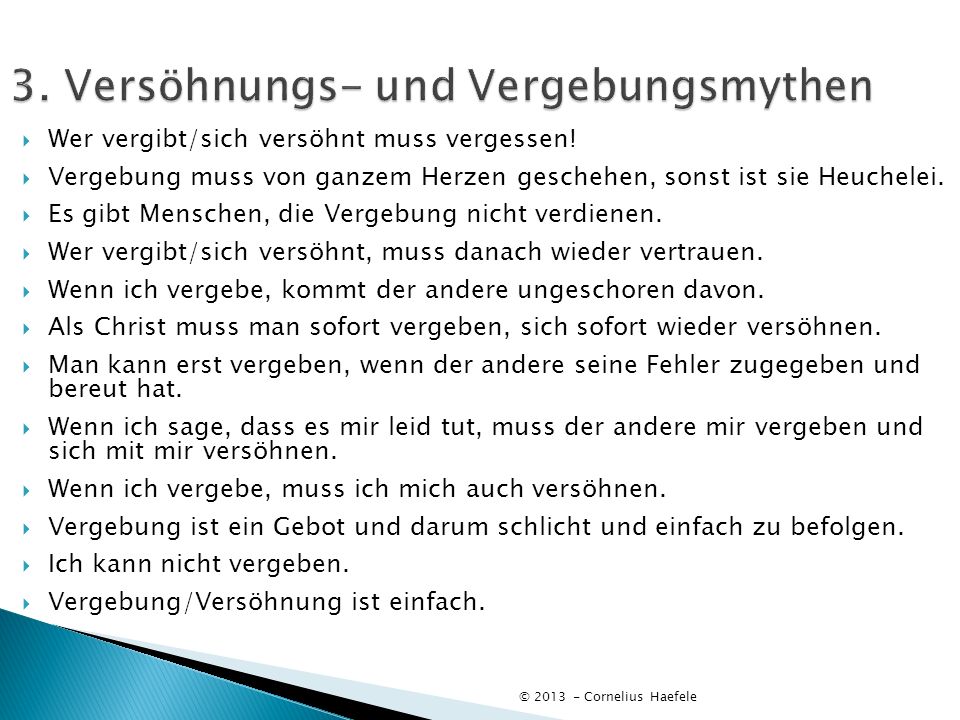
  • "Turning one's cheek when slapped" is not the antithesis to the Old Testament "eye for an eye" policy which served as a check for vengeance.
    "Turning one's cheek when slapped" is neither an act of forgiveness nor was it a sign of acquiescence in the days of Jesus. Turning the cheek would challenge the aggressor to strike with their left unclean hand, or else with the open right hand, which would signal equality. Thus, turning the other cheek was an act of nonviolent resistance.
    When faced with (verbal) aggression Jesus suggested first to ignore it. When attacked with corporeal violence He recommended to directly challenge the opponent as described above. At any rate, He asked to pray for one's aggressors.
Source of inspiration: Maria Mayo M.Div., M.A., Vanderbilt University, Myths About Forgiveness in the Bible, Huffington Post, 16. August 2011
  • Jesus warns his disciples that there is a sin that will not be forgiven: "Blasphemy against the Holy Spirit" (Matthew 12:31-32; Mark 3:29; Luke 12:10). Blasphemy (Greek: blasphemēo) means to speak against or slander. The meaning of "blasphemy against the Holy Spirit" is open to interpretation, but it is clear that there is a sin that God will not forgive under any circumstances. If Jesus teaches unconditional forgiveness, then God must be exempt from that teaching.


  • Jesus forgives the woman caught in adultery (John 8:1-11).
    Perhaps one of the best-known stories about Jesus comes from the Gospel of John, when Jesus confronts a crowd about to stone a woman who was caught in the crime of adultery. Jesus interrupts the melee, saying, "Let anyone among you who is without sin be the first to throw a stone at her" (John 8:7). When no one moves to attack the woman, Jesus says to her, "Neither do I condemn you. Go your way, and from now on do not sin again" (8:11).
    This story is often cited as an example of Christian forgiveness. However, the Greek term most commonly translated as "forgive," aphiēmi, does not appear in this story. Jesus' refusal to condemn the woman is not the same as an offer of forgiveness. Further, Jewish wisdom teaches that only a victim may forgive an offender. Since the woman has not done anything to Jesus, he has nothing to forgive her for. His refusal to condemn her is more a lesson to the crowd about judgment than it is an expression of forgiveness.


  • Jesus cries out, "Father forgive them, for they do not know what they are doing" (Luke 23:34). Readers often take this to mean that Jesus forgives those who are attacking him. However, a closer look at the syntax reveals that Jesus is not, in fact, forgiving his attackers; rather, he is praying that God might do so.
    It is possible that the lack of repentance from his attackers prevents Jesus from forgiving the men directly, since he has taught his followers that repentance is a requirement for forgiveness. Also, earlier in the Gospel of Luke Jesus instructs his disciples to "pray for those who abuse you" (Luke 6:38). While his prayer from the cross is a perfect model of this teaching, it is not an explicit act of forgiveness.


Forgiveness sets free

  • Jesus warns, "So my heavenly Father will also do to every one of you, if you do not forgive your brother or sister from your heart" (Matthew 18:35). In this case, forgiving is in the best interest of the one forgiving in order to avoid an afterlife of torture and abuse. However, the concern here is not a psychological one, but rather a concern for salvation.
    Again, it may well be true that "Forgiveness sets you free." However, the idea of forgiveness as a psychological or emotional condition traces to 18th-century moral philosophy, not first-century Christian writings. Forgiveness in the time of Jesus was an action verb, and Jesus' instructions served as checks for the health of the community, both on earth and in the world to come. There is nothing in the Bible that says that forgiveness is good for the physical or mental health of the forgiver. It is anachronistic to suggest otherwise.


Maria Mayo M.Div., M.A., Vanderbilt University, Myths About Forgiveness in the Bible, Huffington Post, 16. August 2011

BW-Messwerte: Vergebung / Forgiving

  • BW 540+ – Haltung des Vergebens und die Übergabe der Sache an Gott
  • BW 450 – Haltung des Vergebens und Vergessens/Übersehens durch Güte
  • BW 350 – Vergebung als Aufgabe von Rachsucht durch Barmherzigkeit

  • LoC 540+ – Willingness to "forgive and surrender to God"2
  • LoC 450 – Willingness to "forgive and forget"
  • LoC 350Forgiving as in foregoing revenge by mercy

Index: Vergebung / Forgiveness – Bücher von D. Hawkins

Englische Werke

Index: Audio- und Videomedien (engl.) von und mit D. Hawkins


Links zum Thema Vergebung / Forgiveness

Literatur

Literatur (engl.)

  • Everett L. Worthington Jr. (Herausgeber), Handbook of Forgiveness, Ergebnisse aus der Vergebungs-Forschung, Brunner-Routledge Verlag, 21. Juni 2005

Externe Weblinks  


Externe Weblinks (engl.)

Audio und Videolinks

Audio- und Videolinks (engl.)

Interne Links

Wiki-Ebene

Englisch Wiki


1 Stand: 2007

2 Dissolving the Ego, Realizing the Self. Contemplations from the Teachings of David R. Hawkins, M.D., Ph.D., chapter 1, S. 34, quote 1