
Wiki / Depression
Inhaltsverzeichnis: (verbergen)

Sonnenuntergang in Kuba |
|
Die Mehrzahl der Menschheit führt |
|
Depression ist die |
|
| Quelle (engl.): ► Videovortrag von Dr. med. Timothy R. Jennings, US-amerikanischer Facharzt für Psychiatrie, Psychopharmakologe, Das Gehirn, Depressionen und Gott, präsentiert von YHWHJesusAlive, YouTube Film, 38:19 Minuten Dauer, eingestellt 20. März 2013 |
|
Die Depression ist eine Selbstwertregulationsstörung. Die Ursache der Depression ist eine emotionale Mangelsituation ("zu wenig" Zuwendung und Geborgenheit) in der Schwangerschaft und frühen Kindheit. Mangelnde Versorgung und man-
Kompensationsstrategien:
b) Pseudo-Unabhängigkeit
Laut Angaben der Weltgesundheitsorganisation (WHO) leiden über 300 Millionen Menschen an Depressionen. Die WHO sieht voraus, dass chronische Depression im Jahr 2020 weltweit die zweithäufigste Erkrankung sein wird – unmittelbar nach den Herzkreislauf-Erkrankungen.
Laut einer Studie der Deutschen Angestellten Krankenkasse (DAK) durchgeführt im Zeitraum 1997-2004 stieg die Zahl der psychischen Erkrankungen um 70%. Am häufigsten litten die Betroffenen unter Ängsten und depressiven Störungen. In der Altersgruppe der 15- bis 34-Jährigen hat sich die Zahl der Fälle von klinischer Depression zum Teil verdoppelt. Sie tritt vorwiegend im Alter von 24 bis 44 Jahren auf, bei Frauen ist sie doppelt so häufig anzutreffen wie bei Männern. Seit der Jahrtausendwende ist ein Anstieg der psychischen Krankheit bei Männern zu beobachten.
Neuere Studien ergaben, dass Gewalt- und Missbrauchserfahrungen die höhere Depressionsrate von Frauen erklären können. Mädchen haben ein doppelt so hohes Risiko als Jungen, missbraucht zu werden. |
| Siehe auch: ► Die Stimme des wahren Selbstes erheben |

Frauen können ihre depressive Erkrankung eindämmen, indem sie den Weg zu ihrer eigenen Stimme finden.
Die amerikanische Psychologin und Professorin für Genderstudien Dr. Carol Gilligan betont die Wichtigkeit, das weibliche "Bezie-
hungsselbst" dem männlichen "autonomen Selbst" gleichzu-
stellen und aufzuhören, fremde, männliche Werte überzubewerten. Weibliche Depression kann überwunden werden, wenn Frauen ihre eigenen Fähigkeiten und Ressourcen aufspüren und sie für ihre ur-
eigenen Ziele einsetzen. Wichtig ist, dass sie sich erlauben, Unter-
stützung und Hilfe anzunehmen und zu aktivieren.
Das Risiko für Frauen, depressiv zu werden, erhöht sich, wenn sie ihr Bedürfnis nach Bindung unterdrücken und ihr wahres Selbst zum Schweigen bringen, weil sie glauben, dass dieses im Außen nicht akzeptiert und anerkannt wird.
| Quelle: ► Dr. Carol Gilligan (*1936) US-amerikanische Professorin für Genderstudien, Psychologin, feministische Ethikerin (Gemeinschaft, Beziehung), Autorin, Die andere Stimme. Lebenskonflikte und Moral der Frau, Deutscher Taschenbuch Verlag (dtv), München, 1996 |
| Siehe auch: ► Stimme |
| See also: ► Transforming rankist rape culture into digntiarian consent culture |
 Im Grimmschen Märchen Das Mädchen ohne Hände hatte ein armer Müller seine Tochter – im Glauben, es handle sich um einen Apfelbaum – dem Teufel verschrieben, um selbst zu Reichtum zu kommen. Drei Jahre später kam der Teufel, um seinen Teil des Handels abzuholen. Dreimal erschien der Teufel bei der Müllerstochter, doch jedes Mal musste er weichen – ohne Beute.
Durch die Reinheit ihrer Tränen, mit denen sie sich die Hände gewaschen hatte, ent-
Im Grimmschen Märchen von Rapunzel kann der durch einen Unfall erblindete Königssohn wieder sehen, als die Tränen seiner geliebten Rapunzel seine Augen berühren. |
| Artikel: ► Heldenweg-Stationen im Märchen vom Mädchen ohne Hände |
|
Tränen sind das Kondensat einer inneren Dramatik. Sie sind das Überlaufventil des Körpers bei Stress, Traurigkeit, Trauer, Angst, Frustration und Wut. Neben der körperlichen Entgiftung entlasten emotionale Tränen das Herz und die Seele. Tränen (der Freude) – beispielsweise nach einer Geburt oder Prüfung – drücken Erleichterung aus. Tränen helfen, schwierige Gefühlslagen zu lindern und Negativität zu vertreiben. Zu weinen vermittelt ein besseres Gefühl, insbesorndere wenn der auslösende Streit damit beendet wurde. Es erleichtert auch dann, wenn ein Problem fortbesteht. Heftig zu weinen, kann – 90 Minuten danach – die eigene Stimmung verbessern.2 Für manche, die Tränen eher zurückhalten, ist weinen zu können, ein Durchbruch.
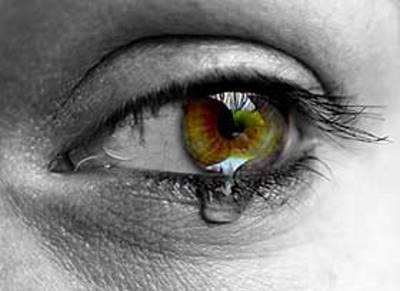 Tränen sind bei Männern und Frauen gleichermaßen ein Zeichen von Mut, Kraft und Authentizität. Tränen zu vergießen, fühlt sich reinigend an. Mit Weinen lassen sich aufgestaute Emotionen be-
Das unter einem Tränenschleier verschwommene Sehen behindert aggressive oder defensive Handlungen / Reaktionen des Weinen-
Ergebnisse von empirischen Studien
⚑ Wie das Meer bestehen Tränen aus Salzwasser.
⚑ Alle Tränen enthalten Wasser, Elektrolyte (Salze), Proteine, Enzyme, Lipide, Stoffwechselprodukte Hormone, Antikörper und Mineralien. Das Verhältnis dieser Inhaltsstoffe ist unterschiedlich.
 Tränen unterm Mikroskop, fotografiert von Maurice Mikkers "Der Flüssigkeitsfilm, der häufig mit einer Rötung der Au- gen einhergeht, erschwert Betrachtern die Sicht auf Blick- richtung und Pupillenbewegungen des Weinenden. […] Exzessives Weinen könnte so Informationen darüber zu- rückhalten, welche Absichten gehegt werden und somit andere hemmen." Oren Hasson, israelischer Evolutionsbiolo- ge, Tel Aviv Universität, Fachzeitschrift Evolutionary Psychology, Juli 2009, zitiert in: Artikel Tränen-Studie. Warum wir weinen, präsentiert von dem deutschen Nachrichtenmagazin Spiegel Online, 31. August 2009
"Durch Weinen teilt man anderen nicht nur mit, wie man sich fühlt, Säuglinge sichern sich dadurch sogar ihr Überleben. Weinen hat viele Vorteile für den Körper und die See- le. Es verlangsamt sich die Herzfrequenz und die Atmung, die Verdauung wird wieder aufgenommen und der Körper entspannt sich. Weinen kann sogar dem Immunsystem auf die Sprünge helfen. Es setzt nämlich Stresshormone frei, die als natürliche Schmerzmittel fungieren und dem Körper so helfen, sich zu entspannen." Artikel Deswegen geht es Menschen, die oft weinen tendenziell besser, präsentiert von dem internationalen französischen Lifestyle-Magazin Elle, Michelle Hartmann, 19. Oktober 2017
| |||||||||||||||
| ||||||||||||||||||||||
| Artikel: ► Tränen-Studie. Warum wir weinen, präsentiert von dem deutschen Nachrichtenmagazin Spiegel Online, 31. August 2009 ► Was Nahaufnahmen von Tränen verraten, präsentiert von der überregionalen deutschen Tageszeitung Die Welt, Wissen, Julika Meinert, 5. Oktober 2014 ► Deswegen geht es Menschen, die oft weinen tendenziell besser, präsentiert von dem internationalen französischen Lifestyle-Magazin Elle, Michelle Hartmann, 19. Oktober 2017 ► Heul doch! – Warum Tränen so wichtig sind, präsentiert von der Pforzheimer Zeitung, Magazin, Simon Walter, 17. August 2018 |
| Siehe auch: ► Traurigkeit und ► Trauer und ► Lachen und ► Mut und ► Echtheit |
| See also: ► Benefits of tears – Judith Orloff |
Hypoglykämie bezeichnet einen zu niedrigen Blutzuckerspiegel, einen zu geringen Glukoseanteil im Blut (Unterzucker).
Oft geht das mit Symptomen verminderter Hirnleistung, Krampfanfällen oder verstärkter Adrenalinausschüttung einher. Bei einer Unterzuckerung sinkt der Zuckergehalt im Zwischenzellwasser so weit, dass die Zellen deshalb nicht korrekt funk-
tionieren. de.Wikipedia-Eintrag
Der amerikanische Psychiater ⚡ Dr. David Hawkins hat im Lauf seines Berufslebens Tausende von Patienten, die unter Depressionen und Angststörungen litten, behandelt. Er selbst hatte Angststörungen, bei denen Antidepressiva nicht an-
schlugen.
Das 1996 im Verlag Zweitausendeins, Frankfurt am Main erschienene Buch Zucker Blues. Suchtstoff Zucker von William Dufty, gab ihm den entscheidenden Hinweis auf den oft übersehenen Auslöser von 95% der Depressionerkrankungen: Funktionelle Hypoglyklämie.
Zuckerunverträglichkeit von Glukose und Saccharose wirkt sich schädlich auf das Gehirn eines Depressiven aus. Der Ver-
zicht auf Industriezucker ist angezeigt. Fruchtzucker (Fruktose) ist möglicherweise ein geeigneter Ersatz. Wenn diese Voraus-
setzung erfüllt ist, haben Antidepressiva überhaupt erst die Chance, zu wirken. Laut Hawkins, der sich damit auf die überholte
Chemische-Ungleichgewicht-Theorie berief, sind sie hilfreich, um die Gehirnchemie eines Depressiven ins Gleichgewicht zu bringen.
| Quelle: ► Gelöschtes Audiointerview (engl.) mit ⚡ Dr. David Hawkins, Dr. David R. Hawkins, M.D., Ph.D. – Internationally renowned psychiatrist, physician, researcher, präsentiert über den US-amerikanischen Webradiosender Blogtalkradio, Sendung Awakenings, Gastgeberin Michele Meiche, Minute 49:52, 55:18, 90:00 Minuten Dauer, Mittwoch, 15. Juli 2009 |
| Siehe auch: ► Essen |
| ||||||||||||||||||||||||||||||
| Literatur: ► Buch: Dr. med. Elisabeth Kübler-Ross (1926-2004) Schweizer US-amerikanische Psychiaterin, Ärztin, Sterbe- und Nahtodforscherin, Autorin, Interviews mit Sterbenden [Originial 1969], 3. Auflage 10. September 2009 ► Buch: Bernard Jakoby sterbeforschung.de (*1957) deutscher Sterbeforscher, Nahtodexperte, Literaturwissenschaftler, Dozent, Autor, Geheimnis Sterben. Was wir heute über den Sterbeprozess wissen, Langen-Müller, 3. Auflage 1. Juli 2004 ► Buch: Bernard Jakoby sterbeforschung.de (*1957) deutscher Sterbeforscher, Nahtodexperte, Literaturwissenschaftler, Dozent, Autor, Wir sterben nie. Was wir heute über das Jenseits wissen können, Rowohlt Taschenbuch Verlag, 5. Auflage 2. Januar 2009 |
| Referenzen: de.Wikipedia-Eintrag ► Die fünf Phasen des Sterbens and Pflegewiki and ► Phasenmodell nach Dr. Kübler-Ross |
| Reference: en.Wikipedia entry ► The Five Stages Of Grief – Model of Coping with Dying |
| Siehe auch: ► Sterben und ► Krankheit und ► Ignoranz und ► Zorn und ► Akzeptanz |
| See also: ► Five strategies when faced with the inevitable – Elisabeth Kübler-Ross and ► Quotes by Elisabeth Kübler-Ross |
|
| Source: ► Article Title unknown, presented by the monthly peer-reviewed medical journal American Journal of Psychiatry, volume 6, S. 158, 839-847, 2001 |
Persönliche Bekenntnisse von Depressiven und deren Angehörigen und Freunden
Während einer Depression von Mitte August 1945 bis Mitte April 1946 schrieb Frankl an seinen Freund Rudolf Stenger, Wien,
30. Oktober 1945.
Die Liebe der Ehepartnerin reichte nicht aus, um die Depression des deutschen Nationaltorwarts Robert Enke zu neutralisieren.

Schlussfolgerungen
Einsichten

Antidepressiva sind wirkungslos.
15% der an schweren Depressionen Erkrankten begehen Selbstmord, 56% versuchen, sich das Leben zu nehmen.
Jährliche Todesstatistik in der EU: 58.000 EU-Europäer sterben durch Selbstmord oder Selbstschädigungen,
etwa 50.700 sterben durch Verkehrsunfälle und etwa 5.350 durch Mord oder Totschlag.
|
Personal avowals of depressives
Bill Wilson and his mistress Helen Wynn experimented with LSD to help diehard drunks discover a power greater than themselves. In 1956 Bill W. set out for his first LSD trip.

Recommendations
Appeals
Conclusions
Inquiries
Insights
|
|
Antidepressants: Opioids in 1970s, Oxytocin in 1980s, Prolactin in 1990, Play/tickling/laughter in 1997
|
The creative process of making meaning in life, when stymied can lead to depression or what we've mistakenly called "mental illness."
|
Literary quotes
Threefold approach to healing depression: antidepressants, positive thinking [LoC 499], spiritual work.
Conclusion
|
|
| Sources featuring Stephen S. Ilardi, Ph.D., US American associate professor of psychology, University of Kansas ► Book The Depression Cure. The 6-Step Program to Beat Depression without Drugs, Da Capo Lifelong Books, 1st edition 1. June 2009 ► Educative video Anti-Depression "Stone Age" Remedy, presented by the Watercooler Diaries KBT, YouTube film, 5:21 minutes duration, posted 15. October 2007 ► Audio Interview MP3, presented by the US American Radio Project, series Equal Time, aired July 20th, reaired 7. September 2009 ► Video presentation Stephen Ilardi: Therapeutic Lifestyle Change for Depression, sponsored by the College of Liberal Arts, University of Kansas (KU), YouTube film, 1:44:39 duration, posted 8. January 2013 ► Video presentation Depression is a disease of civilization, sponsored by TEDxEmory, Atlanta, Georgia, YouTube film, 22:20 minutes duration, 23. May 2013 |
| See also: ► Keeping one's heart healthy |
|
| Source: ► Quiz How much do you know about depression?, presented by Lost Connections, 2018 |
| Reference: ► Article Do Antidepressants Work? The most comprehensive study on them has recently been published, showing mostly modest effects., presented by the US American daily newspaper The New York Times, Aaron E. Carroll, 12. March 2018 |
| See also: ► Purpose and ► Work and ► Friendship and ► Loneliness and ► Community and ► Trauma and ► Dignity and ► Economic and status gap ► [❄] Healing individual trauma and transforming culture and society – Peter Levine ► [*] Results of the Mincome experiment in Canada ► [♦] Income and status gap in 23 of the rich developed countries worldwide – Wilkinson und Pickett (2011) ► [♦] Worldwide economic inequality gap – Statistics 2014-2018 ► [♦] Statistics of economic inequality in United States (1774-2011) |
|
|
|
"Lincoln’s look at that moment – the classic image of gloom – was familiar to everyone who knew him well. … He often wept in public and cited maudlin poetry. He told jokes and stories at odd times – he needed the laughs, he said, for his survival. As a young man he talked of suicide, and as he grew older, he said he saw the world as hard and grim, made that way by fates and forces of God. 'No element of Mr Lincoln's character,' declared his colleague Henry Whitney, 'was so marked, obvious and ingrained as his mysterious and profound melancholy.' His law partner, William Herndon said, 'His melancholy dripped from him as he walked.' " Joshua Shenk, US American essayist, author, creative strategist, Lincoln’s Melancholy. How Depression Challenged a President and Fueled His Greatness, Boston, Houghton Mifflin Company, 2005
Lincoln's melancholia allowed him to see events with preternatural second sight. […] Nevertheless, he felt compelled to speak out against the madness, even at the risk of his career. Paradoxically, his political career took off […] .
Back in Lincoln's time, living successfully with a mental illness was viewed as a character virtue.
[H]aving decided that he WOULD live, he then decided HOW to live. When faced with the challenge of a lifetime, he proved more than ready.
[…] On assuming his second term of office, Lincoln spoke the finest words ever uttered in the English tongue:
| Reference: ► Abraham Lincoln Research Site |
|
Personal avowals
|
|
The benefits of tears
 Tears of ending and beginning, photographer Rose-Lynn Fisher
|
| Source: ► Blog article by Judith Orloff, M.D., Ph.D. (*1951) US American assistant professor of psychiatry, UCLA, empath, dying companion, lecturer, author, The Health Benefits of Tears, presented by the US American liberal-oriented online newspaper Huffington Post, 21. July 2010, updated 17. November 2011 |
|
Both urination and tears clean out impurities.
|

If there were wanting any argument to prove that man is not mortal, I would look for it in the strong, convulsive emotion of the breast, when the soul has been deeply agitated, when the fountains of feeling are rising, and when tears are gush- ing forth in crystal streams. O, speak not harshly of the stricken one – weeping in silence! Break not the deep so- lemnity by rude laughter, or intrusive footsteps. Despise not a woman’s tears – they are what make her an angel. Scoff not if the stern heart of manhood is sometimes melted to tears of sympathy – they are what help to elevate him above the brute. I love to see tears of affection. They are painful tokens, but still most holy. There is pleasure in tears – an awful pleasure! If there were none on earth to shed a tear for me, I should be loth to live; and if no one might weep over my grave, I could never die in peace. First appeared in the Miscellany section of The American Masonic Register, by Anonymous, Albany, 6. February 1841; secondly presented by "The Mother's Assistant", attributed to Dr. Johnson, S. 77, published 1845, later falsely attributed to Washington Irving (1783-1859)
|
| Written references: ► Feature article on the works of photographer Rose-Lynn Fisher, Topography of Tears, presented by the Black+White Photography magazine, S. 31-37, October 2016 ► Q&A contribution Why is it easier for women to produce tears than men?, presented on the Californian question-and-answer website Quora, Elfriede Ammann, 1.9k views · 8 upvotes, 23. April 2019 |
| Media reference: ► Video presentation by Ad Vingerhoets, Ph.D., Dutch professor of clinical psychology, Why do only humans weep?, presented by the TEDx program – TEDxAmsterdam, YouTube film, 15:58 minutes duration, posted 27. November 2015 |
| See also: ► Sadness and ► Grief and ► Courage and ► Authenticity |
| Siehe auch: ► Lösende Tränen und ► Die weinende Kamelmutter |
Recommendation
My duty as physician and healer is to talk people out of suicide.
I can be effective because I absolutely know there's hope for everyone and that depression is a distortion. It swallows
the light, making misery seem like the only truth. But it is not. You must remember that. If ever suicide starts looking
good, stop, regroup, and fight to find hope. Reach out for help. Don't be seduced by the voice of depression.
Facing one's demons
Leaving your body doesn’t make emotional challenges disappear. The soul's work continues. What I intuitively sense about
its destinations is that who you are here is who you’ll be there too, albeit without the physical form you're accustomed to identifying with.
I don't mean this punitively. I'm simply saying you'll eventually have to face your demons.
| Source: ► Judith Orloff, M.D., Ph.D. (*1951) US American assistant professor of psychiatry, UCLA, empath, dying companion, lecturer, author, Emotional Freedom. Liberate Yourself From Negative Emotions and Transform Your Life, subtitle Suicide: A Perspective Beyond Time and Space, S. 284, Harmony Books, 2009 |
| ||||||||||||||||||||||||
| Source: ► Elisabeth Kübler-Ross, M.D. (1926-2004) Swiss US American psychiatrist, death and dying researcher, founder of Near-death studies, author, On Death and Dying, 1969, Scribner, paperback edition 9. June 1997 |
| Reference: en.Wikipedia entry ► The Five Stages Of Grief – Model of Coping with Dying |
| See also: ► Dying and ► Disease and ► Ignorance and ► Anger and ► Acceptance ► Quotes by Elisabeth Kübler-Ross and ► Stages of deprogramming |
| Siehe auch: ► Fünf Strategien angesichts des Unausweichlichen – Elisabeth Kübler-Ross |
|
|
|
| Source: ► Article by Jed Diamond, Ph.D. (*1943) US American psychotherapist, marriage and family counselor, author, Men and Stress: Saving Your Sanity and the Only Brain You'll Ever Have, presented by the publication MenAlive, 2. August 2012 |
| |||||||
|
|
A lazy part of us is like a tumbleweed. |
|
Hiding in my room, safe within my womb, |
|
Links zum Thema DepressionLiteratur
Betonung auf Herzkohärenz: Synchronisierung von Herzschlag, Atmung und Blutdruck zur Verbesserung der Herzratenvariabilität
Etwa 10% der Bevölkerung leiden unter den wenig bekannten Stoffwechselstörungen Kryptopyrrolurie (KPU) und die Hämopyrrolaktamurie (HPU); mögliche Folgen: Histaminintoleranz, Ängste, Depressionen, Schilddrüsenstörungen (Hashimoto Thyreoiditis), chronische Erschöpfungszustände
Literature (engl.)
Orthomolecular medicine approach (high dosage of multivitamins)
Externe Weblinks
Vier Millionen Deutsche leiden an Depressionen. GLYX-13 ist ein Antidepressivum ohne Nebenwirkungen.
Laut des Robert-Koch-Instituts (RKI) gehören Depressionen zu den häufigsten psychischen Leiden in Deutschland. Rund 5,3 Millionen der in der Bundesrepublik Lebenden erkranken jährlich an einer behandlungsbedürftigen Depression. Doppelt so viele Frauen wie Männer erkranken an der Volkskrankheit, die auch Angehörige, Freunde und Kollegen in die Leidensspirale reinzieht. Experten gehen nicht von einer Zunahme von Depres-
Weblinks zum Thema Depression – QuoraBeiträge verfasst von Elfriede Ammann, präsentiert auf der kalifornischen Frage-und-Antwort Webseite Quora DE
External web links (engl.)
"Gifted and talented persons are more likely to experience a type of depression referred to as existential depression."
Insight: Undetected reversible biochemical imbalances like low blood sugar level [hypoglycemia] which can masquerade as schizo-
Depressives engage a mental ability known as cognitive and emotional processing. Repeatedly thinking through stressful experiences is a coping mechanism. Yet repeated dwelling, brooding, called depressive rumination (overthinking) may be a risk factor for the onset and continuation of depression. Measures of rumination taken in adolescent girls predict their depression up to 2.5 years later. Research from nearly 40 years ago confirms that depressives tend to have more negative thoughts.
1. Chronic illness
"Depression rates are higher in countries that place a premium on happiness. Feeling at times sad, disappointed, envious, lonely – that isn't maladaptive, it's human. Brock Bastian, Australian associate professor of social psychology, University of Melbourne
Extracted from Hari's new book Lost Connections. Uncovering the Real Causes of Depression – and the Unexpected Solutions, Bloomsbury,
A study of over a hundred people's brains suggests that abuse during childhood is linked to changes in brain structure that may make depression more severe in later life.
1. Depression is not just one thing.
1. Depression is not just one thing.
1. Reactive depression (lasting ~12 weeks unless new stressful events occur) Linkless articles
Audio- und Videolinks
Die Ergebnisse der Nonnenstudie, einer Längsschnittstudie (Longitudinalstudie) über das Altern und die Faktoren der Alzheimer-Krankheit bei Frauen in den Vereinigten Staaten beinhaltete alljährliche Demenztests an 678 katholischen Nonnen (im Alter von 75-106). Der Studienleiter und Epidemiologe David Snowdon (1986-2001) stellte fest, dass kaum eine untersuchte Nonne dement war, wiewohl deren Gehirngewebe teilweise stark abgebaut war. Den Gehirnen der Nonnen ist es gelungen, den naturgegebenen Abbau durch neuroplastische Kompensation (neue neuronale Verbindungen) auszugleichen. Die drei salutogenetischen Grundregeln, die zu Kohärenz [Grundvertrauen] führen, waren erfüllt: Dokumentationen und Filme
Linkloses Medienangebot
Audio and video links (engl.)
Racist and elitist eugenics [dysgenics] was introduced by Charles Darwin's cousin Francis Galton (1822-1911) in 1883.
Discussing the art of Feeling Good using Cognitive Therapy to control anxiety and depression
Well documented battle with Clinical depression and alcoholism
Depression requires psychotherapeutic and medicated help.
Andrew Solomon: "The opposite of depression is not happiness, but vitality, and it was vitality that seemed to seep away from me in that moment."
Depression is as real of a biological disease as is diabetes.
Research that lends meaning to the experience of depression
Linkless media offerings
Audio and video links (engl.) – Sean BlackwellMedia list provided by the YouTube channel Bipolarorwakingup – Sean Blackwell
Audio and video links (engl.) – Peter BregginPeter R. Breggin, M.D. (*1936) US American psychiatrist, critic of biological psychiatry and psychiatric medication, director of the non- Video series: Simple Truths in Psychiatry
Audio and video links (engl.) – Colin RossAudios and videos on Psychiatry by Colin Ross, M.D. (*1950) Canadian psychiatrist, trauma expert, president of the International Society for the Study of Trauma and Dissociation (1993-1994), researcher, lecturer, author
Audio and video links (engl.) – Abram HofferAudios and videos on Depression featuring Abram Hoffer, M.D., Ph.D. (1917-2009) Canadian psychiatrist, biochemist, agricultural chemist
Focussing also on: Hypoglycemia [Unterzuckerung], coauthored with David Hawkins, Linus Pauling
Audio and video links (engl.) – Vitamine D3 intake / Vitamin D3-Gaben
Linkless media offering
Documentaries and movies (engl.)
| ||||||||||||||||||||||||||||||||||||||||||||||||||||||||||||||||||||||||||||||||||||||||||||||||
Hawkins
1 Romano Guardini (1885-1968) italienischer katholischer Religionsphilosoph, Theologe, Autor, Vom Sinn der Schwermut, S. 45, Matthias-Grünewald-Verlag, Mainz, 1987 ⇑
2 Article Crying has its perks. Effect of crying on one's mood, presented by the US American news website for topical science articles Science Daily, 24. August 2015 ⇑
3 Laut der Forschung des Biochemiker und "Tränenexperten" Dr. William Frey vom Ramsey Medical Center in Minneapolis ⇑
4 Ergebnis von Tränenstudien des niederländische Professor für Psychologe Ad Vingerhoets, zitiert in: Gelöschter Artikel Heul doch! – Warum Tränen so wichtig sind, präsentiert von der Pforzheimer Zeitung, Magazin, Simon Walter, 17. August 2018 ⇑
5 Kaiser Permanente-CDC Adverse Childhood Experiences Study ⇑
6 Article Is everything you think you know about depression wrong?, presented by the British daily newspaper The Guardian, Johann Hari (*1979) British columnist, journalist, writer, 7. January 2018 ⇑
7 Gabor Maté, M.D. drgabormate.com (*1944) Hungarian-Canadian addiction expert, talk at St. Andrew's-Wesley United Church, Vancouver, 27. November 2011; cited in: Article Gabor Maté: 'Organized insanity' for doctors to ignore health, poverty link. Can social inequity cause sickness? Vancouver's Dr. Gabor Maté thinks so., presented by the independent Canadian online newspaper The Vancouver Observer, 29. November 2011 ⇑
8 Audio presentation by Gabor Maté, M.D. drgabormate.com (*1944) Hungarian-Canadian addiction expert, Capitalism Makes Us Crazy: Dr. Gabor Maté on Illness and Addiction, presented by zvents.com, recorded by the listener-funded Californian radio station KPFA Public Radio Exchange (PRX), Berkeley, California, minute 11:58, 29:00 minutes duration, aired 19. November 2011 ⇑
9 Bessel van der Kolk, Ph.D. (*1943) Dutch-American professor of psychiatry, researcher in post-traumatic stress, Boston University, educator, author, 2005, cited in: Video opening public keynote address by Gabor Maté, M.D. drgabormate.com (*1944) Hungarian-Canadian physician, addiction expert, speaker, author, Women, Addictions and FASD – Public Keynote Address, sponsored by the Regional FASD Conference "Hope in Action – A Caring Community", Smithers, B.C., 7.-9. February 2012, YouTube film, minute 100:13, 1:44:36 duration, posted by SCSASmithers 6. March 2013 ⇑

