SpiritualWiki

Wiki / Interdependenz

Wiki-Menu:  

2·2012


Hawkins-Menu:


Interdependenz – Interverbundenheit
Wechselwirkung – Partnerschaft


Forever


With all things and in all things, we are relatives.
Wisdom of the Sioux


Geschichtliches

Der Begriff Interdependenz tauchte zum ersten Mal 1848 in dem Werk Das Kommunistische Manifest (Manifest der Kommunistischen Partei) von Karl Marx. Er wies darin auf die universelle gegenseitige Abhängigkeit der Nationen hin im Vergleich zu dem scheinbar unabhängigen Denkmodell der örtlichen Selbstversorgung.

"Kleine-Welt"-Phänomen: Jeder kennt jeden über sechs Ecken.

Das Kleine-Welt-Phänomen besagt, dass Menschen durch überraschend kurze Kette intervernetzt sind: Jeder sozial agierende Mensch auf dem Erdball ist mit jedem anderen über nur sechs Bekanntschaftsbeziehungen verbunden und miteinander bekannt.


Zwischen jedem Menschen und einem beliebigen anderen Menschen, den er treffen möchte, liegen nur sechs menschliche Zwischenträger.
Ab 1967 und in den 70er Jahren führten die US-amerikanischen Sozialpsychologen Dr. Stanley Milgram und Jeffrey Travers von der Harvard University ein Experiment der Interverbundenheit durch. Eine Gruppe von Menschen aus einem Teil der USA verschickte einen Brief an ausgewählte, ihnen persönlich unbekannte Personen in einem anderen Teil der USA. Die Absender wurden gebeten, die Briefe an Menschen zu versenden, von denen sie vermuteten, den Empfänger zu kennen. Die Briefe, die tatsächlich ankamen, benötigten durchschnittlich nur fünf bis sechs Zwischenstationen (manche weniger und manche mehr).
In Milgrams erfolgreichstem Versuch wurden insgesamt 217 Briefe versendet. Es kamen allerdings nur 64 Briefe (29%) beim ausgewählten Empfänger an. Somit waren 29% aller Teilnehmer im Schnitt über sechs Ecken mit dem Empfänger verbunden. 71% der Teilnehmer hatten keine funktionierende Interverbundenheit.


Eine Studie amerikanischer Soziologen1 an der Columbia University in New York wertete den E-Mail-Verkehr von 61.168 Freiwilligen aus 166 Ländern aus. Auch bezogen auf das weltumspannende Datennetz bestätigten Duncan Watts und seine Kollegen die bereits in den sechziger Jahren aufgestellte "Small- World-Hypothese".


2008 haben die Microsoft-Wissenschaftler Jure Leskovec und Eric Horvitz die Kleine-Welt-These bezüglich eines Netzwerks von Instant-Messenger-Nutzern (180 Millionen Knoten mit 9,1 Milliarden Kanten) empirisch bestätigt.


Quellen:
* Über 6,6 Ecken. Das Jeder-kennt-jeden-Gesetz, präsentiert von Spiegel online, Holger Dambeck, 2. August 2008
Über 30 Milliarden Instant Messages wurden ausgewertet. Am Ende stand die verblüffende Erkenntnis: Es gibt tatsächlich ein Grundgesetz für soziale Netzwerke. Jeder kennt jeden über 6,6 Ecken - wie von einem US-Psychologen [S. Milgram] schon vor Jahrzehnten postuliert.

Wie ein Bogenstrich

Doch alles, was uns anrührt, dich und mich,
nimmt uns zusammen wie ein Bogenstrich,
der aus zwei Saiten eine Stimme zieht.
Auf welches Instrument sind wir gespannt?
Und welcher Geiger hat uns in der Hand?

Rainer Maria Rilke (1875-1926) böhmisch-österreichischer Lyriker, Liebes-Lied

Zitate zum Thema Interdepenz / Interdependence and Mutuality

Zitate allgemein

Heile die Atmosphäre und die Atmosphäre heilt dich. Vedischer Leitgedanke, Veden [BW 970] hinduistische Weisheitsschriften


  • Wir sind aus demselben Ursprung ausgeflossen, und mit allem, was wir sind, haben wir dasselbe Ziel und kehren zu demselben Ursprung zurück. Johannes Tauler [BW 640] (ca. 1300-1361) deutscher katholischer Theologe, neuplatonischer Dominikaner, Rheinland-Mystiker, Volksprediger, Predigten in 2 Bänden, Hrsg. u. übertr. v. Georg Hofmann, Johannes Verlag, Einsiedeln 1979, Neuauflage, 2011


  • Jedes werdende Menschenkind ruht, wie alles werdende Wesen, im Schoß der großen Mutter: der ungeschieden vorgestaltigen Urwelt. Von ihr auch löst es sich ins persönliche Leben [...]. Aber jene Ablösung geschieht nicht, wie die von der leiblichen Mutter, plötzlich und katastrophal; es ist dem Menschenkind Frist gewährt, für die verloren gehende, naturhafte Verbundenheit mit der Welt geisthafte, das ist Beziehung, einzutauschen. [...] Die Schöpfung offenbart ihre Gestaltigkeit in der Begegnung; sie schüttet sich nicht in die wartenden Sinne, sie hebt sich den fassenden entgegen. Martin Buber [BW 530] (1878-1965) österreichisch-jüdischer Religionsforscher und -philosoph, Das dialogische Prinzip. Ich und Du. Zwiesprache. Die Frage an den Einzelnen. Elemente des Zwischenmenschlichen. Zur Geschichte des dialogischen Prinzips, Auszüge, Verlag Lambert Schneider, Heidelberg, 1923, Gütersloher Verlagshaus, Heidelberg, 4. September 2001, 10. Auflage, 2006


  • Mein Bruder bat die Vögel um Verzeihung. Das scheint sinnlos, und doch hatte er Recht, denn alles ist wie ein Ozean, alles fließt und grenzt aneinander; rührst du an ein Ende der Welt, so zuckt es am anderen. (Sosima) Fjodor Michailowitsch Dostojewski [BW 465] (1821-1881) russischer Schriftsteller, Die Brüder Karamasow VI, 3


  • Die Rettung der Menschheit besteht gerade darin, dass alle alles angeht. Alexander Issajewitsch Solschenizyn (1918-2008) russischer Schriftsteller, Dramatiker, Dankesrede zur Entgegennahme des Nobelpreises für Literatur, nobelprize.org, 10. Dezember 1970


  • Wenn die Wahrnehmung der Realität eben nur durch Messung und Beobachtung stattfinden kann, also durch Interaktion, wie auch immer, und die Wahrheit dieser Beobachtungen nur durch Kommunikation mit anderen Lebewesen einigermaßen überprüft werden kann, so ist die Lehre der Quantenphysik, dass eben unsere Welt, wo Phänomene nur existieren, wenn sie auch beobachtet werden, ein partizipatorisches Universum ist. John Archibald Wheeler (1911-2008) US-amerikanischer theoretischer Physiker, Nobelpreisträger in Quantenelektrodynamik, 1965


  • Wir leben noch immer in einer 'Entweder-Oder'-Kultur, nicht in einer 'Sowohl-als-auch'-Kultur. Wir achten noch immer auf Rangfolgen, statt uns zu vernetzen. Statt eine zirkuläre Weltsicht zu vertreten, betrachten wir das Leben noch immer aus hierarchischer Sicht. Tatsächlich haben wir im Lauf der menschlichen Geschichte größtenteils anders gelebt. Es ging um Verbundenheit, nicht um Rangordnungen. Der Kreis war das Paradigma der Gesellschaft. Gloria Steinem (*1934) führende US-amerikanische Feministin, Journalistin, Autorin, @katiecouric: A Woman's World?, US-amerikanischer TV-Sender CBS NEWS, Interviewerin Katie Couric, YouTube film, Minute 37:29, eingestellt 22. Juni 2010

Zitate (engl.) allgemein

Personal avowals


  • Interdependence is and ought to be as much as the ideal of man as self-sufficiency. Man is a social being. Without interrelation with society he cannot realize his oneness with the universe or suppress his egotism. His social interdependence enables him to test his faith and to prove himself on the touchstone of reality. Mahatma Gandhi [LoC 760] (1869-1948) Indian sage, spiritual activist leader, humanitarian, lawyer, nonviolent freedom fighter, Young India, pg. 93, 21. March 1929


  • The lives of 6.8 billion human beings from different continents are very much interdependent, interconnected. All parts of the world are part of me. My own happy future, my success, my peaceful life depend on the rest of the world. That kind of conclusion can develop out of investigation, not just out of mere compassion. H.H. 14th Dalai Lama Tenzin Gyatso [LoC 570] (*1935) Tibetan monk, leader of the Gelug or "Yellow Hat" branch of Tibetan Buddhism, Peace Nobel Prize laureate, 1989, Peace Summit, clip 2 of 4 at 2/3rd section, minute 50:13-55:00, Vancouver, Sunday 27. September 2009


  • The basic thought that guides these specific means of national recovery is not narrowly nationalistic. It is the insistence, as a first consideration, upon the interdependence of the various elements in all parts of the United States – a recognition of the old and permanently important manifestation of the American spirit of the pioneer. Franklin D. Roosevelt [LoC 499] (1882-1945) 32nd US president during World War II., First Inaugural Address, 1932


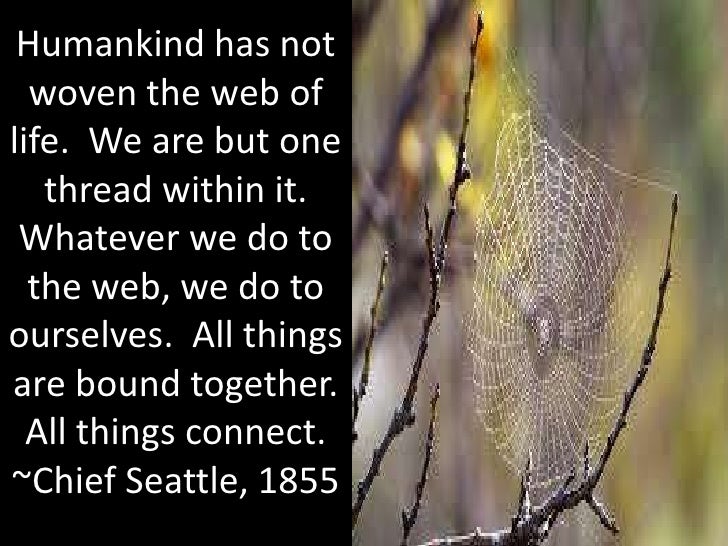
  • Imagine a multidimensional spider's web in the early morning covered with dew drops. And every dew drop contains the reflection of all the other dew drops. And, in each reflected dew drop, the reflections of all the other dew drops in that reflection. And so ad infinitum. That is the Buddhist conception of the universe in an image. Alan Watts [LoC 485] (1915-1973) British philosopher, writer, speaker, on the Indra's net


  • We must all learn to live together as brothers or we will all perish together as fools. We are tied together in the single garment of destiny, caught in an inescapable network of mutuality. And whatever affects one directly affects all indirectly. For some strange reason I can never be what I ought to be until you are what you ought to be. And you can never be what you ought to be until I am what I ought to be. This is the way God’s universe is made; this is the way it is structured. Rev. Martin Luther King, Jr. (1929-1968) US American Baptist minister, activist, leader of the African American civil rights movement


  • Men on frontiers, whether of time or space, abandon their previous identities. Neighbourhood gives identity. Frontiers snatch it away. Herbert 'Marshall' McLuhan (1911-1980) Canadian educator, philosopher, scholar, communication theorist, professor of English literature, literary critic, rhetorician


  • [E]ach system – genetic code or I Ching – gives a microcosmic rendition of a larger principle of cochaos theory. Fortunately, these two models, ancient and modern, provide a means to observe a mathematical paradigm that is perhaps inherent in the fabric of the universe itself. Numbers create the patterns of the universe. Analogs form the networks of qualitative resonance in the timing and spacing of matter and energy, while linears develop the discrete sums that quantify units of whatever is being spaced or timed. Together – as analinear number – they give a flowing, connective quality to the universe's discrete quantities. To merge the analog with the linear in cochaos patterning provides a truly universal computation method. Katya Walter Ph.D., US American multi-disciplinary scientist, physicist, I Ching scholar, Jungian scholar, A New (and very Old) Model for Nonlinear Computation, presented at Sixth International Conference on Human-Computer Interaction, Tokyo, July 1995


  • To balance and harmonize the analog and linear functions of number is the special gift of analinear computation. It is evident in the ancient I Ching and in modern DNA. By combining unitized counting with flowing proportions, this paradigm creates nonlinear equations, or more appropriately, analinear equations. Katya Walter Ph.D., US American multi-disciplinary scientist, physicist, I Ching scholar, Jungian scholar, A New (and very Old) Model for Nonlinear Computation, presented at Sixth International Conference on Human-Computer Interaction, Tokyo, July 1995


  • [There is] strong evidence that we are different than we've been told. We really are not separate. This is why people respond to tragedies like Haiti. When we see the Haitian children, whom we've never met, we intuit and know in our hearts that they are family, that they are our brothers and sisters. It's natural that we want to reach out. We participate in a society that disconnects us from that. It says, 'okay, that was fine. Now, you have to get back to the 'real world.' This idea of a 'real world' isn't the real world. Audio interview with Tom Shadyac, US American Hollywood film director, multimillionaire, truth seeker, neardeather (2007) changed to the path of simplicity, producer of the documentary I am, CHANGING OUR STORY TO SAVE THE WORLD, presented by Radio New Dimensions, host Justine Willis, 1 hour duration, 5. March 2011


  • [...] for many of our white brothers, as evidenced by their presence here today, have come to realize that their destiny is tied up with our destiny. And they have come to realize that their freedom is inextricably bound to our freedom. Rev. Martin Luther King, Jr. (1929-1968) US American clergyman, activist, leader in the African American civil rights movement, I have a dream, 28. August 1963


  • Moreover, I am cognizant of the interrelatedness of all communities and states. I cannot sit idly by in Atlanta and not be concerned about what happens in Birmingham. Injustice anywhere is a threat to justice everywhere. We are caught in an inescapable network of mutuality, tied in a single garment of destiny. Whatever affects one directly, affects all indirectly. Never again can we afford to live with the narrow, provincial "outside agitator" idea. Anyone who lives inside the United States can never be considered an outsider anywhere within its bounds. Rev. Martin Luther King, Jr. (1929-1968) US American clergyman, activist, leader in the African American civil rights movement, Letter from Birmingham Jail, 16. April 1963


  • Still, while there is no such requirement, this much should be said: long-term relationships do hold remarkable opportunities for mutual growth, mutual expression, and mutual fulfillment – and that has its own reward. Neale Donald Walsch [LoC 450] US American spiritual teacher, Conversations with God trilogy, Book 1, S. 138


  • Humanity is now going through its final examination as to whether it can qualify for its Universal function and thereby qualify for continuance on board the planet. Whether humanity will pass its final exams for such a future IS DEPENDENT ON YOU AND ME. Buckminster Fuller [LoC 445] (1895-1983) US American architect, constructor, designer, philosopher, author


  • The individual mind is immanent but not only in the body. It is immanent also in the pathways and messages outside the body; and there is a larger Mind of which the individual mind is only a sub-system. This larger Mind is comparable to God and is perhaps what some people mean by “God,” but it is still immanent in the total interconnected social system and planetary ecology. Gregory Bateson (1904-1980) British America anthropologist, biologist, social scientist, linguist, visual anthropologist, semiotician, cyberneticist, philosopher, concerned with the concept of information flow in nature, Steps to an Ecology of Mind. Collected Essays in Anthropology, Psychiatry, Evolution and Epistemology , Chandler Press, San Francisco, pg. 467, 1972, University of Chicago Press, 23. May 2000


  • [T]he new physics presents prima facie evidence that our human thoughts are linked to nature by nonlocal connections: what a person chooses to do in one region seems immediately to effect what is true elsewhere in the universe. This nonlocal aspect can be understood by conceiving the universe to be not a collection of tiny bits of matter, but rather a growing compendium of ‘bits of information’. […] And, I believe that most quantum physicists will also agree that our conscious thoughts ought eventually to be understood within science and that when properly understood, our thoughts will be seen to DO something: they will be efficacious.” [emphasis in original] Article by Henry P. Stapp, US American quantum physicist, Harnessing science and Religion. Implications of the new scientific conception of human beings, Research News, 1(6): 8. February 2001


  • Independent thinking alone is not suited to interdependent reality. Independent people who do not have the maturity to think and act interdependently may be good individual producers, but they won't be good leaders or team players. They're not coming from the paradigm of interdependence necessary to succeed in marriage, family, or organizational reality. Stephen R. Covey (*1932) US American leading management consultant, best-selling author, Principle Centered Leadership, Stephen Covey, Wikipedia entry, Free Press, 1. October 1992


  • The research I and others in many different fields have been doing, to me, suggests we are rapidly approaching a world where we recognize a measure of Interdependence that was never acknowledged before. That you have the power not only to change your life but to change the world. Conclusion, of audio interview with Stephan A. Schwartz, Ph.D., US American futurologist, Applied Parapsychology, presented by Virtual U Wisdom Network Radio, host Dr. Jeffrey Mishlove, aired 24. May 1999


  • We are all linked in a vast network of life, from the smallest cell to the highest and most powerful person. We are all not only linked but interdependent. That the well being of the one affects the wellbeing of the many, and that as we seek to that which is life affirming, we evoke the best that is within us. Interview with Stephan A. Schwartz, Ph.D., US American futurologist, Nonlocal Awareness and Visions of the Future, presented by Health World Online, Daniel Redwood D.C., page 16 (last page), 2005


  • The great challenge facing humanity today is to overcome the ethos of selfishness and "me-firstism" (or in the case of nation states, "we-firstism"). Once we recognize that we are all interdependent, we will be able to work as one united human race to undo the 150 years' worth of damage we and our ancestors have perpetrated on the life-support system of the planet. To many of us, this may sound like some Utopian fantasy, but to survive on this planet, we must change the way we think. We need to do everything we can to build a new ethos of love, recognition of our mutual interdependence, and a whole new attitude toward the universe based on awe, wonder, and radical amazement at the grandeur of creation to replace our utilitarian materialistic world view toward nature and each other. Every specific political decision needs to be made within the context of whether it advances or impedes this urgent survival necessity. Michael Lerner (*1943) US American rabby, visionary political activist, editor of Tikkun, progressive Jewish interfaith magazine, author


  • Each [...] part lives only by participating in and eventually giving itself up to the whole. [...] the 'self' or identity which is given up, however, is only the claim on the part of a fragment to be the whole, a truth claiming to be truer than it is. Georg Wilhelm Friedrich Hegel [LoC 425] (1770-1831) German philosopher of the German idealism, author


  • All the religions and all the peoples of the world are undergoing the most radical, far-reaching, and challenging transformation in history. The stakes are high: the very survival of life on our planet; either chaos and destruction, or creative transformation and the birth of a new consciousness. Forces, which have been at work for centuries, have in our day reached a crescendo that has the power to draw the human race into a global network. Ewert Cousins (1927-2009) US American Fordham professor of theology emeritus


  • Once the realization is accepted that even between the closest human beings infinite distances continue, a wonderful living side by side can grow, if they succeed in loving the distance between them which makes it possible for each to see the other whole against the sky. Rainer Maria Rilke (1875-1926) Bohemian-Austrian poet


  • The great gift of human beings is that we have the power of empathy, we can all sense a mysterious connection to each other. Interview with Meryl Streep (*1949) US American actress, Cosmo, host Michael Segell, May 1991


  • Hence, international co-operation and solidarity and the relentless search for consensus become an absolute imperative. They are the only possible alternative for all nations, whose interdependence is being made increasingly manifest by the rapid development of production technology, of transport and communications, as well as by the overhanging threat of deterioration of the environment and exhaustion of natural resources. And what is one to say of the frightful accumulation of means of destruction in a world facing the no less frightful problems of hunger, disease and ignorance? Federico Mayor Zaragoza (*1934) Spanish scholar, politician, address to the Symposium 80 on International Cultural Relations. Bridges Across Frontiers, Bonn, 27. May 1980


  • When we try to pick out anything by itself, we find it hitched to everything else in the Universe. John Muir (1838-1914) Scottish-born US American naturalist, author, early advocate of preservation of wilderness in USA, My First Summer in the Sierra, chapter 7, Houghton Mifflin Harcourt, 1911


  • We are not similar [...] or alike [...] we are each other. Eva Athena


  • Given our interdependence, any world order that elevates one nation or group of people over another will inevitably fail. So whatever we think of the past, we must not be prisoners of it. Our problems must be dealt with through partnership; progress must be shared. [Applause] Historic address to the Muslim world by Barack Obama, 44th US president, Remarks by the President on a New Beginning, Cairo University, Egypt, presented by Whitehouse.gov, Thursday, 4. June 2009


  • There is sometimes a sense that old ways of thinking must prevail; a conception of power that is rooted in the past rather than in the future. [...] In 2009, a great power does not show strength by dominating or demonizing other countries. [...] As I said in Cairo, given our interdependence, any world order that tries to elevate one nation or one group of people over an other will inevitably fail. The pursuit of power is no longer a zero-sum game – progress must be shared. Historic address to the Muslim world by Barack Obama, 44th US president, trip to Russia, July 2009

Zitate (engl.) von David R. Hawkins

  • In this interconnected universe, every improvement we make in our private world improves the world at large for everyone. We all float on the collective level of consciousness of mankind, so that any increment we add comes back to us. We all add to our common buoyancy by our efforts to benefit life. It is a scientific fact that what is good for you is good for me. Dr. David R. Hawkins, Power versus Force, S. ?


No Man is an Island

  • All mankind is of one author, and is one volume; when one man dies, one chapter is not torn out of the book, but translated into a better language; and every chapter must be so translated. [...]
    As therefore the bell that rings to a sermon, calls not upon the preacher only, but upon the congregation to come: so this bell calls us all: but how much more me, who am brought so near the door by this sickness. [...]
    No man is an island, entire of itself, entire of itself; every man is a piece of the continent, a part of the main. [...] any man's death diminishes me, because I am involved in mankind; and therefore never send to know for whom the bell tolls; it tolls for thee. John Donne (1572-1631) English metaphysical poet, satirist, lawyer, priest, poem Meditation XVII, famous line No man is an island, 1623

Englische Texte – English section on interdepence

X


Links zum Thema Interdepenz / Interdependence and Mutuality

Literatur

Literatur (engl.)

Externe Weblinks


Externe Weblinks (engl.)


Audio- und Videolinks

  • Videointerview mit Dieter Broers, deutscher Biophysiker, Erfolgsautor, zum Thema Über die Verbundenheit allen Seins, präsentiert von Internet-TV-Sender Mystica TV, YouTube Film, 33:09 Minuten Dauer, eingestellt 8. January 2011
    Themen: Gravitationskraft, 12-Dimensionen-Theorie Burkhard Heim, deutscher Physiker, „Hyperraum", Interdependenz, „Weltformel"


Audio- und Videolinks (engl.)

Interne Links

Englisch

Hawkins


1 Peter Sheridan Dodds, Roby Muhamad und Duncan J. Watts, "An Experimental Study of Search in Global Social Networks", veröffentlicht in Wissenschaftsmagazin Science, Band 301, S. 827-28, Ausgabe 8. August 2003