
Wiki / Politik
Inhaltsverzeichnis: (verbergen)
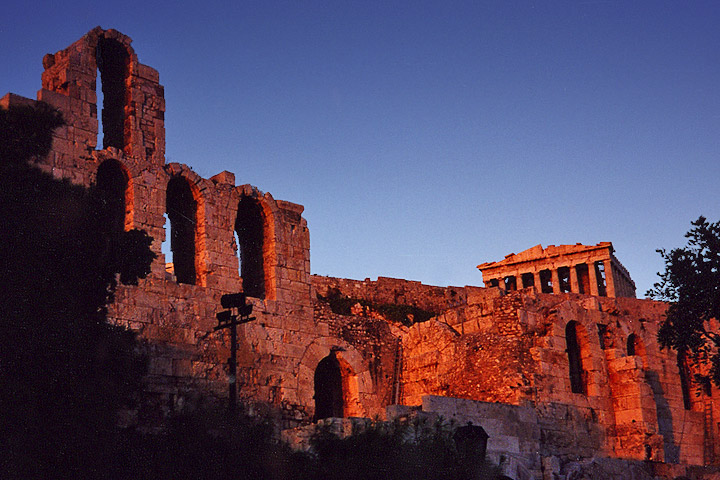 Akropolis im Sonnenuntergang |
|
Die Naivität, mit der manche Menschen in diesem Lande Politik machen, wird nur noch übertroffen von der Naivität, mit der manche dann darüber schreiben. |
Die DNS von Säugetieren ist auf Demokratie ausgerichtet, ihr Entscheidungszentrum im Gehirn ist demokratisch.
Alphahirsche entscheiden nicht für die Herde, sie haben lediglich die Wahl hinsichtlich ihrer sexuellen Vorliebe.

Die Biologen Dr. Timothy J. Roper und Dr. Larissa Conradt von der Universität Sussex in Cornwall, England, führten eine Studie über die Entscheidungsfindung in Tierherden durch.
Demokratische einfache Mehrheitsentscheidung von 51%
Demokratische Zwei-Drittel-Mehrheitsentscheidung
von 66% bei Gefahr
Diese demokratischen Wahlmuster sind im gesamten biologischen Spektrum anzutreffen, von Insekten bis hin zu den Orangutans. Alle Herdenmitglieder entscheiden anhand der von ihnen geäußerten Verhaltensanzeichen.
| Quellen (engl.): ► Dr. Timothy J. Roper, britischer Biologe, Dr. Larissa Conradt, britische Biologin, Consensus decision making in animals [Gruppenabgestimmte Entscheidungsfindung bei Tieren], Fachbereich für Biologie und Umweltwissenschaften, Universität von Sussex, Brighton, United Kingdom, präsentiert von The Human Condition und der medizinischen Datensammlung ScienceDirect, Band 20, 8. August 2005 ► Dr. Larissa Conradt, britische Biologin, Christian List, Group decisions in humans and animals: a survey, Fachbereich für Biologie und Umweltwissenschaften, Universität von Sussex, Brighton, United Kingdom, präsentiert von der wissenschaftlichen Fachzeitschrift herausgegeben von der britischen Royal Society Philosophical Transactions of the Royal Society, 12. Dezember 2008, 27. März 2009 |
| Source: ► Dr. Timothy J. Roper, British biologist, Dr. Larissa Conradt, Britih biologist, department of biology and environmental science, University of Sussex, Brighton, United Kingdom, Democracy in animals: the evolution of shared group decisions, presented by the Proceedings of the Royal Society B, 274(1623), S. 2317-2326, published online 20. July 2007, 22. September 2007 |
| Siehe auch: ► Kollektive Weisheit und ► Tiere |
| See also: ► Democratic group decision-making in herd animals |
Die so genannte Strohmeier-Studie (Mitgliederbefragung) des Bundeswehrverbandes bezüglich der Berufszufried-
enheit unter der Leitung des Politikwissenschaftlers Gerd Strohmeier an der Universität Passau erbrachte, dass viele
deutsche Soldaten unzufrieden mit ihrem "Beruf" sind.
Die einzige Frage zur realen Kriegssituation galt der Betreuung von Soldatinnen/Soldaten mit posttraumatischen Belastungsstörungen.
Der verwendete Fragebogen enthält keine Fragen
| Quelle: ► Gelöschte Strohmeier-Studie des Bundeswehrverbandes (10. Dezember 2006-28. Februar 2007) 73,8 Prozent der Berufs- soldaten finden ihren "Beruf" nicht empfehlenswert, präsentiert von der NGO-online Internet-Zeitung für Deutschland, 26. April 2007 |
Persönliche Bekenntnisse
1943 wurde Sophie Scholl zusammen mit ihrem Bruder Hans beim Austeilen von Flugblättern in der Münchener Universität verhaftet. Vier Tage später wurden beide wegen "Hochverrat" und "Wehrkraftzersetzung" mittels einer Guillotine enthauptet.

Appelle an mündige Bürger
1995 stellte der Europäische Gerichtshof für Menschenrechte in Straßburg fest, dass die mit dem Radikalenerlass verbundene Einstellungspraxis deutscher Behörden mit der Europäische Menschenrechtskonvention unvereinbar ist.
Versprochen, gebrochen
Zukunftsaussicht
Schlussfolgerungen
|
Seit 1976 bestimmt die deutsche Pharmalobby, welche Gesetze in der BRD zustandekommen oder nicht.
Siehe dazu: Hausarbeit von M. A. Alexander Gajewski, Der Lobbyismus der Pharmaindustrie in Deutschland, 20 Seiten, Note: 1,3, 2009
| ||||||||||||||||||||||||||||||||||||||||||
|
Ungeachtet der Wahlen werden große Entscheidungen von Plutokraten getroffen und der Bürger bleibt ungehört.
USA / NATO (1 Milliarde) ⇔ BRICS-Staaten (3,5 Milliarden)
|
Literaturzitate
Satire
Mausfelds Fazit
Der Bielefelder Soziologe Prof Wilhelm Heitmeyer (*1945) hat diese Entwicklung hin zur 'rohen Bürgerlichkeit' untersucht.
| Urheber: Prof. Rainer Mausfeld (*1949) deutscher Professor für Allgemeine Psychologie, Kognitionsforscher, Hochschullehrer, Autor ► Videointerview Rainer Mausfeld: Gibt es Hoffnung für die Lämmer?, Teil 1, präsentiert von dem online Fernsehsender Weltnetz TV, Gastgeber Pascal Luig, YouTube Film, 51:54 Minuten Dauer, gefilmt 4. Juni 2019, eingestellt 12. Juni 2019 ► Literatur Warum schweigen die Lämmer? Wie Elitendemokratie und Neoliberalismus unsere Gesellschaft und unsere Lebensgrundlagen zerstören, Westend, Frankfurt am Main, 2015, 3. Auflage 2018, 1. erweiterte Studienausgabe 4. Juni 2019 |
Personal avowals
On March 2, 1861, the Corwin Amendment that gave constitutional protection to slavery passed overwhelmingly.
⚡ Harry S. Truman (1884-1972) was the 33rd US president during World War II, a 33rd degree Freemason, and a war criminial
Nonsensical statement
Rare disclosure
Recommendation

Appeals
Conclusions
Alarm
Sent for reprint to Huffington Post, Rolling Stone, The New Yorker, Harper's Magazine and The Atlantic, this article got rejected by all these press organs.
Future prospect from 1920
Prophetic prospect from 1924

Roosevelt mused on "the right kind of a civilization".
Burke immediately opposed the French Revolution, warning his countrymen against the dangerous abstractions of the French.
|
Dignitarian politics: Rankism defeated, exemplified by Don Imus' fall


|
|
Literary quotes

| |||||||||||||||||||||||||||
| Inspired by source: ► Audio interview with Father Charles L. Moore (1927-2007) US American Roman Catholic priest, theologian, philosopher, scholar, historian, district attorney, spiritual teacher, modern mystic, Benefits of governance by the grand-mother council, presented by the US American web radio station KKUP, program Vibrational Voyage, host Anthony J. McGettigan, ~50:43 minutes duration, recorded 10. December 2002, reposted 23. March 2010 |
| Further presentations featuring Father Charles L. Moore (1927-2007) US American Roman Catholic priest, theologian, philosopher, scholar, historian, district attorney, spiritual teacher, modern mystic ► Audio presentation MP3, part 2 of 2, March 2003, presented by the US American web radio station KKUP, program Vibrational Voyage, host Anthony J. McGettigan, 56:52 minutes duration, posted 1. March 2011 ► Video statement Grandmother Councils, Womens Circles, Hiawatha, a New form of Government, YouTube film, 3:43 minutes duration, posted 24. April 2013 Both legendary Native American leaders Hiawatha and Great Peacemaker [Deganaweda] taught that the human race was one great family. |
| Other references: ► Peter Gold, US American professor of anthropology, non-profit institution of higher education California Institute of Integral Studies (CIIS), research associate at the "Laboratory of Anthropology", Museum of New Mexico, director of the Ancient Ways Project, tibetologist, practitioner of Tibet's Buddhist philosophy and musical traditions, author of four books on Tibetan culture, Two-Hearted Nation, presented by the blogspot "Humane Being", 14. February 2007 ► Book Timothy Gloege, Ph.D., US American historian, author on (American) history, class, history of religion, fundamentalism, evangelicalism, Guaranteed Pure. The Moody Bible Institute, Business, and the Making of Modern Evangelicalism, University of North Carolina Press, 27. April 2015 ► Article How a Pioneer of Branding Invented Christian Fundamentalism, presented by the publication Religion Dispatches, Daniel Silliman, 6. May 2015 Philanthropist Henry Parsons Crowell (1855-1944), the founder of the "pure" branded product Quaker Oats, was one of the key players within the Moody Bible Institute (MBI). Using modern marketing he also sold "pure" fundamentalist Christianity. |
|
Hierarchical positioning Jesus, pope, cardinal, bishop, priest, churchgoer
|
|
Obedience versus allegiance
|
|
Popes as representatives of the imperialistic Roman greed system
|
|
Praying with Deva/Earth – Unanimous voice of Polynesian Kahuna women – 5000 years ago
|
|
Soulsickening schism within the Disunited States of America
|
|
|
|

In view of the prospective US presidents Obama or Romney
Love as the bottom line
Government representing we the people by the people for the people
Claiming the audacity of hope, activism and wielding power
| Reference: ► Article Marianne Williamson Breeds a New Generation of Sister Giants, presented by the US American business magazine Forbes, Emily Bennington, 6. November 2012 |

Supposedly the winner of the financial gambling game in Europe, Iceland (~300,000 inhabitants) faced bancruptcy as a result of the long-lasting international banking crisis in September 2008. Iceland's three largest private banks failed. Their market lost 90% of its value. The financial fall was the result of only male leaders tempted by baits offered to them by economic hitmen working on behalf of the international financial elite. Since the 2008 crash Big Media kept ignoring the phenome-
nal Icelandic revolution.
| Reference: ► en.Wikipedia entry 2009 Icelandic financial crisis protests [Kitchenware Revolution] |
| |||||||||||||||||||||||
| |||||||||||||||||||||||||||
| Written references ► Deleted article Iceland's amazing success taking back their country from the international banker gangs controlling the world, presented by the dissolved website voicesweb.org, Bill, 17. July 2012 ► Article Human rights and equality. Gender equality, Centre for Gender Equality Iceland, updated January 2012 ► Bjarni S. Jonsson, management consultant, expert on large-scale systemic change Nordic consulting firm Capacent with about 500 specialists in Denmark, Iceland, Sweden and Finland, Notes from the Field Iceland National Assembly. A Short History from a Personal Perspective, presented by the Integral Leadership Review, Volume X, No. 1, January 2010 ► Article Why Did The Media Keep The Recent Peaceful Icelandic Revolution Quiet?, presented by the online publication Collective Evolution, Joe Martino, 11. January 2013 ► Article Still fighting: Iceland sentences 26 bankers to a combined 74 years in prison, presented by the decentralized direct action group's website US Uncut, James Wood, reissued by the online publication Sott.net, 22. October 2015 ► Article Breaking: Iceland Passes Law Requiring Equal Pay For Men And Women, True Activist, Amanda Froelich, 10. March 2017 ► Article It's Now Illegal to Pay Men More Than Women in Iceland, presented by the multinational US American business magazine Fortune, Sarah Gray, 2. January 2018 ► Article Iceland to Ban Infant Circumcision, Introduces 6-year Jail Term for Offenders, presented by the publication Saving Sons, 11. February 2018 |
| Audio and video sources ► Video interview with Hordur Torfason (*1945) Icelandic persecuted non grata human rights and democracy activist, leader of the Iceland political revolution, homosexual actor, singer, songwriter, poet, Iceland's Revolution Leader Hordur Torfason, presented by People's Congress, hosts John Mulkins and Kelly Gerling, 59:29 minutes duration, aired 3. June 2012 Following a bank holiday on October 6, 2008 Torfason began to initiate a peaceful, weekly-persistant, legal, simple revolution in Iceland (2008-2012). He asked two questions, "What has happened to our country?", and "What are we going to do about it?" People subsequently agreed upon pressing three claims 1) the government to step down; 2) the board of the national bank to step down; 3) the board of the financial supervisory authority to step down. Five months later during 2009: 1) The government, the national bankers and their supervisors resigned. 2) Private Icelandic bankers were prosecuted and jailed. 3) A new constitution was written by the people. 4) First the Icelandic banks were nationalized, then privatized again. 5) Since 2009 Icelandic people kept integrating the shocking news about the depth of the corrupted debt-money system. |
| Written references ► Video interview with Hordur Torfason (*1945) Icelandic persecuted non grata human rights and democracy activist, leader of the Iceland political revolution, homosexual actor, singer, songwriter, poet, Iceland's Peaceful Revolution, interoccupy.net, host Mark Taylor-Canfie, US American journalist, 1. August 2012, YouTube film, 34:57 minutes duration, posted 2. February 2013 ► Video TV interview with Iceland's president Ólafur Ragnar Grímsson, Iceland's Unconventional Comeback – LASST DIE BANKEN PLEITE GEHEN!, Davos-Kloster, January 2013, presented by the US American basic cable and satellite news television channel ⚡ Fox News, program After the Bell, YouTube film, 5:49 minutes duration, posted 10. February 2013 |
| Removed reference video: ► Cutting Loose: Hungary pays off IMF debt, may eye EU exit, presented by the first Russian 24/7 English-language news channel Russia Today News (RT), news channel, YouTube film, 3:11 minutes duration, posted 18. August 2013 |
| See also: ► Women |
| Referenzen (Print, Audio und Videomedien): ► Radiobeitrag zu Islands Verfassungs-Experiment Das Verfassungsreferendum in Island Modell für mehr Bürgernähe in Europa?, präsentiert von der deutschen Hörfunkanstalt Deutschlandradio, Hörprogramm Deutschlandfunk (DLF), Moderator Maximilian Steinbeis, Sendetermin 21. Oktober 2012 ► Video Dokumentation Islands eindrucksvoller Weg aus der Schuldenkrise, präsentiert von dem deutschen öffentlich-rechtlichen Fernsehsender ARD, Wirtschaftsmagazin Plusminus, 22. August 2012, YouTube Film, Minute 6:12, 6:40 Minuten Dauer, eingestellt 3. September 2012 ♦ Entscheidung für den steinigen sozialen Weg der Volksentscheidung gegen die geplante Bankenrettung: "Island hat sich dafür entschieden, den demokratischen Weg zu gehen. Und ich glaube, das ist auch ein Grund dafür, warum sich unsere Wirtschaft so viel besser und schneller erholt hat als jede andere Volkswirtschaft in Europa." Ólafur Ragnar Grímsson (*1943) isländischer Politiker, fünfter isländischer Staatspräsident ♦ "In unserem Fall haben wir uns dafür entschieden, die [drei] Banken [Islands] pleite gehen zu lassen. Es sind private Banken, und wie ich schon sagte, habe ich nie verstanden, aus welchem Grund Banken als die heiligen Kirchen der modernen Wirtschaft angesehen werden. […] Wir haben entgegen den orthodoxen Sichtweisen der Finanzwelt gehandelt, die in den Vereinigten Staaten und Europa vorherrschen. Und nun, vier Jahre später, erholt sich Island in bemerkenswerter Weise." Interview mit Ólafur Ragnar Grímsson (*1943) isländischer Politiker, fünfter isländischer Staatspräsident, Weltwirtschaftsforum (WEF), Davos-Klosters, präsentiert von dem US-amerikanischen Kabel- und Satellit-Nachrichtensender ⚡Fox News Channel, Programm After the Bell, 26. Januar 2012 |
| Referenzen (Print, Audio und Videomedien): ► Artikel Island setzt korrupte Regierung ab und verhaftet alle Rockefeller und Rothschild Bankster, präsentiert von der Plattform, Pravda-TV.com, 17. Juli 2012 ► Artikel Von den Lügenmedien totgeschwiegen: Island setzte korrupte Regierung ab, präsentiert von dem Wordpress Blogspot News Top-Aktuell, 29. Mai 2015 ► Gelöschter Artikel Island verabschiedet das erste Gesetz der Welt, das gleiche Bezahlung für Männer und Frauen festlegt, präsentiert von PIQD, Daniel Schreiber, 30. März 2017 |
| Siehe auch: ► Globaler Index zur Geschlechterkluft – Ländervergleich 2009-2012 and ► Frauen |
Links zum Thema Integrale Politik – Exopolitik / Integral politics – ExopoliticsLiteratur
Das Ende des Sozialstaats
Entwicklungstendenzen des hegemonialen atlantischen Kapitalismus – mit Essays von 17 Autoren: Jörg Becker, Daniele Ganser, Bernd Hamm, Hansgeorg Hermann, Hannes Hofbauer, Jochen Krautz, Mike Lofgren, Rainer Mausfeld, Ullrich Mies, Jens Wernicke, Hermann Ploppa, Jürgen Rose, Werner Rügemer, Rainer Rupp, Andreas Wehr, Wolf Wetzel, Ernst Wolff
Analyse der aktuellen politischen und kulturellen Situation Deutschlands
Warnruf hinsichtlich der Architektur der Unterdrückung: Über 500 Quellen belegen das Corona-System Merkel, die Zerstörung der Demokratie,
Hörfunkinterview Wie man Hass zu Geld macht, präsentiert von dem öffentlich-rechtlichen, werbefreien Rundfunksender Deutschlandfunk (DLF), Programm Deutschlandradio Kultur, Moderatorin Simone Miller, 38:48 Minuten Dauer, Sendetermin 14. März 2021
Literature (engl.)
The United States and Torture: Interrogation, Incarceration, and Abuse; Rules of Disengagement: The Politics and Honor of Military Dissent; Cameras in the Courtroom: Television and the Pursuit of Justice
Political orientations (left-right voting) arise from three clusters of measurable personality traits i.e. opposing attitudes toward (1) tribalism: ethnocentricity ⇔ ethnophilia, (2) human nature: competitiveness ⇔ cooperation, (fundamentalist) religiosity vs. secularism, (3) tolerance of inequality: rankism, sexism, racism, classism.
Externe Weblinks
Seit Mitte der 90er Jahre polarisieren und befeinden sich amerikanischen Demokraten und Republikaner immer stärker.
Linklose Artikel
Weblinks zum Thema Politik – QuoraBeiträge verfasst von Elfriede Ammann, präsentiert auf der kalifornischen Frage-und-Antwort Webseite Quora DE
External web links (engl.)
Impromptu speech about the divide between rich and poor in America
Sent for reprint to Huffington Post, Rolling Stone, New Yorker, Harpers and Atlantic, this article got rejected by all.
Audio- und Videolinks
Dynamik der Medien und des Internets und ihre Auswirkungen auf Gesellschaften
Ursünde der westlich-imperialistischen Politik: Inszenierter Putsch gegen die demokratisch gewählte Regierung von Mohammad Mossadeg (1880/2-1967) im Iran, der 1951 Irans Erdölindustrie verstaatlicht hatte und 1953 zusammen von dem CIA (USA) und dem MI6 (GB) entmachtet wurde
Die deutschen Journalisten treiben die Politik vor sich her. Die von ihnen betriebene Hysteriemaschine dreht Trump, Merkel und Schulz durch
Der Begriff "Deep State" oder "Dualer Staat" wirkt (ver)störend. Pohlmanns Bericht bietet eine staatsrechtliche Analyse und zeigt auf, wann, wo
Dokumentationen
Audio and video links (engl.)
Marrs is the author of Rule By Secrecy. The Hidden History that Connects the Trilateral Commision, the Freemasons and the Great Pyramids, Harper Collins, 2000, The Terror Conspiracy. Deception, 9/11 and the Loss of Liberty, The Disinformation Company, 2006, The Rise of the Fourth Reich. The Secret Societies That Threaten to Take Over America, William Morrow, 2008. He exposed a likely conspirative complicity
Ghonim began a Facebook page that galvanized protest in Egypt's democratic revolution January-February 2011
➤ United States is the US Empire. Linkless media offerings
Uncovering the century-old dominance of religion and governments applying control-by-fear tactics
|
Englisch Wiki
Hawkins
1 Abschiedsrede von US Präsident Dwight D. Eisenhower, 1961, Präsident Eisenhower über den militärisch industriellen Komplex, YouTube Film, 0:45 Minuten Dauer, eingestellt 10. Februar 2009 ⇑
2 Donald Trump's Craziest Quotes, presented by liveabout ⇑
3 "We are a republican government. Real liberty is never found in the despotism or the extremes of democracy." Alexander Hamilton [US 'Founding Father'] (1755-1804) US American, soldier, economist, political philosopher, constitutional lawyer, first United States secretary of the treasury ⇑
4 Video TV presentation by Catherine Crier (*1954) US American Emmy, du-Pont-Columbia, and Gracie Allen Award-winning journalist, CNN newscast co-anchor, youngest state judge to ever be elected in Texas, author, BookTV: Catherine Crier, "Patriot Acts", presented by the Book TV, US American cable television network C-SPAN, recorded in Women's National Republican Club, New York City, 9. November 2011, YouTube film, 10:05 minutes duration, posted 19. December 2011 ⇑
5 Note criticism: Criticism of the Pledge of Allegiance ⇑
6 Quotes on indebtedness (original sin) – Joseph P. Farrell ⇑
7 Reference to: The nation shall have a new birth of freedom, and the government of the people by the people for the people shall not perish from the earth. Abraham Lincoln (1809-1865) assassinated 16th US President (1861-1865), Gettysburg Address, 19. November 1863 ⇑
8 Incarceration is not an equal opportunity punishment, presented by prisonpolicy.org, Peter Wagner, updated 28. August 2012 ⇑
9 Großbritannien und die Niederlande verklagten Island vor dem EFTA-Gerichtshof in Luxemburg, der Island am 28. Januar 2013 von allen Anklagepunkten freigesprochen hat. London und Den Haag müssen die geliehenen Gelder abschreiben. Artikel Reykjavíks Sturheit zahlt sich aus, präsentiert von der überregionalen deutschen Zeitung Die Tageszeitung (taz), 28. Januar 2013 ⇑
10 Icesave dispute ⇑
11 Article Iceland’s new PM is a 41-year-old anti-war feminist and environmentalist, presented by Metro, Joe Roberts, 2. December 2017 ⇑