
Wiki / Respekt
Inhaltsverzeichnis: (verbergen)
 |
|
Ehrlich und herzlich den gelten lassen, der |
|
Das Wort Respekt kommt aus dem Lateinischen. respectus bedeutet Zurückschauen, Rücksicht, Berücksichtigung. |
|
Eine Gruppe von Mönchen lebte mit ihrem Meister in einem tibetischen Kloster. Sie führten ein diszipliniertes und engagiertes Leben in einer klösterlichen Atmosphäre, in der sie harmonisch und friedlich zusammenlebten. Die Menschen aus Dörfern in der nahen und fernen Umgebung besuchten gern das Kloster, um sich in der Wärme dieser liebevollen spirituellen Ausstrah-
Eines Tages verließ der Meister seine irdische Gestalt. Anfangs behielten die Mönche ihren gewohnten Tagesablauf bei, so wie sie es bisher getan hatten, doch nach einiger Zeit wurden die Disziplin und die Hingabe schwächer. Die Zahl der tägli-
Bald stritten die Mönche untereinander, einige zeigten mit dem Finger auf andere, andere fühlten sich von Schuldgefühlen geplagt.
Schließlich konnte der älteste Mönch die feindselige Stimmung innerhalb der Klostermauern nicht mehr ertragen. Als ihm zu Ohren kam, dass ein spiritueller Meister nur zwei Tagesreisen entfernt als Einsiedler lebte, machte sich der Mönch sogleich auf, ihn aufzusuchen. Als er den Meister in seiner Waldkapelle antraf, erzählte ihm der Mönch von dem misslichen Zustand,
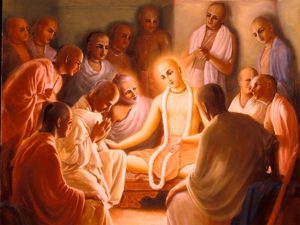 Lehrer mit Gloriole unter Schülern Der Meister lächelte. "Es gibt einen unter euch, der die Verkörperung Gottes ist. Da die Menschen um ihn herum ihn nicht respek- tieren, wird er sich nicht offenbaren, und deshalb wird das Kloster zerrüttet bleiben." Nach dieser Erklärung schwieg der Meister und fügte nichts mehr hinzu.
Auf dem Heimweg zurück ins Kloster fragte sich der Abt, wer von seinen Brüdern der Mensch gewordene Gott sein könne.
"Vielleicht ist es Bruder Jaspar, der für uns alle kocht."
sagte der Mönch laut. Schon eine Sekunde später dachte er, "Nein, Bruder Jaspar kann es nicht sein. Er ist unordentlich und schlecht gelaunt, und das Essen, das er zubereitet, schmeckt nicht."
"Vielleicht ist unser Gärtner, Bruder Timor, der Richtige."
vermutete er als nächstes, um auch diesen Gedanken alsbald wieder zu verwerfen. "Natürlich ist er es nicht. Gott ist nicht so faul wie Bruder Timor. Bei Gott gäbe es kein vom Unkraut überwuchertes Salatbeet wie bei uns im Klostergarten."
Nachdem er jeden einzelnen seiner Brüder aufgrund dieser oder jener Unzulänglichkeit verworfen hatte, erkannte der ältere Mönch schließlich, dass er keinen mehr zur Auswahl hatte. Eingedenk dessen, was der Meister ihm gesagt hatte, war er beunruhigt. Einer seiner Mönchsbrüder musste doch der Gottmensch unter ihnen sein. Und schon hatte er einen neuen Einfall. "Es könnte doch sein, dass der Heilige sich entschieden hat, sich fehlerhaft zu verhalten, um sich zu tarnen. Gewiss, so könnte es sein. Es muss sogar so sein!"
Als er das Kloster erreichte, erzählte er seinen Brüdern unverzüglich, was der Einsiedler ihm enthüllt hatte. Und alle waren ebenso erstaunt wie er, dass der Göttliche unter ihnen weilte.
Da nun jeder wusste, dass nicht er selbst der Mensch gewordene Gott war, begannen alle Mönche, ihre Mitbrüder sorgfältig zu beobachten, um feststellen zu können, wer unter ihnen der Heilige war. Und doch konnte jeder nur die Fehler und Unvoll-
Nach vielen Diskussionsrunden beschlossen die Mönche schließlich einstimmig, sich von nun an zu bemühen, freundlich und liebevoll miteinander zu verkehren und einander mit dem Respekt und der Ehrerbietung zu behandeln, die man selbstver-
Alle Mönche im Kloster waren so sehr darauf bedacht, den Gott im anderen zu sehen, dass sich ihre Herzen schon bald mit großer Liebe füreinander füllten und die vorherige Feindseligkeit von ihnen abfiel. Im Lauf der Zeit sahen sie Gott nicht nur in ihren Brüdern, sondern in jedem und allem, was ihnen begegnete. Sie verbrachten ihre Tage in freudiger Würdigung und erfreuten sich über Seine Heilige Gegenwart. Das Kloster strahlte diese Freude wie ein Leuchtfeuer aus. Kurz darauf kehrten auch die Dorfbewohner zurück. Wie zuvor strömten sie durch das Tor und wollten sich von der Liebe und Hingabe, die dort zugegen war, berühren lassen.
Einige Zeit später beschloss der Bruder Abt, dem Einsiedler einen weiteren Besuch abzustatten, um ihm dafür zu danken, dass er ihm und seinen Mitbrüdern das Geheimnis enthüllt hatte.
"Habt ihr herausgefunden, wer der Gottesmensch unter euch ist?"
fragte der Meister. "Ja, das haben wir",
erwiderte der ältere Mönch. "Wir haben erkannt, dass ER in uns allen wohnt."
Der Meister lächelte. |
| Siehe auch: ► Geschichtensammlung und ► Würde und ► Geheimnis und ► Hingabe und ► |
| See also: ► A tale on respect and dignity |

|
|
Der Mensch gleicht einem Gästehaus. Jeden Tag neue Gesichter. |
| Quelle: ► Mevlana Dschelaleddin Rumi (1207-1273) persischer islamischer Mystiker, Jurist, Theologe, Dichter des Sufismus, Gedicht Das Gästehaus, zitiert in: Turkish Talk |
Warning
Insights

|
Literary quotes
|
A group of monks were living with their master in a Tibetan monastery. Their lives were disciplined and dedicated, and the atmosphere in which they lived harmonious and peaceful. People from villages far and wide flocked to the monastery to bask in the warmth of such a loving spiritual environment.
Then one day the master departed his earthly form. At first the monks continued on as they had in the past, but after a time, the discipline and devotion slackened. The number of visitors each day began to drop, and little by little, the monastery fell into a state of disrepair.
Soon the monks were bickering among themselves, some pointing fingers of blame, others filled with guilt. The energy within the monastery walls crackled with animosity.
Finally, the senior monk could take it no longer. Hearing that a spiritual master lived as a hermit two days walk away, the monk wasted no time in seeking him out. Finding the master in his forest hermitage, the monk told him of the sad state the monaste-
The master smiled. "There is one living among you who is the incarnation of God. Because he is being disrespected by those around him, he will not show himself, and the monastery will remain in disrepair."
With those words spoken, the master fell silent and would say no more.  Composite of depictions of the incarnation of God All the way back to the monastery, the abbot wondered which of his brothers might be the Incarnated One.
"Perhaps it is Brother Jaspar who does our cooking,"
the monk said aloud. But then a second later thought, "No, it can't be him. He is sloppy and ill tempered and the food he prepares is tasteless."
"Perhaps our gardener, Brother Timor, is the one,"
he then thought. This consideration, too, was quickly followed by denial. "Of course not. God is not lazy and would never let weeds take over a lettuce patch the way Brother Timor has."
Finally, after dismissing each and every one of his brothers for this fault or that, the senior monk realized there were none left. Knowing it had to be one of the monks because the master had said it was, he worried over it a bit before a new thought dawned. "Could it be that the Holy One has chosen to display a fault in order to disguise himself? Of course it could! That must be it!"
Reaching the monastery, he immediately told his brothers what the master had said and all were just as astonished as he had been to learn the Divine was living among them.
Since each knew it was not himself who was God Incarnate, each began to study his brothers carefully, all trying to determine who among them was the Holy One. But all any of them could see were the faults and failings of the others. If God was in their midst, he was doing a fine job of hiding himself. Finding the Incarnated One among such rubble would be difficult, indeed.
After much discussion, it was finally decided that they would all make an effort to be kind and loving toward each another, treating all with the respect and honor one would naturally give to the Incarnated One. If God insisted on remaining hidden, then they had no recourse but to treat each monk as if he were the Holy One.
Each so concentrated on seeing God in the other that soon their hearts filled with such love for one another the chains of negativity that held them bound fell away. As time passed, they began seeing God not just in each other, but in every one and everything. Days were spent in joyful reverence, rejoicing in His Holy Presence. The monastery radiated this joy like a beacon and soon the villagers returned, streaming through the doors as they had before, seeking to be touched by the love and devotion present there.
It was some time later that the senior monk decided to pay the master another visit to thank him for the secret he had re-
"Did you discover the identity of the Incarnated One?"
the master asked.
"We did,"
the senior monk replied. "We found him residing in all of us."
The master smiled. |
| See also: ► Stories and ► Dignity and ► Secretand ► Devotion and ► Joy |
| Siehe auch: ► Eine Geschichte über Respekt und Würde |
In the second part, Jonathan transcends into another society
where all the gulls enjoy flying.
He is only capable of this after practicing hard alone for a long time
(described in the first part).
In this other society,
real respect emerges as a contrast of the coercive force
that was keeping the former "Breakfast Flock" together.
en.Wikipedia entry Jonathan Livingston Seagull
Links zum Thema Respekt / RespectLiteraturLiterature (engl.)
Externe Weblinks
External web links (engl.)Audio- und Videolinks
Audio and video links (engl.)
|
Englisch Wiki
Hawkins