
Wiki / Soziologie
Inhaltsverzeichnis: (verbergen)

Verbindungswege von und zwischen Menschen

|
|
1 – Einer genügt, um einen zu kennen. |
|
Der britische Wirtschaftshistoriker Richard Wilkinson (ehemals Universität Nottingham) und seine Kollegin und Partnerin, die Sozialepidemiologin Kate Pickett (Universität von York) fanden im Verlauf von jahrzehntelangen Vergleichsstudien bezogen auf 21 Industrieländer (Nordamerika, Europa, Australien, Japan) heraus: Die Wurzel einer Vielzahl von sozialen Missständen in Industrieländern liegt nicht an der Höhe des Ein- kommens, sondern an der Einkommenskluft innerhalb einer Gesellschaft und dem damit einhergehenden Bewertungs- und Würdigunggefälle.
Ab einer Einkommens- und somit Chancenverteilung''', die grundlegende Lebensbedürfnisse abdeckt – wie etwa in dem Land Kuba – ist nicht für das allgemeine Wohlbefinden und die Lebensqualität der Gesamtbevölkerung mehr die Höhe |
| Source: ► Ed Diener, Daniel Kahneman, Raksha Arora, James Harter, William Tov, Income's Differential Influence on Judgments of Life Versus Affective Well-Being, Assessing Well-Being, Social Indicators Research Series, Volume 39, 2009 |
| See also: ► Income, status and affective wellbeing – Having ♦ Doing ♦ Being and ► Dignity |
|
|
Anhand von öffentlich zugänglichen und von Fremdquellen erstellten Statistiken auf internationaler Ebene schlussfolgerte das Forscherpaar Wilkinson/Pickett, dass das rankistische Machtgefälle zwischen den 20% der ärmeren und den 20%
Je gravierender das Einkommens- und Statusgefälle zwischen den Gesellschaftsschichten in einem Staat ist, desto verschärfter treten auch dessen Problemfelder auf, hervorgerufen durch Rangstellungsmissbrauch. Je ungleicher die Gesellschaftsschichten eines Volkes beschaffen sind, desto mehr wird es durch Herrschaftsansprüche (Überlegenheit/
|
| Quelle: ► Richard Wilkinson (*1943) britischer Gesundheitswissenschaftler, emeritierter Professor für Sozialepidemiologie, Universität von Nottingham, Prof. Kate Pickett (*1965) britische Professorin für Epidemiologie, Universität York, Mitautorin, Gleichheit ist Glück. Warum gerechte Gesellschaften für alle besser sind, Tolkemitt bei Zweitausendeins, 3. Auflage Dezember 2009 |
| Siehe auch: ► Würde |
|
| ||||||||||||||||||||||||||
| ||||
| ||||||||
|
Im Jahr 1970 wertete Aaron Antonovsky (1923-1994) eine Erhebung über die Anpassungsfähigkeit von Frauen verschiedener ethnischer Gruppen an die Menopause aus. Eine Gruppe von Probandinnen war 1939 zwischen
In der aufwendigen Kauai-Längsschnittstudie analysierten die amerikanische Entwicklungspsychologin Emmy Werner (1929-2017) und ihre Kollegin Ruth Smith die Langzeitfolgen von prä- und perinatalen Risikobedingungen sowie die Auswirkungen ungünstiger Lebensumstände in der frühen Kindheit. Ihre Probanden, 698 polynesische Kinder, stammten aus einem kompletten Jahrgang. Sie wurden bei der Geburt und im Lebensalter von 1, 2, 10, 18, |
|
Zwanghaft wachstumsorientierte Krebszellen tragen nicht wie gesunde Zellen zum Gesamtwohl des Organismus bei.  Duktales Karzinom in situ
Bei erfolgender Heilung einer Krebserkrankung werden etwa zwei Drittel der nicht wandlungsfähigen entarteten Zellen als ausgefällter Eiweißstoff vom Körper verbraucht beziehungsweise ausgeschieden. |
|
Gut zwei Drittel Deutsche fliehen den Tod, während drei Fünftel der Deutschen glauben, dass es kein Weiterleben nach dem
Tod gibt.
Der Pressemitteilung zur Studie "Spiritualität in Deutschland" der Identity Foundation in Düsseldorf, April 2007, ist zu ent-
nehmen, wie Deutsche mit dem Tod umgehen. Im März 2006 wurden 1.000 Interviewpartner auch zu ihrem Verhältnis zum
Tod befragt:
|
|
| See also: ► Tod and ► Statistik |
| ||||||||||||||||||||||||||||||
| Siehe auch: ► Genderforschung |
Schlussfolgerungen
Dieser Ausspruch wurde bereits der ersten Frau von Ludwig XIV. vorgeworfen, später der französischen Königin Marie Antoinette. Er stammt nachweislich nicht von ihr.
Bangladesch gehört mit einem Bruttoinlandsprodukt pro Kopf im Jahr 2007 von ungefähr 490 US Dollar zu den ärmeren Ländern der Welt.

These: Steuern zu entrichten, ist eine versäumte Chance thymotischer Genugtuung.
Peter Kruse: Wir haben seit dem Mittelalter keine Fiskalphilosophie. [Minute 0:27:44]
Mittelalterlicher fiskalischer Lehrsatz: "Wo der Fikus [Reichsschatulle] ist, dort liegt das Reich [Befehlsvollmacht]." [Ubi fiscus ibi imperium. ]
Jesus Christus: Wo dein Schatz ist, da wird auch dein Herz sein. Matthäus 6, 21 (NT)
Lebenskraft, Gemütsanlage, das emotionale sterbliche Bedürfnis nach Anerkennung. (Thymos)
Der globale Bevölkerungsanteil der Kinder im Alter von unter 5 Jahren lag in den 1960er Jahren bei 15% und 2012 unter 7%, und er sinkt weiter. Die jährlichen Geburten erreichten Ende der 80er Jahre mit ~138 Millionen ihren Höhepunkt und blieben seitdem nahezu – konstant bei 135 Millionen (2011), und sie werden bald sinken. Der Anteil der Weltbevölkerung unter 18 Jahren betrug 27% (2012) und wird nur von Jahr zu Jahr sinken. Die Geburtenraten sinken fast überall rapide, während sich die durchschnittliche Lebensdauer jedes Jahr geringfügig verlängert. Im März 2011 überschritt die Weltbevölkerung die Rate von 7 Milliarden Menschen. Man rechnet damit, dass sie im Jahr 2025 8 Milliarden betragen wird. Im Jahr 2012 prognostizierten die Vereinten Nationen 9 Milliarden bis 2050 und 10 Milliarden bis 2100.
Die Wächter der öffentlichen Diskussion – die Vertreter der Leitmedien - wähnen nur jene Akteure im "Wahren", die sich an Orten äußern (dürfen),
die von den medialen Torhütern als legitim anerkannt sind.
|
Literaturzitate
|
| Quelle: ► Video Fernsehinterview mit Dr. Hans-Joachim Maaz (*1943) deutscher Psychiater, ärztlicher Psychoanalytiker, Autor, Das falsche Leben, präsentiert von dem Schweizer Non-Profit-Internet-Fernsehen Free Spirit-TV, Gastgeberin Aline N. Brandstetter, YouTube Film, 1:16:31 Dauer, eingestellt 14. April 2019 |
 Hans-Joachim Maaz
|
| Quelle: ► Gelöschtes Videointerview mit Dr. Hans-Joachim Maaz (*1943) deutscher Psychiater, ärztlicher Psychoanalytiker, Autor, Das falsche Leben, YouTube Film, 59:44 Minuten Dauer, eingestellt 17. Februar 2018 |
Die Hauptursache für psychische Probleme im Erwachsenenalter ist die frühkindliche Entwicklungsphase.
Social engineering steuert in die Normopathie.
|
| Siehe auch: ► Mütterlichkeits- und Väterlichkeitsstörungen – Hans-Joachim Maaz und ► Familiäre Konstellationen – Hans-Joachim Maaz |
Personal avowals
Conclusion – from things to persons
Speech delivered to the clergy and laymen concerned about the Vietnam war
Neoliberal individualized ideology
Conclusion – from democracy to inverted totalitarianism
Warning – Future outlook
Insights
Status 1948
Micheal, a 10 year old boy, had inquired in a letter as to whether Fuller was a "doer" or a "thinker".
Roosevelt mused on "the right kind of a civilization".
The global percentage of children at age <5 was 15% in the 1960s, and was under 7% in 2012, and is further declining. The total annual births peaked at ~138 million in the late 1980s and remained essentially constant since then – at 135 million (2011) , and will soon be declining. The fraction of global population <18 was 27% (2012) and will only go downward year after year. Birth rates are dropping precipitously almost everywhere, whereas the average lifespans lenghten a bit every year. In March 2011 the world population transcended the rate of 7 billion humans. It is projected to reach 8 billion by 2025. In 2012 the United Nations prognosticated 9 billion by 2050, and 10 billion by 2100.
According to the UNDP Human Development Report, ~663 million people moved above the world's absolute poverty level between 1990 and 2010. The poverty rate was halved from 43% to 21%. The World Bank estimated 1.29 billion people (~400 million people in India and 173 million people in China) were living in absolute poverty in 2008.
FAO – The State of Food Insecurity in the World – 2012
Dan Pallotta: "In the United States, poverty has been stuck at 12% for the last 40 years." 1. March 2013
Puritan constraints and double standard of US charities: Nonprofits are rewarded for frugality (little spending) – not for their accomplishments (morality).
Dan Pallotta: "In the United States, poverty has been stuck at 12% for the last 40 years." "Let's change the way we think about changing the world." 1. March 2013
Narcissism ⇔ totalitarianism

|
The universe notes and records every action and returns it in kind.
|
Suspending beliefs
Leap from self-interest to altruism at the threshold of integrity
Personal avowals
Especially males act violently when faced with disrespect, shame, or threats to their social status.

Consumerism and competitiveness
Excess growth and sustainablity of economy are social issues.

Background information: availed Poorest migrant workers (55%) are not allowed to get married or pregnant. minute 18:06
Biritish social epidemiologist Richard Wilkinson, Ph.D., Kate Pickett, Ph.D. (*1965), The Spirit Level. Why More Equal Societies Almost Always Do Better, Bloomsbury Press, 22. December 2009
Not money (bribes), nor contraceptiva, nor the one-child policy, nor force, but equality between men and women, i.e. shared human dignity allows for sustainability and stable population rates.
|
The root of many social ailments is not due to the amount of income/living standard but due to the relative income gap and the corresponding estimation gap.
It isn’t about money, it’s about the monkey brain, the pecking order […]. I sometimes say, "This is about monkeys, not Marx.” Richard Wilkinson, Ph.D. (*1943) British professor emeritus of social epidemiology, University of Nottingham2
 Homeless man, Paris, France, June 2005 Comparing the rich countries worldwide – as well as the 50 states of the United States of America among each other – Wilkinson/Pickett found that the more unequal societies are Note: The major financial crashes in 1929 and 2007/2008 happened both when inequality and indebtedness peaked.
Once the basic needs for sustaining life are met in a country The average life expectancy of Cubans is age 77, of US Americans age 78, and of Brits age 79. Rich Cubans aren't much richer than poor ones. All Cubans spend way less money on health care than Americans.
In more equal societies skilled craftsmen are not regarded as losers. The culture shifts with a considerable inequality gap. |
| |||||||||||||||||||||||||||||||||||||||||||||||||||||||||||||||||||||||||||
| Source: ► Richard Wilkinson, Ph.D. (*1943) British professor emeritus of social epidemiology, University of Nottingham, economy historian, researcher of inequality data in health and social determinants, author, How economic inequality harms societies, presented by TED Talks, YouTube film, minute 2:58, 16:55 minutes duration, filmed July 2011, posted 24. October 2011 |
| After 30 years of research British socioepidemiologists Wilkinson and Pickett found a unilateral pattern concerning (mainly) all social maladies in modern wealthy countries: The size of the income gap interrelated with psychosocial concordant dignity gradients. Correlation: the bigger a nation's income gap interrelated with its concordant dignity gradient is the bigger are its failures in regard to health, human capital, and social relations. |
[T]he US is a very individualistic country as opposed to Japan, which is a very collectivist country. […] If you take individualism too far,
then it becomes narcissistic. If you take collectivism too far, then it becomes totalitarian.
Audio interview with Mario Martinez, PsyD, Uruguaian clinical neuropsychologist, contemplative psychologist, psycho-neuroimmunologist, author, Empowerment
and 'Navigating the Drift' MP3, presented by Sounds True, host Tami Simon (*1953), minute 55:14 of podcast, 60 minutes duration, aired 2. October 2012
| ||||||||||||||||||||||||||||||||||||
| Source: ► Richard Wilkinson, Ph.D. (*1943) British professor Emeritus of social epidemiology, University of Nottingham, researcher of inequality data in health and social determinants, How economic inequality harms societies, presented by TED Talks, YouTube film, 16:55 minutes duration, filmed July 2011, posted 24. October 2011 | |||
| References featuring Richard Wilkinson, Ph.D. (*1943) British professor Emeritus of social epidemiology, University of Nottingham, researcher of inequality data in health and social determinants, author ► Book: Richard Wilkinson, Ph.D., Kate Pickett, Ph.D. (*1965) British professor of epidemiology, University of York, co-author, The Spirit Level. Why More Equal Societies Almost Always Do Better, Bloomsbury Press, 22. December 2009 ► Video presentation by Richard Wilkinson, Ph.D. (*1943) British professor Emeritus of social epidemiology, University of Nottingham, researcher of inequality data in health and social determinants, sponsored by Simon Fraser University, Vancouver, YouTube film, posted 11. March 2011 ♦ The Spirit Level, part 1 of 3, 12:30 minutes duration ♦ The Spirit Level, part 2 of 3, 13:46 minutes duration ♦ The Spirit Level, part 3 of 3, 11:07 minutes duration | |||
| Reference: en.Wikipedia entry ► The Spirit Level: ... Why Equality is Better for Everyone, updated version, 2010 The book Spirit Level was on the bestseller list at various times. It sold about four times the numbers of copies in Britain (despite the much smaller population) as in the United States. Over 20 foreign editions are either published or being translated. The impact of the book and over 500 speaking engagements [in a period of 2 years] on its findings worldwide have taken over the lives of the authors in a quite unexpected way. The Quaker charity Joseph Rowntree Charitable Trust support the Equality Trust financially. |
| Book recommendations ► Stewart Lansley, British economist, financial journalist, author, The Cost of Inequality. Three Decades of the Super-Rich and the Economy, Gibson Square Books, 27. October 2011 ► Kwame Anthony Appia, US American scholar, president of the PEN American Center, The Honor Code. How Moral Revolutions Happen, W. W. Norton & Company, 13. September 2010 |
| Video documentaries ► Video infographics Wealth Inequality in America, YouTube film, 6:24 minutes duration, posted 20. November 2012 Distribution of wealth in the United States of America, inequality and difference between the actual statistics and the perception of inequality, ignorance of US American citizens on the stunningly massive the wealth gap in the United States3 ► Video infographics Viral Video Shows the Extent of U.S. Wealth Inequality, presented by the digital media guide website Mashable, Charlie White, 2. March 2013 ► Video infographics Global Wealth Inequality, presented by The Rules Org, YouTube film, 3:51 minutes duration, posted 7. July 2013 The richest 2% in the world have more wealth than the rest of 7 billion people worldwide. The richest 300 people have more wealth than 3 billion people (population of India, China, Brazil, and the United States combined). Gap 1810s: The richest countries were 3 times as rich as the poorest countries. Gap 1960s (end of colonialism): The richest countries were 35 times as rich as the poorest countries. Gap 2013: The richest countries are 80 times richer as the poorest countries. |
| ||||||||||||
| Source: ► Article High Wellbeing Eludes the Masses in Most Countries Worldwide. Majorities in 19 out of 124 countries "thriving," mostly in Europe and the Americas , presented by the publication Gallup, Julie Ray 19. April 2011 |
Income's Differential Influence on Judgments of Life Versus Affective Well-Being
Below an annual income of 60.000 $ people are progressively unhappy –
above 60.000 $ income per year feelings of happiness do not rise.
Depending on which self (experiencing self or remembering self) is predominant influences the poll results.
Personal income in the United States (average 45.000 $)
| |||||||||||||||||||||||||||||
|
| Literature: ► Carol Graham (*1962) US American professor of public policy, University of Maryland, senior fellow, Brookings Institution, research fellow, Institute for the Study of Labor, Happy Peasants and Miserable Millionaires. Happiness Research, Economics, and Public Policy, VOX CEPR Policy Portal, 30. January 2010 |
| Further references: ► Video presentation by Hans Rosling, M.D., Ph.D. (1948-2017) Swedish professor of global health, medical doctor, statistician, data visionary, Karolinska Institute, Stockholm, public speaker, New insights on poverty, presented by TED Talks, 18:44 minutes duration, filmed March 2007, posted June 2007 ► Video interview/presentation by Stephen Walt, US American professor of International Affairs, Harvard University, The Global Income Gap, presented by the US American web portal Big Think, recorded 8. October 2007, 2:15 minutes duration, posted 27. December 2007 Stephen Walt: "Social Inequality is the biggest challenge in the coming decade." (2008-2018) |
| Source: ► Money |
|
| ||||||||||||||||||||||||||||||||||||||
| Source: ► Video presentation by Niall Ferguson, M.A., D.Phil. (*1964) British Harvard and Oxford historian, specialised in financial and economic history, colonialism, The six killer apps of prosperity, presented by TED GLOBAL 2011, Edinburgh, Scotland, minute 1:19 / minute 8:20, 20:20 minutes duration, filmed July 2011, posted September 2011 | |||
| Reference: ► Article What was the Great Divergence?, presented by the English-language weekly newspaper The Economist, C.W., 2. September 2013 | |||
| Reference: en.Wikipedia entry ► Great Divergence | |||
| See also: ► Two versions of Darwin's Evolutionary Theory – David Loye ► Current trend – Shifting from PUSH mode to PULL mode ► Shifting from ego-system to eco-system awareness ► Brain lateralization resulting in 2,500 years of split Western culture – Iain McGilchrist ► Dignity and ► Leadership and ► Tao and ► Equality and ► Moral and ► Heart and ► Work and ► Money and ► Medicine | |||
|
|
The Austrian psychotherapist and Nazi concentration camp survivor Viktor Frankl found meaning in his intense suffering. The spiritual / soul life strengthened the camp prisoners, helped them adapt, and so improved their chances of survival. It
Psychoanalyst, child psychologist, and Nazi concentration camp survivor Bruno Bettelheim (1903-1990) found the sociological tripartition formula applicable to those who are faced with an extreme crisis in life. He published his
Bread and games keep the masses going. |
| |||||||||||||||||||||||||||||||||||
These recommentations conincide with the lower and middle rungs of the pyramid of needs created by the US American psychologist Abraham Maslow.
Austrian-born author Bruno Bettelheim suggested:
| Note: ♦◊♦ The Greek philosopher Socrates lived by the guidance of his inner voice (daemon). A two thirds majority of the committee in Athens sentenced him to death (by hemlock poison) in 399 BC. ♦◊♦ Two thirds of the US Americans favor prosperity over fairness [social justice]. [Status 2011] ♦◊♦ The apocalyptic Revelation (last book of the New Testament) refers to the 2/3 ⇔ 1/3 ratio: Two thirds of mankind will perish whereas a third of mankind will rise after having endured the shortened "tribulation" period. |
|
| References / critical biographies: ► Nina Sutton, British-French journalist, author, Bettelheim. A Life and a Legacy, Basic Books, 1996, 2nd edition 20. July 1997 ► Richard Pollak, US American author, The Creation of Dr. B. A Biography of Bruno Bettelheim, Simon & Schuster, 1st edition 1. January 1997, Touchstone, 6. April 1998 Definitive exposure of Bettelheim as a charlatan whose life was based on falsehood and self-aggrandizement |
| See also: ► Classic psychology experiments Solomon Ash (1950s) and Stanley Milgram (1961) found that two thirds of the subject were conforming with authority whereas one third of the test persons refused to take non-ethical orders from authority. They carried out the dictum of their inner value structure. ► Progression of addiction Two thirds remain in addiction mode, one third endures the sobering relearning process. |
| See also: ► Psychology and ► Consciousness-Tables and ► Bread ♦ games ♦ endurance – when exposed to extreme conditions |
| Siehe auch: ► Resilienz – Zwei Drittel ⇔ Ein Drittel-Verhältnis ► Krebsheilung – Zwei Drittel ⇔ Ein Drittel-Verhältnis [Healing of cancer – Ratio of two thirds ⇔ one third] |
The American professor of sociology and political science Lane Kenworthy, Ph.D., East Carolina University (currently University of Arizona) published the results of his international comparative study of cross-cultural poverty assess-
ment in Western nations in 1999.
Kenworthy's team compared fifteen affluent industrialized nations extending welfare benefits. Both absolute and relative measures of poverty rates were applied over the period 1960-1991.
|
|
| Source: ► Article Do Social-Welfare Policies Reduce Poverty. A Cross-National Assessment, presented by the quarterly peer-reviewed academic journal of social science Social Forces, volume 77, issue 3, pp. 1119-1139, 1. March 1999 |
| See also: ► Statistics ► Income and status gap in 23 of the rich developed countries worldwide – Wilkinson und Pickett ► Dignity outweighs wealth, charity, and markets. |
The British anthropologist Robin Dunbar (*1947) proposed that humans can comfortably maintain only 150 stable, cohesive social relationships. He suggested that the number of ~150 [between 100-230] individuals as part of a human group comprise the theoretical cognitive limit for comfortably managing social interactions. The ideal human group size of 150 is correlated with the size and function of the human neocortex.
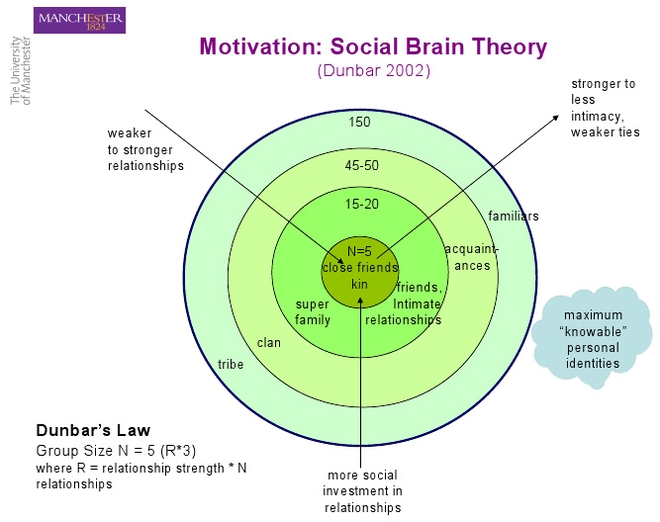
Robin Dunbar researched on village and tribe sizes. He found the band-level of tribal groups is past 150 members. 150 is the estimated size of a Neolithic far-
ming village, Mesopotamian tribes, ancient Roman army corps, 11th-century villages in Wales, the split-
ting point of Hutterite settlements, the basic unit size of professional armies in Roman antiquity and in modern times since the 16th century, appropriate company size. 200 is the upper bound on the number of academics in a discipline's sub-specialization.
The mean group size of 148, found by Robin Dunbar, was rounded up to 150 for simplicity's sake. 150-200 people is the extent of relationships humans are able to keep track of without taxing their cognitive limits and emotional capacity.
Layers of functional community comprise:
5, 15, 50, 150, 500, 1,500, 5,300 people.
The more people there are in a community the more relationships are of a lower quality.
Interestingy, the Mormons, the Hutterites, and the Amish do not allow their community sizes to grow bigger than 150 members each.
That way the establishment of a police force can be skirted as peer pressure is sufficient to guard the social stability.
|
| Reference: en.Wikipedia entry ► Dunbar's number Dunbar’s number 150 represents the ideal human group size. |
| Video presentations/interview featuring Robin Dunbar, Ph.D. (*1947) British anthropologist, specialist in primate behaviour, professor of evolutionary psychology, University of Oxford ► Social brain theory – Nobel Conference 2008, YouTube film, minute 15:00, 1:19:58 minutes duration, posted 17. September 2009 ► Dunbar's Number: Why We Can't Have More Than 150 Friends, 5:06 minutes duration, recorded by the event video production company Fora.tv and Vision, RSA, London, first posted 18. February 2010, reposted 16. March 2010 ► Interview Social Networking – Professor Robin Dunbar, presented by , YouTube film, 4:50 minutes duration, posted 17. December 2010 ► Can the internet buy you more friends?, presented by TEDxObserver, London, LND, United Kingdom, 10. March 2012, YouTube film, 15:16, minutes duration, posted 21. March 2012 ► Robin Dunbar, Time budgets and the evolution of language, sponsored by the Committee for Philology, Department of English, Nicolaus Copernicus University, Toruń, conference "Ways to Protolanguage 3", Torún, Poland, YouTube film, 57:35 minutes duration, posted 11. September 2013 |
| Written reference: ► Article: How many friends do you really need?, presented by the US American daily newspaper The New York Times, Catherine Pearson, 7. May 2022, updated 10. June 2022 |
| See also: ► Community and ► Friendship and ► Relationships ► Neuro science |
| Siehe auch: ► "Kleine-Welt"-Phänomen: Jeder kennt jeden über sechs Ecken. |
Links zum Thema Soziologie / SociologyLiteratur
[Wortwörtliche Übersetzung des Originaltitels: Wasserwaage. Warum gleichere Gesellschaften fast immer besser dran sind]
Die vierte Gewalt der Medien wird abgelöst von einer fünften Gewalt der Vernetzung.
Analyse der aktuellen politischen und kulturellen Situation Deutschlands
Literature (engl.)
An introduction to systems thinking, exemplified by the novel, Ishmael, 1992
Largest non-profit independent film release in history Political orientations (left-right voting) arise from three clusters of measurable personality traits i.e. opposing attitudes toward (1) tribalism: ethnocentricity ⇔ ethnophilia, (2) human nature: competitiveness ⇔ cooperation, (fundamentalist) religiosity ⇔ secularism, (3) tolerance of inequality: rankism, sexism, racism, classism.
Externe Weblinks
Graf wertete für ihre Studie die Werdegänge von 407 Mitgliedern der Wissenschaftselite im Zeitraum 1945-2013 aus. Seit siebzig Jahren
Weblinks zum Thema Soziologie – QuoraBeiträge verfasst von Elfriede Ammann, präsentiert auf der kalifornischen Frage-und-Antwort Webseite Quora DE
External web links (engl.)
Joe Henrich and his colleagues are shaking the foundations of psychology and economics – and hoping to change the way social scientists think about human behavior and culture.
Rule 1. We need each other.
Audio- und Videolinks
Der moderne Fortschrittsmythos bewirkte Veränderungen im Fühlen und Denken der Menschen.
Wirtschaft und Unternehmen im Übergangsstadium, Netzwerke als Wahrnehmungsorgan für Führung, Intelligente Generierungssysteme (Plattformen) brauchen intelligente Bewertungssysteme.
Ethische Betrachtung und Unterscheidung von Steuern GEBEN ⇔ Steuern DULDEN
Das Missverständnis des formlosen informellen Netzwerkgedankens, die mystische Vorstellung von Selbstorganisation; Voraussetzung dafür: qualitätsgesicherte Prozesse, Disziplin, die Wichtigkeit von Feedbacks
Linklose Medienangebote
Starke Ungleichheiten können schlimme Folgen (schlechtere Gesundheitsversorgung oder geringere Lebenserwartung) für die Ärmere haben.
Audio and video links (engl.)Poverty
Ongoing research in the Lucy to Language project
Empathy is the core of sociology.
Excessive wealth in the hands of a few triggers a breakdown of society, particularly the United States
On the origins of morality and its basis in politics and religion referring to Haidt's new book The Righteous Mind. Why Good People
Distribution of wealth in US, inequality and difference between the actual statistics and the perception of inequality, ignorance of Dokumentarfilme
Audio and video links (engl.) – Zeitgeist
Tribute to the study results of Richard Wilkinson and Kate Picket Minute 4:08
Tribute to the study results of Richard Wilkinson and Kate Picket
Tribute to the study results of Richard Wilkinson and Kate Picket, the status quo sustaining role of the advertisement industry Minute 2:20
Largest non-profit independent film release in history
Documentaries and movies
|
Englisch Wiki
Hawkins
1 Offenbarung 9, 18 (NT) ⇑
2 Interview "We quite suddenly realized that we were looking at a general pattern": Q&A with Richard Wilkinson, presented by the publication TEDBlog, Emily McManus, 26. October 2011 ⇑
3 From 1947 to 1979 the income of the bottom fifth of Americans rose by 122%. From the introduction of Reagonomics in 1879 to 2009 the income of the top 1% rose by 270% while the other 99%'s income remained stagnant. ⇑
4 Archived article LOVE & DEATH: In His Final Interview, Just Before His Suicide, Bruno Bettelheim Explained Why He Wanted to Die, presented by the US American daily newspaper Los Angeles Times, Celeste Fremon, US American free-lance writer, 27. January 1991 ⇑
5 Article In the Case of Bruno Bettelheim, presented by Leadership U, Molly Finn, 1996, June/July 1997 ⇑
6 From 1947 to 1979 the income of the bottom fifth of Americans rose by 122%. From the introduction of Reagonomics in 1879 to 2009 the income of the top 1% rose by 270% while the other 99%'s income remained stagnant. ⇑