- Man's worst sin is unconsciousness, but it is indulged in with the greatest piety, even among those who should serve mankind as teachers and examples.
Carl Gustav Jung (1875-1961) Swiss psychiatrist, psychoanalyst, founder of a new school of analytical depth psychology, author, Collected Works of C.G. Jung – Volume 9 (Part 1). The Archetypes and The Collective Unconscious, Princeton University Press, 1935, 1. February 1977, 2nd revised edition 1. August 1981
- The unconscious is the only available source of religious experience. This is certainly not to say that what we call the unconscious is identical with God or is set up in his place. It is simply the medium from which religious experi-
ence seems to flow. As to what the further cause of such experience might be, the answer to this lies beyond the range of human knowledge. Knowledge of God is a transcendental problem.
Carl Gustav Jung (1875-1961) Swiss psychiatrist, psychoanalyst, founder of a new school of analytical depth psychology, author, Gerhard Adler, translator, R. F. C. Hull, translator, Civilization in Transition – Collected Works of C.G. Jung, Volume 10, 1928,
S. 565, Princeton University Press, New Jersey, 2nd edition 1. August 1970
- Empirical psychology loved, until recently, to explain the "unconscious" as mere absence of consciousness – the
term itself indicates as much – just as shadow is an absence of light. Today accurate observation of unconscious processes has recognized, with all other ages before us, that the unconscious possesses a creative autonomy
such as a mere shadow could never be endowed with.
Carl Gustav Jung (1875-1961) Swiss psychiatrist, psychoanalyst, founder of a new school of analytical depth psychology, author,
R. F. C. Hull, translator, Psychology and Religion. West and East – Collected Works of C. G. Jung, Volume 11, S. 14, Princeton University Press, 1938, 2nd edition January 1975
- The unconscious is the unwritten history of mankind from time unrecorded.
Carl Gustav Jung (1875-1961) Swiss psychiatrist, psychoanalyst, founder of a new school of analytical depth psychology, author,
R. F. C. Hull, translator, Psychology and Religion. West and East – The Collected Works of C. G. Jung, Volume 11, subheading
"A Psychological Approach to the Dogma of the Trinity", S. 280, Princeton University Press, 1942, 2nd edition January 1975
- Before the bar of nature and fate, unconsciousness is never accepted as an excuse; on the contrary there are
very severe penalties for it.
Carl Gustav Jung (1875-1961) Swiss psychiatrist, psychoanalyst, founder of a new school of analytical depth psychology, author,
R. F. C. Hull, translator, Psychology and Religion. West and East – The Collected Works of C. G. Jung, Volume 11, essay
Answer to Job, S. 608, 1952, Princeton University Press, New Jersey, 1938, 2nd edition January 1975
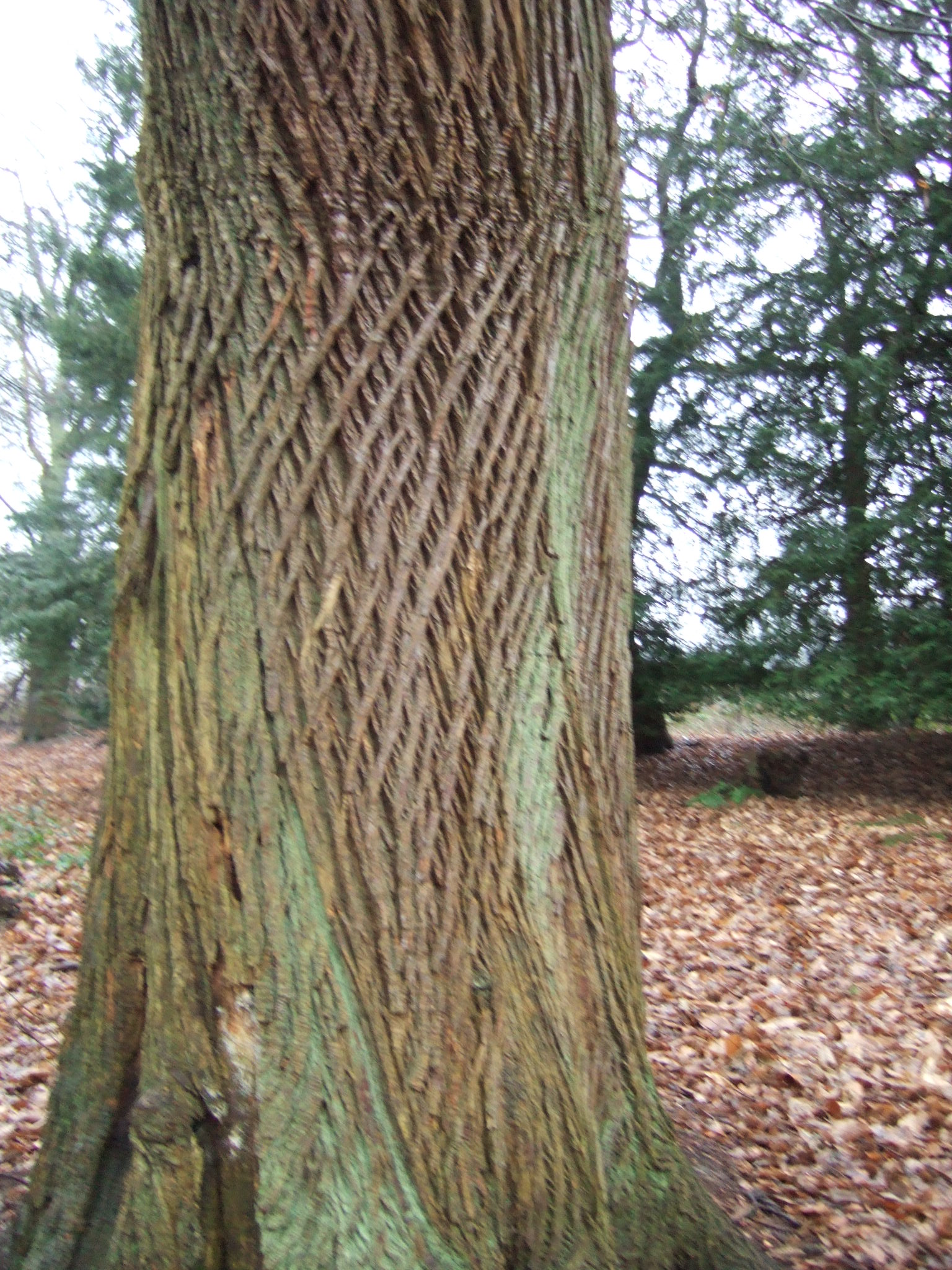
Retiform bark of a sweet chestnut
- In the unconscious is everything that has been rejected by consciousness, and the more Christian one's consciousness is, the more heathenishly does the unconscious behave, if in the rejected heathenism there are values which are important for life. Carl Gustav Jung (1875-1961) Swiss psychiatrist, psychoanalyst, founder of a new school of analytical depth psychology, author, R. F. C. Hull, translator, Psychology and Religion. West and East – The Collected Works of C. G. Jung, Volume 11, essay Answer to Job, Princeton University Press, New Jersey, 1938, S. 713, 1952, 2nd edition January 1975
- Anyone who penetrates into the unconscious with purely biological assumptions will become stuck in the instinctual sphere and be unable to advance beyond it, for he will be pulled back again and again into physical existence.
Carl Gustav Jung (1875-1961) Swiss psychiatrist, psychoanalyst, founder of a new school of analytical depth psychology, author,
R. F. C. Hull, translator, Psychology and Religion. West and East – The Collected Works of C. G. Jung, Volume 11, subheading The Tibetan Book of the Dead. Psychological commentary, S. 843, Princeton University Press, 1935, 2nd edition January 1975
- The world of gods and spirits is truly 'nothing but' the collective unconscious inside me.
Carl Gustav Jung (1875-1961) Swiss psychiatrist, psychoanalyst, founder of a new school of analytical depth psychology, author,
R. F. C. Hull, translator, Psychology and Religion. West and East – The Collected Works of C. G. Jung, Volume 11, subheading "The Tibetan Book of the Dead. Psychological commentary", S. 857, Princeton University Press, 1935, 2nd edition January 1975
- The unconscious mind of man sees correctly even when conscious reason is blind and impotent.
Carl Gustav Jung (1875-1961) Swiss psychiatrist, psychoanalyst, founder of a new school of analytical depth psychology, author,
R. F. C. Hull, translator, Psychology and Religion. West and East – Collected Works of C. G. Jung, Volume 11, essay Answer to Job, S. 608, Princeton University Press, 1952, 2nd edition January 1975
- A man who is unconscious of himself acts in a blind, instinctive way, and is, in addition, fooled by all the illusions that arise when he sees everything that he is not conscious of in himself coming to meet him from outside as projections upon his neighbour. Carl Gustav Jung (1875-1961) Swiss psychiatrist, psychoanalyst, founder of a new school of depth psycho-
logy, author, R.F.C. Hull (translator), Alchemical Studies – Collected Works of C. G. Jung, Volume 13, essay The Philosophical Tree, paragraph 335, S. 610, 1945, 1967, S. 265, Princeton University Press, New Jersey, 1983
- Filling the conscious mind with ideal conceptions is a characteristic of Western theosophy, but not the confrontation with the Shadow and the world of darkness. One does not become enlightened by imagining figures of light,
but by making the darkness conscious. The latter procedure, however, is disagreeable and therefore not popular.
Carl Gustav Jung (1875-1961) Swiss psychiatrist, psychoanalyst, founder of a new school of analytical depth psychology, author,
R.F.C. Hull (translator), Alchemical Studies – Collected Works of C. G. Jung, Volume 13, essay "The Philosophical Tree", para-
graph 335, S. 265, 1945, 1967, Princeton University Press, New Jersey, 1983

Two child sisters
- Any attempt to determine the nature of the unconscious state runs up against the same difficulties as atomic physics: the very act of observation alters the object observed. Consequently, there is at present no way of objectively determining the real nature of the unconscious.
Carl Gustav Jung (1875-1961) Swiss psychiatrist, psychoanalyst, founder of a new school of analytical depth psychology, author, Gerhard Adler, editor, R. F. C. Hull, translator, Mysterium Coniunctionis – Collected Works of C. G. Jung, Volume 14,
S. 88, 1st edition 1955, Princeton University Press, New Jersey,
2nd edition 1. August 1977
- As we all know science began with the stars, and mankind discovered in them the dominants of the unconscious, the "gods," as well as the curious psychological qualities of the Zodiac: a complete projected theory of human character.
Carl Gustav Jung (1875-1961) Swiss psychiatrist, psychoanalyst, founder of a new school of analytical depth psychology, author,
R. F. C. Hull, translator, Psychology and Alchemy – Collected Works of C. G. Jung, Volume 12, S. 245, 1944, Routledge,
London, 2nd edition 1968
- [If the unconscious is] […] properly dealt with in one place only, it is influenced as a whole, i.e., simultaneously and everywhere.
Carl Gustav Jung (1875-1961) Swiss psychiatrist, psychoanalyst, founder of a new school of analytical depth psychology, author, Letters, Vol. 2. 1951-1961, S. 595, Princeton University Press, 1. April 1976
- Just as the unconscious affects us, so the increase in our consciousness affects the unconscious.
Carl Gustav Jung (1875-1961) Swiss psychiatrist, psychoanalyst, founder of a new school of analytical depth psychology, author, autobiography Memories, Dreams, Reflections, S. 326, Fontana Press, 1961, reissued edition 6. March 1995
- If the activation is due to the collapse of the individual's hopes and expectations, there is a danger that the collec-
tive unconscious may take the place of reality. This state would be pathological. If, on the other hand, the activation is the result of psychological processes in the unconscious of the people, the individual may feel threatened or at any rate disoriented, but the resultant state is not pathological, at least so far as the individual is concerned. Neverthe-
less, the mental state of the people as a whole might well be compared to a psychosis. […]
Whenever contents of the collective unconscious become activated, they have a disturbing effect on the conscious mind, and contusion ensues. Carl Gustav Jung (1875-1961) Swiss psychiatrist, psychoanalyst, founder of a new school of depth psychology, author, Michael Fordham, editor, The Structure of the Psyche (1913-1935), included in: The Structure and Dynamics of the Psyche – Collected Works of C.G. Jung, Volume 8, section "The Psychological Foundation for the Belief in Spirits", S. 595, 1920, Princeton University Press, 1. January 1970
- The collective unconscious – so far as we can say anything about it at all – appears to consist of mythological motifs or primordial images, for which reason the myths of all nations are its real exponents. In fact, the whole of mythology could be taken as a sort of projection of the collective unconscious.
We can see this clearly if we look at the heavenly constellations, whose originally chaotic form were organised through the projection of images […]. These influences are unconscious introspective perceptions of the activity of the collective unconscious. We can therefore study the collective unconscious in two ways, either in mythology or
in the analysis of the individual. Carl Gustav Jung (1875-1961) Swiss psychiatrist, psychoanalyst, founder of a new school of analytical depth psychology, author, Michael Fordham, editor, The Structure and Dynamics of the Psyche – Collected Works of C.G. Jung, Volume 8, centerpiece On the Nature of the Psyche, including The Structure of the Psyche (1913-1935), 1920, paragraph 325 (S. 152), Princeton University Press, 1. January 1970
- Greater than all physical dangers are the tremendous effects of delusional ideas […]. The world powers that rule
over humanity, for good or ill, are unconscious psychic factors, and it is they that bring unconsciousness into
being […]. We are steeped in a world that was created by our own psyche.
Carl Gustav Jung (1875-1961) Swiss psychiatrist, psychoanalyst, founder of a new school of analytical depth psychology, author, Michael Fordham, editor, The Structure and Dynamics of the Psyche – Collected Works of C. G. Jung, Volume 8, centerpiece
"On the Nature of the Psyche", paragraph 747, 1920, Princeton University Press, 1. January 1970

Child, mother, grandmother and greatgrandmother
- One cannot resist it. It gets you below the belt and not in your mind, your brain just counts for nothing, your sympa-
thetic system is gripped. It is a power that fascinates peo-
ple from within, it is the collective unconscious which is activated, it is an archetype which is common to them all that has come to life. And because it is an archetype, it has historical aspects and we cannot understand the events without knowing history.
Carl Gustav Jung (1875-1961) Swiss psychiatrist, psychoanalyst, founder of a new school of analytical depth psychology, author, The Symbolic Life. Miscellaneous Writings – Collected Works of C. G. Jung, Volume 18, S. 164, Princeton University Press,
1. February 1977
- The conscious mind allows itself to be trained like a parrot, but the unconscious does not – which is why St. Augus-
tine thanked God for not making him responsible for his dreams. The unconscious is an autonomous psychic entity; any efforts to drill it are only apparently successful, and moreover harmful to consciousness. It is and remains be-
yond the reach of subjective arbitrary control, a realm where nature and her secrets can be neither improved upon nor perverted, where we can listen but may not meddle. Carl Gustav Jung (1875-1961) Swiss psychiatrist, psychoanalyst, founder of a new school of analytical depth psychology, author, R. F. C. Hull, translator, Psychology and Alchemy – Collected Works of C. G. Jung, Volume 12, 1944, S. 51, Routledge, London, 2nd edition 1968
- We know that the mask of the unconscious is not rigid – it reflects the face we turn towards it. Hostility lends it a threatening aspect, friendliness softens its features. Carl Gustav Jung (1875-1961) Swiss psychiatrist, psychoanalyst,
founder of a new school of analytical depth psychology, author, R. F. C. Hull, translator, Psychology and Alchemy – Collected Works of C. G. Jung, Volume 12, S. 29, 1944, Routledge, London, 2nd edition 1968
- The unconscious is not a demoniacal monster, but a natural entity which, as far as moral sense, aesthetic taste, and intellectual judgment go, is completely neutral. It only becomes dangerous when our conscious attitude to it is hope-
lessly wrong. To the degree that we repress it, its danger increases. Carl Gustav Jung (1875-1961) Swiss psychiatrist, psychoanalyst, founder of a new school of analytical depth psychology, author, The Practical Use of Dream Analysis – Collected Works of C. G. Jung, Volume 16, 1934, S. 329, Bollingen Foundation, Pantheon Books, New York, New York, 1954
|



